Search This Blog

Friday, August 23, 2024

“Bicycling,” the New Craze

Guest Blogger Dept.: We haven’t heard from Robert Benchley since January, at which time he was addressing a very seasonal topic - a mid-winter sport carnival, to be exact. Wishing to assert himself as a man for all seasons, or at least the current temperate one, he offers this disquisition on bicycling.


THERE is a new sport this season which bids fair to have great popularity among the younger sets, a sport imported, as are so many of our outdoor games, from England, where it has had a great vogue for several years now. This sport is called “bicycling,” and derives its name from the instrument on which it is practiced—the “bicycle.” You will see that this word is made up of two words: “bi,” meaning “two,” and “cycle,” meaning wheel—“two wheels.” And such indeed it is, a veritable two-wheeled contraption, on which the rider sits and balances himself until he is able, by pushing two pedals arranged for the purpose, to propel the whole thing along the roadway at a great rate. And what a lark it is, too!

Drawing by Gluyas Williams
We show a picture of a bicycle here, and you may figure out for yourself just how it works. You will see that the pedals are so fixed that when one foot is up the other is down, thus giving the feet an equal chance at the rousing exercise and doing away with any chance of the rider’s becoming one-sided, as might well result from a position where one foot was up all the time and one foot down.

You will also observe that the saddle is placed at just the right height from the pedals, so that the rider sits on it easily without having to stretch his legs out beyond their natural length—or, on the other hand, without having to contract them. When experiments were being made on the first bicycle by the inventor, it was thought that it would be necessary for anyone who was going to ride one of the things to stretch his legs out anywhere from one to four feet beyond their natural length in order to reach the pedals. The inventor was very much discouraged when he realized this, “for,” as he said to his partner, “there won’t be enough people in the world who can stretch their legs out from one to four feet to make any decent kind of sale for my machine at all.”

Friday, August 16, 2024

Grin and Berlioz It

DURING A Q&A SESSION at the Bard Music Festival, the question was posed: “Do you ever fall asleep when you’re conducting?” The question was aimed at Leon Botstein, president of Bard College and conductor of the orchestral portions of the festival programs. “Do you ever get bored up there?” This took place during a panel discussion titled “A Revolutionary Life in a Revolutionary Era,” and the subject – the subject of two weekends’ worth of programming, in fact – was Hector Berlioz.

The question was inspired by Berlioz’s “Lélio,” a work for narrator, vocal soloists, chorus, and orchestra, performed at the festival the evening before. It’s a formidable work (not that you expect anything less from this composer) that resists categorization. It is rarely performed, which is a major reason it was part of the festival’s opening concert, paired with Berlioz’s most famous work, the “Symphonie fantastique,”to which it is intended as a sequel.

Dr. Botstein has an impressively elegant way of suffering fools. His reply was measured, with just a whiff of archness. In the days before media saturation, before recordings were available, he explained, concert pieces were constructed to give listeners some musical signposts. And those listeners (I’m not quoting exactly) had actual attention spans. They didn’t have phones in front of their faces. In other words, it’s not the music that’s the problem. It’s the distracted listener.

Yet if ever there was a composer for the distracted listener, it’s Berlioz. Not for him, generally, the intimate gesture. “Lélio” just happens to be one of his least-accessible works. I wasn’t there for that performance, but I spent the entirety of the following day soaking in the variety of events that characterizes each day of this festival.

Friday, August 09, 2024

Metamorphosis on the Lake

CLASSICAL MUSIC, as far as mainstream listeners are concerned, has become remote and intimidating. Probably because it has faded from pop-culture contexts. It used to permeate cartoons (saluted recently by an appearance at Caroga Arts by The Queen’s Cartoonists), not to mention mainstream movies and TV commercials, but my understanding is that such is now rarely the case.

Garrett Hudson, Jason Kutz, and Kara LaMoure
What’s needed is a community-based approach in which the music is performed in a welcoming space with a track record of presenting enjoyable stuff, and this is exactly the forum presented each summer for the past baker’s-dozen years by the Caroga Arts Collective. The group offers an ambitious program that takes place on the grounds of a former amusement park next to a still-popular but somewhat obscure lake in New York’s Fulton County, a damp dot on the map between Utica and Albany. It remains a popular summer resort, so the concerts have a built-in local draw, but the series has gained a reputation that summons an audience from beyond as well.

They take a two-pronged approach to programming, nesting the classical-music concerts amidst a schedule of pop-music events. And the classical music is performed by an ensemble comprising players drawn from throughout the country who participate in a summer-long program of training and performance, players who are immensely skilled when they get there and are no doubt even better when they leave.

Which brings me to the concert I attended on August 2, held in the venerable Sherman’s Park Dance Hall building. It’s a large space with a flexible layout, largely defined by the placement of chairs. The concert was titled “Metamorphosis: Where Nature Meets Music,” and the presence of four large TV screens portended what was to come.

Friday, August 02, 2024

Splendid Vibes

ON THE FIRST TRACK of his first album as a leader, Bobby Hutcherson doesn’t solo until four minutes into the song. It’s “If Ever I Would Leave You,” from the then-recent Broadway show “Camelot,” and we start out with the domineering inventiveness of Joe Henderson on tenor sax. Recorded at the very end of 1963, this album, titled “The Kicker” after a Henderson original, wasn’t released until Mosaic’s Michael Cuscuna oversaw its issue in 1999.

And it seems to be a Henderson showcase throughout, although when Hutcherson brings his vibes to the fore, it’s always arresting. As in a Joe Chambers ballad, “Mirrors,” that puts Hutcherson squarely in the forefront and doesn’t welcome Henderson in until the four-minute mark.

Hutcherson was a performer steeped in the swing-era language of the vibraphone but with the innovations of Milt Jackson intruding to push Hutcherson’s creativity even beyond as he leaped into the world of hard bop. In that regard, he’s well-matched on this recording by pianist Duke Pearson. Listen to the piano on “For Duke P.,” a Hutcherson original, where Pearson tears through the up-tempo piece with the fleetest of fingers. And there are some surprises squirreled away throughout. Hutcherson’s “Step Lightly” finds Pearson slyly quoting “I’m Beginning to See the Light.” Perhaps in retaliation, guitarist Grant Green finds a moment in “Bedouin” to quote, of all things, “And the Angels Sing.”

Wednesday, July 31, 2024

Even Though Your Heart Is Breaking

Glimmerglass Festival 2024 Dept.: The fourth and final opera of my Glimmerglass season was that perennial, “Pagliacci.” Often paired with “Cavalleria rusticana,” another verismo one-act opera, it was here given a delightfully different performance context, as described below.


COMEDY AND DEATH GO HAND-IN-HAND. When you fail onstage, you complain that you “died.” And comedy loosens audience emotions, making us more susceptible to the effects of tragedy. I offer the finale of Chaplin’s “City Lights” as proof.

Robert Stahley as Canio.
Photo by Brent DeLanoy/The Glimmerglass Festival
Ruggero Leoncavallo’s 1892 opera “Pagliacci” is the mother ship from which many a “laugh, clown, laugh” story emerged (including Lon Chaney’s 1928 movie “Laugh, Clown, Laugh”). The aria that ends Act One, “Vesti la giubba,” has been a favorite since the dawn of recordings, with artists as diverse as Enrico Caruso, Freddie Mercury, and Spike Jones waxing distinctive versions.

This summer’s Glimmerglass approach deconstructs the piece. First, with the festivities that precede the opera proper. Weather permitting, there’s a performance on lawn. It’s a loose-limbed commedia dell’arte show, reminding us what the onstage “Pagliacci” audience had assembled to see. And would have seen, had jealous passion not intervened. Next, with an eerie approach to the opera’s Prologue, in which Tonio (Troy Cook) wanders through a gloomy warehouse, uncovering the props and set he remembers from an ill-fated performance.

Tuesday, July 30, 2024

Murder and the Music Hall

Glimmerglass Festival 2024 Dept.: Our third opera this summer was a recent work, “Elizabeth Cree,” commissioned by Opera Philadelphia in 2017 and here making its Glimmerglass debut. My review is below.


A SERIAL KILLER IS STALKING LONDON. It’s 1880, just a few years before Jack the Ripper cuts his own swath through the city. Dan Leno is a rising star in the music halls, and has been the salvation of young Lambeth Marsh Lizzie, lately escaped from an abusive mother, now a stage star in her own right. How these stories intersect is the marvel at the heart of the Glimmerglass Festival’s brilliant presentation of “Elizabeth Cree,” a recent opera by Kevin Puts and Mark Campbell.

Rear: John Chest, Tara Erraught, and Elizabeth Sutphen.
Front:  Tristan Tournaud, Evan Lazdowski, and Geoffrey
Schmelzer. Photo: Brent DeLanoy/The Glimmerglass Festival
Glimmerglass last presented the work of composer Puts and librettist Campbell in 2018, with their Pulitzer Prize-winning opera “Silent Night,” which you can read about here. Their new piece is every bit as captivating as that one.

Theater, by definition, is an unreliable medium. We’re asked to believe in the memorized words of actors placed in an artificial location presenting some manner of heightened reality. Yet we’ll respond with more emotional intensity than we give to the outside world. Add music and the pipeline to the emotions is even more intense, which is why opera is the most satisfying of the performing arts.

But it’s still unreliable. We don’t usually question that aspect, because it’s part of the pact we make with ourselves before we take our seats. But “Elizabeth Cree” will put paid to that pact.

Sunday, July 28, 2024

Landed Gentry, Humble Berths

Glimmerglass Festival 2024 Dept.: Here’s my review of the second of the four productions I’m seeing at the Glimmerglass Festival this summer.


BEFORE SONDHEIM, THERE WAS GILBERT – W.S. Gilbert, that is, he finest English-language lyricist of his era, and a dab hand at concocting the books to go with them. He was, of course, a product of his time, and the libretto he devised for the 1879 “Pirates of Penzance” overflows with the misdirections and other zany plot devices that Gilbert & Sullivan audiences adored.

Elizabeth Sutphen and Christian Mark Gibbs
as Mabel and Frederic.
Photo by Brent DeLanoy

And still adore. Familiar as the operettas may have become, Sullivan’s scores have a freshness that rewards repeated listening. So it’s a treat to see that the Glimmerglass Festival is offering its first G&S production in 20 years, and doing so with appropriate talent and energy. (If you’re interested, here’s my review of that 1994 “Patience.”)

“Things are seldom what they seem,” sings a character in a different G&S, but that observation rings true here, too. The crew of pirates we meet at the top of the show is a bunch of softies. The policemen we meet in the second act aren’t at all courageous, while the virginal maidens who egg them on turn out to be rather bloodthirsty.

Keeping in mind the Victorian-era sensibilities this story played against, there was plenty of room for social satire, in which Gilbert always gloried. Director-choreographer Seán Curran, reviving his 2013 Opera Theatre of St. Louis production, offers a dazzling festival of movement that pauses long enough to let the plot elements go by, but rarely otherwise slackening the pace.

But there is a meditative Act Two duet – “Stay, Fred'ric, stay,” “Ah, leave me not to pine” – between the sweethearts Mabel and Frederic that is the emotional heart of the piece, rendered by Elizabeth Sutphen and Christian Mark Gibbs with tug-at-your-heartstrings intensity.

Saturday, July 27, 2024

For the Love of Gods

Glimmerglass Festival 2024 Dept.: We have four productions to consider in the coming days as the Glimmerglass Festival presents its 2024 season. The operas, in the order in which I’ll be seeing and reviewing them, are Cavalli’s “La Calisto,” Gilbert & Sullivan’s “Pirates of Penzance,” Kevin Puts’s “Elizabeth Cree,” and Leoncavallo’s “Pagliacci.”


WE PREFER to space out our big emotional moments. The frenzy of infatuation, the despair over marital betrayal, the death of a loved one – too many of them in quick succession become a waking nightmare. But what if it’s all happening to someone else? You might be inclined to enjoy the schadenfreude aspect – or, if you’re in the land of Italian opera, gioia per il male altrui. Because that’s what Francesco Cavalli’s “La Calisto” is offering: heightened passions, from unrequited love to jealous despair, from egotistical aggression to that peculiar feeling you get when you realize you weren’t actually planning to lose your virginity but, well, there it went.

Emilie Kealani (Calisto) and Craig Irvin (Jove).
Photo by Sofia Negron
The work premiered in 1651, helping define, a generation after Monteverdi, the recitative-aria form of opera that has persisted ever since. Three love triangles anchor the plot of Giovanni Faustini’s libretto, drawing from Ovid’s “Metamorphosis,” among other sources. And a triangle outlined by color-changing light defines the stage on which this excellent Glimmerglass Festival production plays out.

For a piece like this to be effective, it needs top-notch voices. That’s pretty much par for the course where Glimmerglass is concerned, but Baroque opera also demands an ability to explore the nuances of those vocal demands through varied tone production, ornamentation, and other period techniques. And a commanding presence doesn’t hurt – after all, you’re probably playing a god. Thus it was that Eve Gigliotti, as Juno, dominated the stage, catching her errant spouse in an unfaithful act and punishing the victim. Yet, “Mogli mie sconsolate,” she sings in a virtuoso moment – “My disconsolate women,” noting that even when married, a woman ends up beside a man who’s irritable or exhausted.

Friday, July 19, 2024

No Power, Some Glory

TUESDAY AFTERNOON the sky darkened and the wind picked up, falling right in line with the tornado warning that caused my cellphone to buzz into life. Tornado skies are different from any other, adding a feral green to the shades of grey and black. I’ve seen it a couple of times since relocating to Montgomery County, NY, 34 years ago. The view from my porch looks downhill to the Mohawk River, which is four miles away, and the river invites weather phenomena like fog and rain and, when conditions are right, twisters.

Not long after moving to this area, I drove in the wake of a small tornado (not that size really matters when the winds are that strong), foolishly piloting a VW camper-bus across the river and on into a little town called Sammonsville. I wanted an ice cream, and Sammonsville hosts a 1897-vintage general store that has specialized in home-made ice cream since long before I got here. Which is only to plead my sugar addiction as an excuse for such reckless behavior. I had heard no tornado warning, but there’s no mistaking that sky.

I was still a few miles from the store when the wind grew so malevolent that horizontal rain and blusting leaves and branches blocked my view. I pulled over. Actually, I just stopped. No road-shoulder was visible. The sounds – wind, rain, branches, leaves – were bad enough, but there also seemed to be a pressure differential that caused the walls of my van to vibrate. I was scared.

Friday, July 12, 2024

Recital by the Lake

SOPRANO MARCELLA SEMBRICH, born in Poland in 1858, made her debut in Athens at 19, singing in five demanding operas; the following year she made her Dresden debut in “Lucia di Lammermoor,” which led to a five-year contract at Covent Garden. She debuted in 1883 at the brand-new Metropolitan Opera in New York, where she created roles as the Queen of the Night in “The Magic Flute,” Gilda in “Rigoletto,” Rosina in “Barber of Seville,” and many others. In all, she sang over 450 performances during her eleven seasons at the Met. After she retired in 1917, she created the vocal programs at the Curtis Institute and the Juilliard School, as well as building a vocal studio near her summer home in Bolton Landing. That studio is now the Marcella Sembrich Opera Museum, an elegant tribute to the singer-teacher’s legacy.

Rubén Rengel and Ahmed Alom
Part of its mission is to present music, and this season’s series opened with a recital by violinist Rubén Rengel and pianist Ahmed Alom, performing in what’s essentially a large salon, a perfect venue for this kind of program. As the museum’s artistic director, Richard Wargo, explained, Sembrich knew many contemporaneous composers, among them Liszt, Brahms, and Kreisler, each of whom was represented in the programming.

Beginning with Liszt’s “Paraphrase de concert sur ‘Rigoletto,’” composed in the late 1850s. Opera arias were the pop songs of their day, and this piece followed a popular tradition of incorporating those arias into virtuoso showcases for instrumentalists.

Friday, July 05, 2024

Gone with the Moon

From the Food Vault Dept.: By the time I wrote the review of Luna 61 you see below, that restaurant had only another two years left. Chef-owners Debra and Peter Maisel moved to Burlington, VT, where they opened Revolution Kitchen – their third vegetarian restaurant together – which they ran for nine years before easing into semi-retirement. Where Luna 61 once prevailed in Tivoli, NY, you’ll find an ice-cream shop. Not quite the vegetarian cuisine I seek for nourishment.


A CROWD FILLED THE SIDEWALK in front of the restaurant, a crowd that spilled into the street and seemed intent on a vintage yellow VW convertible that puttered nearby. It was an odd sight in this sleepy little town at 4:30 on a Saturday afternoon, but revealed itself as we walked closer to be a film crew. The shot was set, following an attractive fair-haired woman who piloted the car from its parking space.

“They’re filming something for German television,” said a woman who stood in front of the restaurant Luna 61. “Doesn’t look like she knows how to drive a stick.”

The VW lurched from its spot, stalled, was re-started and lurched again. I looked at the restaurant hours, posted on the door. “We open in about half an hour,” the woman said. “But you’re welcome to sit out here and have a drink.”

A half-dozen wooden tables sit in front of the restaurant. Although the buildings on this stretch of street are close together, the sense, as we sat, was of pleasant intimacy. Even with all those film-crew people hanging around, conversing in a mix of German and English.

Friday, June 28, 2024

Ulysses: A Glorious Voyage

THE MORE IN TOUCH YOU ARE with your inner monologues, the easier it is to read James Joyce’s “Ulysses.” Easier, but still not easy. An autonomic ease informs those fragmented thoughts and abrupt subject changes, but putting them into written words reveals a terrifying jumble. Song lyrics and other quotations; the distraction of a passerby; guilt, anger, hope, regret – each of us is the sum of a culture absorbed. Make that the culture of Dublin in 1904, add more characters whose heads we inhabit, follow them through that city over the course of a single day. That’s “Ulysses.”

Scott Shepherd and Cast
Photo by Maria Baranova

A high-school teacher advised me simply to launch into the book and not allow myself to be dismayed. A half-century later I took that advice, although I had the massive Cambridge Centenary edition in hand. It reproduces the 1922 text and surrounds it with essays and annotations. I was inspired to take on this task in anticipation of seeing a version of the story on stage. By the time I was in my theater seat, I’d gotten halfway through.

New York-based Elevator Repair Service has won an excellent reputation for adapting classic works of literature for the stage. I saw “Gatz,” their version of “The Great Gatsby,” at EMPAC in Troy, NY, in 2008, two years before its acclaimed debut at New York’s Public Theater. Improbably set in a shabby office building, it opened with Scott Shepherd as a frustrated office worker who finds a paperback copy of “Gatsby” in a desk and begins reading it aloud, thus taking on the character of narrator Nick Carraway and soon drawing his fellow-workers into performing the story. Including every word of the book, “he said”s and “she said”s included.

Friday, June 21, 2024

The Rockwell goes MAD

I DON’T REMEMBER when I discovered MAD, but I know which piece of theirs first shook me out of my suburban complacency. Titled “The National Safety Council's Holiday-Weekend Telethon,” written by Dee Caruso and Bill Levine, drawn by Mort Drucker (one of his earliest pieces), it presented a TV telethon in the Jerry Lewis tradition, although with a Dean Martin caricature instead, and it begged viewers to drive recklessly in order to add fatality numbers to the tote board in order to meet the Safety Council’s quota. The piece ran in the January 1959 issue, when I was not yet three, so I must have discovered it in one of the endless reprints that MAD issued over the years. Laughing at the macabre proved liberating.

Parody Triple Portrait
by Richard Williams


“What, Me Worry? The Art and Humor of MAD Magazine” is an unprecedented exhibition now running (through October 27, 2024) at the Norman Rockwell Museum in Stockbridge, Mass., bringing together original artwork and other related items chronicling the history of our most influential satire magazine.

MAD was created in 1952 when writer-artist Harvey Kurtzman persuaded EC Comics publisher William M. Gaines to launch a humor book – giving Kurtzman a break from the highly popular “Two-Fisted Tales” series he’d been exhausting himself creating. MAD was a four-color comic at first, where talented artists like Wallace Wood, Jack Davis, and, especially, Will Elder were given the liberty to be as crazy as they wished. It worked.

Five rooms at the Rockwell Museum are devoted to the magazine’s artists and pages, which also means that it’s capturing over 60 years of American cultural history. But how odd it is to see those pages – some of which I recognize quite well – enshrined, as it were, as oversized wall displays with careful lighting and dignified info cards. Somebody thinks this is art!

Friday, June 14, 2024

The American Way

DRUM CRASHES OPEN THE PIECE, giving way to the low brass and a rising figure then picked up by the strings. It seems to dissipate in some filigree from the winds, but almost immediately the brass is back with another portentous figure. Orchestral texture is a key to this piece, titled “1920/2019" and written by Joan Tower. She has a long history with the Albany Symphony Orchestra, which means that we know her work through this local connection and welcome each new example of what she’s writing.

The Albany Symphony has been championing music by American composers – and new music in general – for far longer than I’ve been writing about them, which itself takes us back some 40 years. May we therefore conclude that it’s not some kind of gimmick? In fact, it’s what should be the mission of every classical-music performing group. It’s easy, both as listener and performing entity, to get mired in the popular repertory, but the purpose of this kind of music has long been both to entertain and challenge the listener. And this is what the ASO accomplished nicely in the pair of concerts I attended during their annual American Music Festival.

The Albany Symphony Orchestra with
flutist Brandon Patrick George.
Photo by Gary Gold

The full orchestra performed on Saturday, June 8, offering a well-contrasted array of works in the acoustically benevolent EMPAC Concert Hall. Tower explained, in a pre-concert intro, that the title of her work salutes the year in which women got the right to vote and the year the saw the height of the #MeToo movement. “But the title really has nothing to do with the piece,” she concluded in a characteristically humorous way.

Don’t take her joke seriously. There is a vigorous sense of empowerment as the piece builds to its finish. The big moments are gloriously big, the small – as when a solo violin muses over the throb of some winds, or a clarinet is mocked by a trumpet – have a nervous intimacy. But each of these episodes flows into the next with a sense of inevitability, a sense that builds to a satisfying finish.

Friday, June 07, 2024

What Is So Rare?

AN APPOINTMENT BOOK sits open on my desk, its two overview pages for the month of June staring back at me with pencilled appointments filling many of the squares. “Many,” in this case, being a vague term, as vague, in its way, as “most,” but my gut feeling is that the latter term might even more appropriately apply.

I’m pushing 70, “pushing,” in this case, being a vague term that nevertheless feels entirely apt, and because I’m also fat and sedentary, many of those appointment-book squares are filled with medical appointments. There turns out to be a fractal quality about elder health care, as each specialist I consult tends to send me to a sub-specialist to deal with an aspect of my condition I didn’t know was there yet which will demand a blood test and/or MRI and add yet another medication to the daily pile I swallow.

A handful of social events fill other squares; rarely now are there rehearsals and performances, but they do occur and even those can seem burdensome when nestled on those pages.

It’s only the start of June, yet the month already feels oppressive. I’m well familiar with the phenomenon that can make the anticipation of an event more annoying than the event itself – it’s the curse of many a nine-to-fiver – but even with that in mind, I can’t shake this sense of dread. Why?

Let’s try a little exercise. (This is me talking to myself. You don’t actually have to do this.) Imagine that all those appointment squares are blank. Is there a particular event you’d prefer to see listed?

Friday, May 31, 2024

Beethoven Steps Out

From the Classical Vault Dept.: Martha Argerich turns 83 on June 5, so let’s salute her with a look back at performance she gave in Saratoga Springs in 2002, when she was merely 61. She has a full touring schedule listed on her website, but we won’t see her in Saratoga again any time soon: once the powers-that-be axed conductor Charles Dutoit from the roster, we lost access to his wives, current (Chantal Juillet) and former (Argerich) as well as many other friends.


THE IDEAL IS to serve the composer’s music – and thus the composer’s intentions – as well as possible. If this means subsuming yourself to an idea of what the composer might have wanted hear, then Martha Argerich wouldn’t be your pianist of choice. But her performance of Beethoven’s Piano Concerto No. 1 with the Philadelphia Orchestra at SPAC last week demonstrated that when a star soloist places her stamp of individuality on a work like this one, sparks fly. Good ones. The kind that revitalize a well-worn piece of music and remind us why the music became important in the first place.

Written in 1795 and revised over the next few years, the concerto is firmly in the classical form but with substantial bulges at the edges. It’s purposefully written to showcase the soloist, and Argerich put her fiery technique to good use. The opening movement has an air of classical delicacy about it, interrupted periodically by unexpected cascades of arpeggios from the soloist that the orchestra insists on shepherding back into line.

Which adds a nice edge of tension between pianist and orchestra, with Charles Dutoit exacting precise but flexible control over the group as Argerich rode the rhythm with surprising (and surprisingly effective) rubato. The slow movement revealed a level of lyrical drama I’ve never noticed before, and she charged into the finale with both guns blazing yet without sacrificing any of Beethoven’s vaunted wit.

Friday, May 24, 2024

A Day at the Clark

IT’S EASY TO OVERLOOK the outings that take you not very far. What counts as close? Living as we do in the rural wilds of New York’s farming country, between Utica and Albany, a 90-minute drive is nothing. And that’s where Williamstown, Massachusetts awaits, so we decided to make a recent day of it at the Clark.

Or, to put it correctly, the Clark Art Institute. Or, to put it historically, the Sterling and Francine Clark Art Institute, because it was that fabulously wealthy couple who collected enough significant art to decide, as they advance in years, that a museum was needed to house it. Sterling Clark was an heir to the Singer sewing machine fortune, alongside his brothers Stephen and Ambrose, but they were a fractious bunch and plans to put up that museum in Cooperstown were scuppered by fraternal fighting, and Sterling chose Williamstown instead.

A great Francophile, Sterling spent many years in Paris, where he met and married Francine Clary, a performer with Comédie Française. She, apparently, had the better eye for great art, and approved of paintings her husband otherwise might not have acquired.

Sterling wanted a building with plenty of natural light and the classical architecture of the Frick Collection, and went through two designers until he settled on Daniel Perry. The cornerstone was laid in 1953, and the museum opened two years later. Sterling died the following year; Francine survived him by four years.

Along with ongoing renovations to that structure, the Manton Research Center, which houses the library, was added in 1973. The Lunder Center, added in 2008, offers more galleries and a  seasonal café; the Clark Center (2014) has more gallery space as well as dining and retail areas. The artworks in the permanent collection come from a range of classic Dutch, Flemish, and Italian painters, alongside the Impressionists and other fin-de-siècle artists. Works by Renoir, Rodin, George Inness, and John Singer Sargent abound.

Friday, May 17, 2024

Brushing Up Your Shakespeare

The Bard on the Boards Dept.: Here’s a pair of book reviews that turned up in a recently discovered pile of clippings, and it’s one of the few pieces I was asked to write for the Albany Times-Union before that publication tired of me or couldn’t afford me or just plain chose to hate me. I never know for sure, but I am a very dislikable guy.


SHAKESPEARE BIOGRAPHERS are hamstrung by the almost complete lack of documentation about the playwright’s life. But that hasn’t stopped them from coming out with many volumes of what amounts to educated speculation.

Giving Bill Bryson the task of writing the Shakespeare volume for HarperCollins’s “Eminent Lives” series was an inspired choice. The author of “A Short History of Nearly Everything,” among many other fine and funny books, Bryson combines a zest for research with a compelling narrative style. Which are front and center in “Shakespeare: The World as Stage” (Atlas Books, 199 pages, $19.95).

Part of the book’s fun lies in seeing how Bryson juggles those few known facts. Acknowledging that the reader is probably aware of most of them, he reinforces his discourse with the scholarship of others, from reliable writers like Sam Schoenbaum to frauds like the 19th-century fanatic Delia Bacon, who kicked off the  somebody-else-wrote-Shakespeare’s-plays movement that embarrassingly persists today.

Friday, May 10, 2024

The Vinifera Tradition

From the Vines Dept.: Sometimes your past lurks in old bankers boxes. I opened one recently expecting to see only books and found in addition a pile of clippings, including the article reproduced below. I wrote it for the Syracuse New Times in 1988, and it necessitated a very pleasant visit to the winery thus portrayed. I’d written about Hermann Wiemer before, but never visited him in situ. Wiemer sold the vineyard in 2007 to Fred Merwarth, who continues to run the operation under Wiemer’s name.


AS NEW YORK STATE gains an ever-improving reputation for production of good wine, the Finger Lakes, that paw about 80 miles southwest of Syracuse, are recognized as the source of acclaimed wines made from Vitis vinifera, the grape family responsible for the distinguished wines of Europe.

 Hermann J. Wiemer. Photo
by Patricia Darbee Weirich
Vinifera has to go up against the sweet Labrusca grapes that have grown like weeds in this region for so many years, but with a spokesman like Hermann J. Wiemer at the publicity helm, it won’t be long before it predominates. And Wiemer’s winery produces vintage after vintage of award-winning varietals to back up every statement the forthright founder makes.

“I don’t think the big companies will grow vinifera,” he says. “Their attitudes are entirely different from ours. Unfortunately, they have the resources and time to cultivate what they please, but they don’t realize that the consumer is now asking for a better wine.” Wiemer is fond of characterizing New York’s plonk as reeking of the “rubber hose,” used to move the hybrid juice along its brisk production line. “It’s up to the little guys to take the risk and grow vinifera,” he says.

A native of the Mosel region of Germany, Wiemer grew up among relatives on both sides of the family who were immersed in the wine business. He arrived in this country in 1968 to work for the Bully Hill Winery, and discreetly bought 140 acres of land on Seneca Lake a few years later.

Friday, May 03, 2024

The Last Boulevardier

IT STARTED WITH a Criterion Collection closet picks video that featured Justine Triet, a director most recently known for the movie “Anatomy of a Fall.” Criterion invites filmworld-related people of renown to swipe DVDs from their closet while discoursing about their choices, and Triet selected Paul Mazursky’s “An Unmarried Woman,” Soderbergh’s “sex, lies, and videotape,” and Antonioni’s “La notte” before spotting “Presenting Sacha Guitry,” a four-DVD set (part of Criterion’s Eclipse Series, which features overlooked movies) and exulting over Guitry’s classic films.

Good enough for me! I found a copy of that collection and, not knowing what to expect, started with “The Story of a Cheat,” which Guitry wrote and directed in 1936. Unlike the many films he developed from his own plays, this one came from his only novel. Right from the beginning it declares itself a different kind of story, most of it told through flashback and narration as we see Guitry’s character slip through a number of disguises as he makes his dishonest way through French society.

For a man who scorned cinema, insisting that theater was the only viable form of such entertainment, he threw himself onto the screen with surprising and delightful innovations, enough so that he’s credited with influencing directors from Truffaut to Hitchcock to Welles – and it’s easy to draw a connection from Guitry’s use of narration to what Welles did in “The Magnificent Ambersons.” Truffaut, himself a huge, declared “Guitry is Lubitsch’s French brother.”

Friday, April 26, 2024

The Fable of the Bohemian Who Had Hard Luck


Guest Blogger Dept.: Not surprisingly, George Ade has something to say on this matter. I’m not exactly sure what this matter is, but let’s hear him out on the subject. Drawing by Clyde J. Newman.


ONCE UPON A TIME there was a Brilliant but Unappreciated Chap who was such a Thorough Bohemian that Strangers usually mistook him for a Tramp.

Would he brush his Clothes? Not he. When he wore a Collar he was Ashamed of himself. He had Pipe-Ashes on his Coat and Vest. He seldom Combed his Hair, and never Shaved.

Every Evening he ate an Imitation Dinner, at a forty-cent Table d’Hôte, with a Bottle of Writing Fluid thrown in. He had formed a little Salon of Geniuses, who also were out of Work, and they loved to Loll around on their Shoulder-Blades and Laugh Bitterly at the World.

The main Bohemian was an Author. After being Turned Down by numerous Publishers, he had decided to write for Posterity. Posterity hadn’t heard anything about it, and couldn’t get out an Injunction.

Friday, April 19, 2024

Grouching

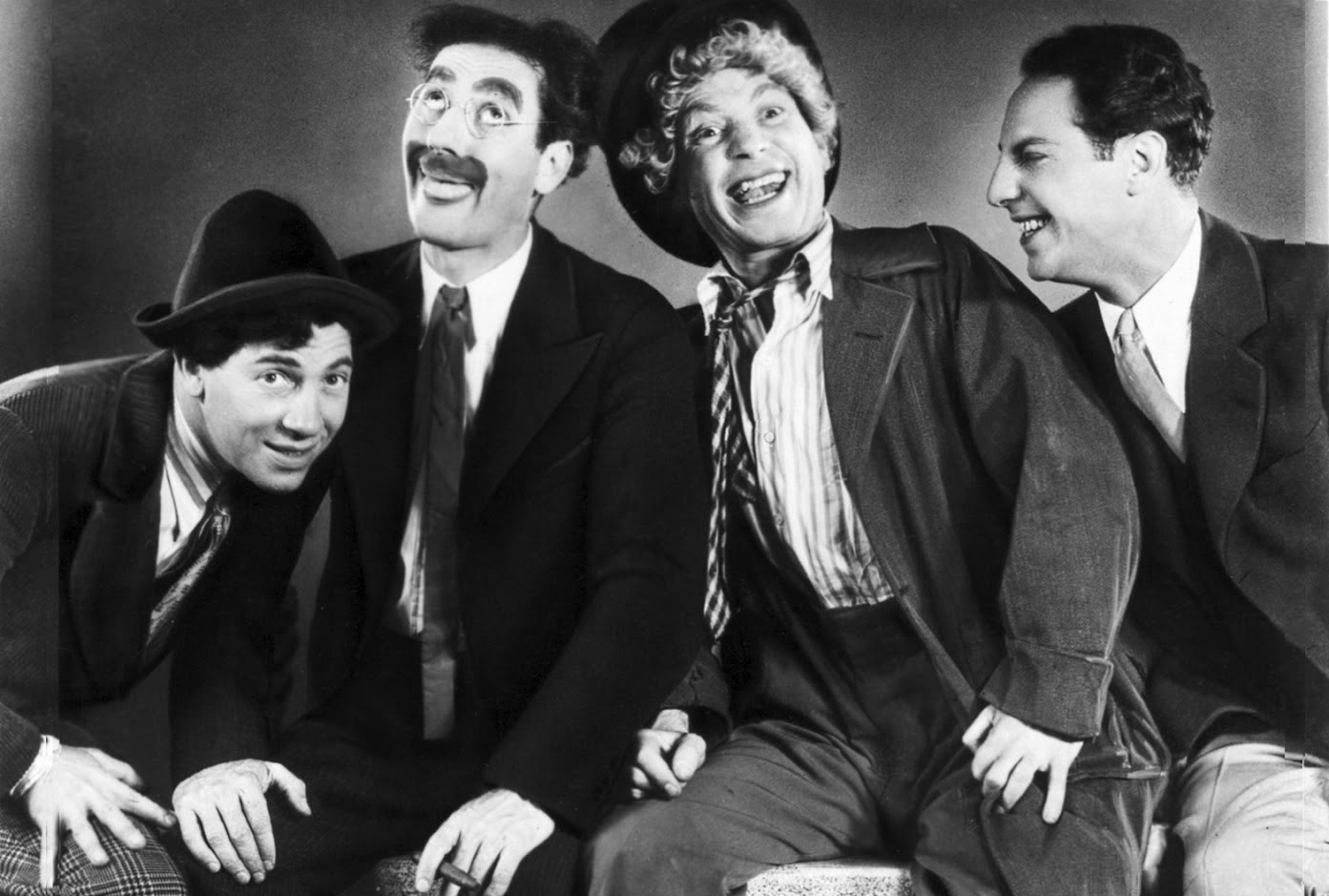
IT BEGAN HAPPENING around Hallowe’en, which is why nobody noticed it at first. Then it became one of those wryly amusing end-of-the-news stories on a local station in Anaheim, but because it was so close to Hollywood, nobody took it very seriously. A man who looked, dressed, walked, and talked exactly like Groucho Marx had been wandering the streets. As he was neither escorting any children nor begging at the doorways himself, his presence aroused suspicion – at least according to a busybody who insisted on being interviewed – but when he remained in the Groucho guise throughout the subsequent days, his wife called a nearby hospital and it made the news again. The local story was picked up by other stations across the country that shared the network, and it made its to social media as well. That’s where I noticed it.

My first experience was in an Aldi. I rounded a corner, its endcap a display of pet food, and glimpsed a man in a swallowtail coat placing items on a checkout line. He was slightly stooped and his hair was brushed back. As he turned to his cart, I saw a mustache, eyeglasses, and improbable eyebrows. I took all this in as, feigning disinterest, I proceeded up the aisle before me, processing the sight. Groucho was buying boxes of cracker assortments.

It wasn’t Groucho, of course. Some wag had chosen to adopt the garb and make-up of the comedian, possibly in a new-inspired copycat gesture. I hurried down the adjacent aisle in time to see Groucho finishing the checkout. “I had a wonderful shopping experience,” I heard him tell the cashier, adding, “but it certainly wasn’t at this fleabitten place.”

Friday, April 12, 2024

A Preferred Byas

WITH NO SLIGHT INTENDED to my family’s generosity, the ultimate Christmas present arrived early, and it came from Mosaic Records. Ten CDs devoted to the work of tenor sax artist Don Byas, ten CDs covering only June 1944 through September 1946, but showcasing a vital moment of transition in the world of jazz. This was a transition being enthusiastically explored by an artist who would then quit the United States in annoyance over his lack of recognition.

Byas was born in Olahoma in 1913 to parents who played musical instruments. By the time he reached his teens, he was playing clarinet, alto sax, and violin, and at 17 he began performing with local bands and even organized a band under his own name. Three years later he was on the west coast, now playing tenor, where he’d work with Lionel Hampton, Buck Clayton, and Eddie Barefield. That’s also where he met Art Tatum, whose work floored him.

“Art Tatum really turned me on,” Byas told jazz writer Art Taylor, who collected the interview in a book titled Notes and Tones. “That's where my style came from...style...I haven't got any style! I just blow like Art. He didn't have any style, he just played the piano, and that's the way I play.”

Given the easy manner in which Byas straddled swing and bebop, he could be termed a musical chameleon – but, as this set proves, he really wasn’t. Those were simply complementary parts of his natural voice. You hear the rhythmically adventurous swing player right from the start, as he solos in “Dance of the Tambourine,” a Hot Lips Page original. Byas follows Page’s vocal with an easygoing chorus (Page, on Mellophone, takes the bridge). But the next session, six weeks later, finds Byas rocketing along in bop mode, as “Riffin’ and Jivin’” throws fast-paced technical challenges at the crew. Trumpeter Charlie Shavers has no problem with this kind of thing, nor does pianist Clyde Hart. And dig Hart’s celeste work on “Free and Easy,” the ballad that follows.

Friday, April 05, 2024

A Fanatic’s Fantastique

More from the Concert Vault Dept.: While perusing some 1987 material, I found the following. The piece is an “advance,” written to promote an event, in this case a concert I very much wish I hadn’t missed, as I, too, am a Berlioz fanatic. I usually only post reviews, but this casts an interesting light on the Berlioz piece. Nelson remains active as a conductor, although he doesn’t seem to be holding down any regular positions at this point, preferring to travel and work throughout Europe when he’s not in Chicago or Costa Rica.


Conductor John Nelson warns right from the start that you will be surprised by the “Sympbonie fantastique.”

He is presenting a version that purports to be truer to the Berlioz original than the one we’re used to hearing when he leads the Indianapolis Symphony Orchestra at 8 p.m. Tuesday at the Troy Music Hall, the last concert in this season of Troy Chromatic Concerts.

“I’m a hopeless Berlioz fanatic,” Nelson admits. “And this new Behrenreiter edition is hair-raising, especially if you’re used to the old one.

“There’s a repeat in the fourth movement that has been omitted for decades, and, because that movement is a march to the scaffold, it’s even more ominous.”

Berlioz wrote the symphony as a tone-poem describing a young artist’s macabre dreams under the influence of opiates (young artists were the 19th-century French equivalent of major-league pitchers today).

Friday, March 29, 2024

A Voyage of New Music

From the Musical Vault Dept.: Long before Rensselaer Polytechnic Institute installed it shiny new performance centr (EMPAC), experimental arts were humming in RPI’s halls. Neil Rolnick taught there from 1981 to 2013, where he started the nation’s first MFA program in Integrated Electronic Arts. Now based in New York City, he’s an Adjunct Faculty member at NYU’s Department of Music Technology in the Steinhardt School of Music and Performing Arts Professions.  And he remains busy as hell. Check out his website for more information. Here’s a piece I wrote about his activity in 1987.


YOU EXPECTED THE PERFORMERS to clone new life or at least travel through time and space. The setup included computers, mixers, amplifiers, keyboards, speakers and lots and lots of twinkling lights And, yes, in a way they did clone new life and move through time and space.

Neil Rolnick. Photo by
Gisela Gamper

Neil Rolnick, director of electronic music at RPI, presented a concert in the Electronic Arts Performance Series Monday night at the RPI Chapel and Cultural Center in which three works that used electronic sampling techniques were featured.

Sampling is a process by which any sound or sequence is recorded (“sampled”) by a synthesizer that can then reproduce it identically or with variance in rhythm and pitch.

And so we began with Rolnick’s own “A Robert Johnson Sampler.” Contemporary classical composers too often lose their senses of humor and musical heritage as they get too academic. Rolnick, on the other hand, affirmed his link with American jazz by sampling the distinctive sound of this blues pioneer and weaving it into a weird texture that began by isolating the matter of the sound itself from the Johnson’s process of making music.

A meditative slow section examined the link between the blues chords and their antecedents in church music; for a finish, the rhythm of the chord-strokes themselves was the subject.

Friday, March 22, 2024

Setting Your Steaks

From the Food Vault Dept.: Mention of our steakhouse meal on board the Queen Mary 2 set me to recalling some of the places in that category that I’ve reviewed over the years. I have a fondness for the The Barnsider in Albany, NY, although I haven’t been there in a long time. Probably worth a revisit now, especially because I can visit as a civilian. Which is also to say that it’s still in business, now with affiliated units in Massachusetts: The Hardcover in Danvers, and Beverly’s The Beverly Depot. (Photos are courtesy The Barnsider.)


SURE, IT SEEMS LIKE the Barnsider always has been there, but the fact that the place has been going strong for over 40 years still seems somehow shocking. Forty years? A steakhouse?

That’s probably one of the keys to its success. It offers, and always has offered, a menu that’s compelling in its reliability. In a market that is notoriously averse to culinary innovation, the Barnsider is more conservative still. Steaks, seafood, salad bar.

Another key: terrific service. It’s easy to argue that steaks are steaks, so there needs to be an extra touch to keep the customers coming back. The Barnsider does it nicely.

When I last wrote about the place, in 1994, I complained that the filet mignon was a pricey $19. Today it’s $23. And pricing on the rest of the menu is consistent with what you’ll find in other area steakhouses; in fact, compared to some of the better ones, the Barnsider is a bargain.

Friday, March 15, 2024

The Long Journey Home

BY THIS TIME, we were so accustomed to packing and moving on that the finish of our stay in London seemed no sadder than that of any of our other stops. My wife and I had given ourselves enough time at each of those places so that we didn’t feel too rushed – three nights in each, two nights in London – and there’s a psychological advantage in knowing that you’ve still got a week on board an ocean liner ahead.

On the morning of August 11, we met our driver, Mohammed, outside the Euston Square Hotel, and set off for Southampton and a 4:30 PM departure of the Queen Mary 2. Mohammed was a native of London, whose first words after greeting us were, “Don’t touch that door!”

This was directed at take-charge Susan, who was about to slide open the side door of his van. But, as he pointed out, the door was motorized and would slide when he pushed the appropriate button. This is not to suggest that he was in any way unpleasant; I heard in his comment too much experience with obtrusive passengers in what, we learned, was his own vehicle.

I should take a moment to note that all of the car-service limos and vans we hired were equipped not only with comfortable seating and plenty of room for our luggage, but also bottled water and charging ports. Like a good waiting room, but without TV screens and, of course, other people.

Friday, March 08, 2024

Crown Jewels

From the Concert Vault Dept.: I’ve reviewed them in these pages before, but it was a treat to discover one I’d forgotten about – especially as my recent UK trip has caused my anglophiliac side to bubble up. So let’s spend a few paragraphs with the King’s Singers as they were some fourteen years ago.


LEGENDARY CHORAL CONDUCTOR Sir David Willcocks likes to tell the story of a group of singers who worked with him at King’s College in the mid-1960s and aspired to go out on their own. “You’ll never make it,” he told the Schola Catorum Pro Musica Profana, as they began calling themselves. After achieving considerable success as the King’s Singers, the group has made a point of saving a seat for Sir David at their annual Albert Hall concert – a seat that Willcocks happily occupies.

Kicking off a three-week U.S. tour, the King’s Singers stopped in Schenectady last Friday, returning to Proctor’s Theatre with a program leaning to the more pop-oriented numbers that make up much of their repertory.

It began with a 1988 arrangement by former Singers tenor Bob Chilcott of five American folksongs including and under the title of “Simple Gifts” – but beginning with a classic shipwreck song titled “Golden Vanity” that highlighted the group’s signature style, creating harmony and rhythmic accompaniment through the deft use of vocalise and lyric fragments.

Friday, March 01, 2024

Woody’n You

From the Record Shelf Dept.: I looked this up online to remind myself of the CD set and – hey! What a handsome job of packaging! I was sent a promotional copy to review, which came in a conventional jewel case with a PDF of program notes. And to make matters worse, Metroland magazine never even ran the review I wrote, so it’s reproduced below. As of this writing, you can get it from woodyguthriecenter.org for a hundred bucks, from Amazon for $65, and from a Discogs seller for about $35 bucks.


EVERY NOW AND THEN, something turns up unexpectedly. Caravaggio's “The Taking of the Christ” was unearthed, but I still await a complete print of Orson Welles’s “The Magnificent Ambersons.” Meanwhile, a stash of Woody Guthrie recordings was discovered in a Brooklyn storage bin, part of the inventory of Stinson-label records that fell into limbo following a tangled series of bankruptcies and family disputes.

It’s too fascinating a story to recount here, and Ed Cray and Bill Nowlin have a detailed essay in the booklet accompanying the four-CD set, “My Dusty Road,” that reissues 54 of these very significant recordings.

One of the unfortunate characteristics of the Guthrie legacy is that his recordings were  produced fast and cheap, and many of them, drawn from dubs of dubs, sound like crap. Some of the songs from these sessions went to original co-producer Moe Asch’s Folkways label, which had a way of making everything sound terrible, and are now available through the Smithsonian-Folkways label. More on that in a moment.

Friday, February 23, 2024

Antiestablishment Enthusiasm

From the Vault Dept.: What was I pondering in print 40 years ago? I had just started writing for Albany’s Metroland Magazine, before it became an alt-weekly. Paul Grossman, the editor, welcomed classical-music coverage, including such musings as you find below.


THE STRANGEST ASPECT of a classical musical concert is the expected regulation of audience enthusiasm. A curious tradition of etiquette is at work here, requiring you to applaud politely only after the piece is over – the sort of thing you were trained to do during grade-school assemblies. But music, being a totally aural art, makes a direct appeal to the senses. And, being a real-time experience, it carries its own momentum, which can produce an excitement you’ll find in no other entertainment. The instrumentalist is trained to sing through a device not connected with the body. An ensemble strives to attain a single identity out of all these abstractions, and therein the magic lies: when that goal is accomplished, you, the listener, are liable to be emotionally transported far beyond the concert hail.

Michael Sylvester, tenor
But don’t applaud too much! And never between movements! The classical Establishment gives that sort of behavior a great big frown. I wonder if those who have put their music on such a pedestal aren’t responsible for driving away a large potential audience with this restraint stuff. It’s your means of communicating with the performers, after all. And they like to know how they’re doing. You wouldn’t let a good lick go unapplauded during a rock or jazz concert, and opera audiences, those unique beasts, are great at showing the singers a response. So here we have an orchestra, or a chamber group or, especially, a soloist, who has just tossed off a neat, nasty movement with aplomb, and you’ll find that most of the audience just sitting there, rustling, coughing, opening the program again.

Most audiences – but not all. A college-student audience can be very responsive, and I’ve never known a performer to dislike the attention. A Carnegie Hall crowd, on the other hand, can be deathlike. They don’t even cough.

Friday, February 16, 2024

London Assurance

WE ARRIVED in the nerve-center of England with very little planned. The evening meal is always a good starting point, so we took a walk in the neighborhood of our hotel to see what came to hand, so to speak.

We were in the borough of Camden, where it turns out that Euston Station – where our train from Edinburgh left us – essentially put the place on the map. It was opened in 1837 to offer train service to Birmingham, the first inter-city line in England, and it was a tremendous success. And this came only 27 years after Euston Square was created, giving a name to this area. It’s still best-known as a transportation hub, with tube and bus service here as well, but it’s also home to University College London.

Which means that we had UCL housing located in our neighborhood, as evidenced by the crowd spilling onto the sidewalk at the Crown and Anchor pub. We were walking up North Gower Street, site of our hotel, toward Drummond Street, where I understood I could find a restaurant.

Good thing we like Indian food. Among the eateries there were Raavi Kebab, Dwana Bhel Poori House, Drummond Villa, Ravi Shankar Bhelpoori House, Sizzling Bombay, Taste of India Euston, and Chutneys. Why did we settle on Masala King? Because a pleasant gentleman in the doorway of that place exhorted us to try it. He was one of several eager souls hawking their restaurants, reminding me of the sales pitches I’d hear in Manhattan’s Little Italy on a Saturday night.

Friday, February 09, 2024

Dogs Go Dutch

From the Classical Vault Dept.: For a while, back in the heady double-aughts, I wrote for the online classical-music journal andante.com, which sparkled briefly and died. And I did double-duty on the concert reviewed below, writing about it both for andante, which you’ll find here, and for Metroland (also dead), which you’ll find below.


THE CUMULATIVE EFFECT of a classical music concert is easily clouded by familiarity, where pieces present themselves as dangerous or safe. Mozart overture: safe. Berg concerto: dangerous. Stravinsky ballet suite: recently dangerous, now, especially with Berg just gone by, very safe indeed.

Photo by Gary Gold
The Albany Symphony’s contemporary music ensemble, the Dogs of Desire, presented eight world premieres last weekend, all of them commissioned by the group. Talk about dangerous! Musically, there was nowhere to hide, and the 99-seat theater in the Troy Performing Arts Center holds you pretty well captive, too, especially when it’s packed to the brim as was the case for the both of the performances (7 and 10 PM) that night.

I saw the early show, and found every aspect of it impressive. The works themselves proved what a vast range of style and sound falls into the category of classical music; the programming demonstrated that the leap from one “dangerous” work to another is itself exciting. I’m sure each of these works would stand the test of familiarity, but the element of surprise was thrilling.

Friday, February 02, 2024

Peint o Gwrw Welsh Pub

From the Food Vault Dept.: Recalling the highlights of my recent trip to the UK, pubs figure prominently. That’s why I’m unearthing this 2014 review of a popular pub in Chatham, NY. As it happened, the place had but two more years of life under Tom Hope’s management, then he sold the place to Angus Van Beusichem, former manager of Albany’s City Beer Hall, and Gray and Thomas Ballinger, who own the City Beer Hall building. Much of the decor was purchased and preserved. Food prep has moved to an open kitchen, with a strong emphasis on locally sourced food and, of course, beer. Look for it now as the People’s Pub.


“IF I LIVED NEAR THE PLACE, I’d be there all the time,” a friend of mine said, and I had to agree. It’s been decades since I’ve shared a neighborhood with a tavern, let alone one that bursts with character.

Styling Chatham’s Peint o Gwrw as a Welsh pub has been more than a marketing gimmick for owner Tom Hope. It salutes his heritage – he has determined it’s one of only four such pubs in the country, with two of them in St. Louis – but also gives him a forum in which to offer the food and hospitality he finds meaningful.

“I’ve been living here for 20 years,” he says, “and I realized soon after I moved in that there was no place nearby where you could get a pint. I had to drive 15 minutes into Hudson.

He’d been working at his wife’s quirky retail store, American Pie, in downtown Chatham when a realtor told him that the price of a building across the street had dropped. He looked at the place and made an offer. “And suddenly I was in the pub business,” he says. Had he run one before? “I didn’t have a clue. I still don’t.” And it was an unluckily timed opening, occurring as it did at the beginning of September August 2001, but the operation has grown and thrived in the succeeding years.

Friday, January 26, 2024

Train to London

EVEN AFTER the Beeching Axe fell in the 1960s, Great Britain still has plenty of trains. Trouble is, the lines are owned by a variety of companies that don’t necessarily coordinate scheduling among themselves, running often elderly equipment over often unkempt track lines.

Nevertheless, I devised a timetable that should have gotten my wife and me around the UK during our fortnight there. We had six connections to pursue. Southampton Central (SOU) to Seaford (Sussex) (SEF) required only one change, with a fifteen-minute window between trains. Seaford to Moreton-in-Marsh (MIM) in the Cotswolds was more involved, with one train-change to put us in London, a brief tube trip, then two more changes of train, the last of which with a nine-minute transfer window.

You get the gist, but let me get this out of my system. Moreton-in-Marsh to Manchester Victoria (MCV) demanded three train-changes, with ten- to 25-minute transfer windows. Manchester Victoria to Edinburgh (EDB) required one change, but Edinburgh to London Euston (EUS) was a single six-hour journey. Ditto the trip from London to Southampton: one train, but a tube trip to London Waterloo to start that one off. And all of this for a grand total of about £1,000.

The online reservations system was frustratingly inconsistent about the seats it offered, with off-peak, first class off-peak, first class anytime, and first-class advance among the mix, without noting why any one was available and others weren’t. Added to that was our luggage – two bags apiece, and that was packing lightly – as well as my transport chair, which folded into its own very bulky package. Would we be able to fit it all, never mind lug it from station to station? And the plan presupposed that trains would be on time, of course, and when I mentioned this to the people we met at our various stops, they laughed hollowly and approved the plan we eventually enacted: car service. I don’t even know how much that eventually cost us, as Susan got those credit-card bills, but it was well over a thousand pounds. And, as she agrees, it was worth it.

Friday, January 19, 2024

A Mid-Winter Sport Carnival

Guest Blogger Dept.: Looking for ways to combat the winter blahs? Robert Benchley offers an inspiring portrait of what the more adventurous folk among us are getting up to.


LONG ABOUT THIS TIME OF YEAR, we sportsmen find ourselves rather up against it for something to do to keep the circulation pounding even sluggishly along. Golf, tennis, and paddling about on water-wings are out of season, and somehow bear-hunting has lost its flavor. Bear-hunting has never been the same since the supply of bears ran out. There really is nothing much to do except sit behind the stove in the club-house and whittle. And even then you are likely to cut your thumb.

Drawing by Gluyas Williams
In an attempt to solve this mid-winter problem for red-blooded men, a postal ballot has been taken to see what others of our sort are doing during the long evenings to keep themselves fit for the coming open season. Some of the replies are strictly confidential and cannot be reprinted here. You would certainly be surprised if you knew. Send a dollar and a plain, self-addressed envelope and maybe we can make an exception in your case. The address is Box 25, Bostwick, Kansas.

Following, however, are some excerpts from letters concerning which the writers have no pride:

“I keep in training during the winter months,” writes one man, “by playing parchesi with my little boy. The procedure of this only fairly interesting game is as follows:

Friday, January 12, 2024

All Hands on Decca

From the Recordings Vault Dept.: I’m guessing that it was the Gershwin pieces, which included arrangements of the Three Preludes, that impelled Heifetz to jump from RCA Victor to Decca in 1945 in order to record a host of short violin pieces. I also suspect he was trying to win some kind of financial concession from RCA, to which he returned after that Petrillo strike mentioned below. The Decca sides also were included in the first Complete Heifetz set; by the time the second appeared, RCA (by then a Sony acquisition) had lost the rights, which went to Deutsche Grammophon, on which label a set of the Deccas appeared. They’ve also been issued in Europe and elsewhere by Naxos as part of a two-disc set that also includes Heifetz’s V-Disc recordings.


ONE OF THE TRAGEDIES OF THE early 1940s was the nearly complete loss of the transition from swing to be-bop. A recording ban instituted by the musicians union’s own Hitler, James Petrillo, stopped such progress dead for many, many months.

One of the first labels to agree to the union’s demands was Decca, and violinist Jascha Heifetz, otherwise a lifelong RCA Victor artist, waxed a number of sides with them, many of which have been unavailable for almost 20 years (some for more than 40).

It’s a collection that duplicates his later, stereo output only a little, and wins in performance comparison. And who can resist the curiosity of the two sides he cut in 1946 with Bing Crosby, as if to attempt a latter-day Fritz Kreisler-John McCormack union?

Heifetz, a longtime Gershwin fan, transcribed selections from Gershwin’s “Porgy and Bess” for violin and piano shortly before recording them in 1945. The arrangements are reminiscent of the turn-of-the-century showpieces Heifetz grew up with, but the playing has the gutsy intensity of one well aware of the lyrics. Although the recordings never sounded very good to begin with and suffered more distortion en route to compact disc, Heifetz plays with a passion that doesn’t come through in his 1965 re-recording of the Gershwin.

Friday, January 05, 2024

Six Concertos for Several Instruments

THERE WAS A CUSTOM that may still persist of welcoming a new year with a concert featuring all six of Bach’s Brandenburg Concertos. I never attended one of those, offering as a weak excuse the fact that I was often working on New Year’s Eve (see previous post). But I like the idea, and often replicated it in my living room, choosing one or another of the many recordings I have of those pieces, sometimes mixing them up to enjoy the exciting contrast between the earlier and later recordings, the latter usually by historically informed performance groups. Here’s a playlist if you want to try it yourself. You can probably find all of these on YouTube:

* Brandenburg Concerto No. 1 in F - Busch Chamber Players (1935)
    As old-fashioned a version as can be. This is the first recording of the piece. That’s Dennis Brain’s father on horn, John Barbirolli’s wife on oboe.
* Brandenburg Concerto No. 2 in F - Orchestra Mozart, Claudio Abbado (2007)
    A small ensemble with original-instrument specialists (see below).
* Brandenburg Concerto No. 3 in G - English Chamber Orchestra, Raymond Leppard (1974)
    A big sound with an intimate-style interpretation, and an unusually extended middle movement.
* Brandenburg Concerto No. 4 in D - Concentus Musicus Wien, Nicholas Harnoncourt (1964)
    The ensemble and conductor that really started the HIP movement - but by now
    sounding comparatively restrained.
* Brandenburg Concerto No. 5 in D - Concerto Italiano, Rinaldo Alessandrini (2005)
    Alessandrini, an early-music specialist, is also on harpsichord.    
* Brandenburg Concerto No. 6 in Bb - Chamber Orchestra, Fritz Reiner (1949)
    Back to the big, pre-HIP sound, but from a conductor who loved Bach.