Search This Blog

Friday, August 18, 2023

A Life on the Ocean Wave, Part 1

ONE OF THE ANNOYING FEATURES of the 1976 Gene Wilder-Richard Pryor movie “Silver Streak” was the amount of time the various characters spent explaining why they were taking a train, as if making apologies for this time-honored means of travel. Airplane travel could be luxurious through the 1950s, but fares fell and the carriers figured out how to fit more and more people into those airborne shells. At one point in the 1960s, my father, a frequent air-traveler for his business, realized that a newly hatched cabin-seating plan was little different from slave-transport ships, a comparison that has picked up some internet life.

The 1965 Broadway musical “Do I Hear a Waltz?” has a Stephen Sondheim lyric that finishes “Your chance of survival is so remote,/You're far better off to cut your throat – /But who has the time to take a boat?/What do we do? We fly!” So it was bad even then and, as you undoubtedly know, it has become far, far worse.

Especially for me, as I am large both in vertical and horizontal directions. I’m the fellow that late-arriving passengers hope like hell not to be seated beside. I’m the one getting yelled at by flight attendants because my foot has intruded into the aisle. So when the subject arose of taking a post (such as it is)-pandemic vacation, I insisted on a domestic, driveable itinerary. Until a friend decried my short-sightedness and reminded me that there’s a ship that crosses the Atlantic.

Friday, August 11, 2023

Major Impact

AMY ENGELHARDT IS A VERY FUNNY PERSON. I hesitate to label her a comedian, although comedy seems to bubble from the soul of her being. But she’s also an excellent singer, as deft at ensemble singing as she is putting across a solo song. And that song may well be one of her own, because she’s an extremely skilled songwriter as well, whose solo recording “Not Gonna Be Pretty” is an amazing distillation of her talents. She also writes prose with the deft hand of one who lives comfortably among words.

Amy Engelhardt
So I should call her a comedian, because it’s the funny people who are most adept at being serious. They understand how irony works; they play with sounds and language to underscore serious points. And Engelhardt brings this all together in “Impact,” which I saw at the Edinburgh Fringe. It’s an intense hour of songs and words with Amy front and center telling a story she needed to tell. That it celebrates – in only most moderately joyful sense of the term – the tragedy of the airplane disaster in Lockerbie, Scotland, in a labyrinthine journey of heartbreak and grief, without lapsing into the maudlin or making a cheap sale of the heart-warming finish, is a testament to Engelhardt’s many skills, all brought together in a piece speaks to all of us who have been anywhere near a tragedy. In other words, all of us.

She establishes three things at the outset of her show: First, that’s she’s a Syracuse University grad; second, that she grew up in New Jersey; and third, that the story to follow will celebrate “thin moments.” Let’s take the last one first. Thin moments, she explained, are those moments in which you feel an uncanny resonance between whatever it is you’re up to and something related, portentous, and less-defined. It’s not déjà vu, although there’s some overlap, and it’s not the phenomenon of “thin places,” another Celtic term, but this one describing a resonant location.

Friday, August 04, 2023

I Put a Spell on You

THE WORLD OF SHAKESPEARE’S “Midsummer Night’s Dream” begins and ends in a nobleman’s home, taking us into the woods only after the plot has leapt into complications. Benjamin Britten and Peter Pears fashioned an opera libretto that invites us into a fairy-kingdom right away, keeping us there until the final scene forces us back into a fancy drawing room. The emphasis thus shifts from quarreling nobles to the magic of this Athenian wonderland, even as the music that Britten wrote suggests uneasiness. “Take nothing for granted while you’re here,” it says. “However well you think you know the play, your expectations are about to be confounded.”

Puck (Oliver Barlow) and fairies.
Photo by Tristram Kenton.
“A Midsummer Night’s Dream” is one of the more popular of Britten’s many operas, and this revival of Peter Hall’s 1981 production, playing through the end of August at the Glyndebourne Festival, is more spirited and charming than any other version I’ve seen. Why this opera is part of this season is examined below; why you should see it now follows immediately.

I like an old-fashioned curtain-up, and this one is thrilling. As conductor Dalia Stasevska leads the London Philharmonic through the unsettling glissandi that open the piece, we see sparkles, a forest, an aggregation of sprites. The glade of glistening trees ease back their branches and leaves to allow the spritely chorus to advance to the proscenium. The singing begins – and it’s an augmented Trinity Boys Choir, so the difficult music is effortlessly sung – and what seemed at first to be merely a moon-drenched sylvan woodland reveals itself as anthropomorphic, each black-clad tree wearing foot-baskets of shrubbery with leaves-laden branches for arms. John Bury’s designs were inspired by the art of Arthur Rackham, but if they’re of an era, it’s a timeless one.

Friday, July 28, 2023

The Money of Power

WHENEVER I LAMENT the lack of cultural awareness across the U.S., I point to the support given to the arts in Europe, where it’s generally understood that opera and dance, theater and classical music will never draw enough paying customers to provide a livelihood to anyone who professionally sings or dances or otherwise writes or performs. Every nation needs its cultural identity to be buttressed by the fine arts, as they’re (unfortunately) snootily known, and smart government entities come up with money in support.

Sir Simon Rattle
If, in the U.S., it splits across party lines, that’s no surprise. Cultural literacy goes hand-in-hand with education, and education encourages liberal thinking. That’s why so many conservatives weaponize their lack of smarts and attack the institutions and traditions of education. Thus the book-bannings, the arts-money cuts, the general hostility toward universities. When Republicans seize enough power in Washington, DC, these days, one of their first targets is the National Endowment for the Arts, whose already minuscule budget is dwarfed by such precious commodities as defense spending. But Republicans are fighting for their own survival. The smarter you are, they understand on some smart-ass level, the more likely it is you’ll vote for someone else.

Friday, July 21, 2023

You Don’t Say!

I DISLIKE speaking with strangers. In fact, I resist speaking with almost anyone, but circumstances rarely allow such silence. Pandemic isolation was glorious, as most of my conversations were conducted through electronic means and allowed time to reflect and time to answer or ignore. Two problems typically arise: I have no wish to engage in a conversation about trivialities – weather conditions, sports scores, Presidential indictments – and, when you get right down to it, I usually have nothing worthwhile to say.

I recently wrote and performed a one-man show as Sydney Greenstreet, the brilliant stage actor who made his movie debut in 1941 in “The Maltese Falcon” and had eight more years of film stardom. Many of the lines I put into his mouth resonate deeply with me. For example: “At heart, I am a bashful man. I approach social gatherings with trepidation. My thoughts, my emotions, are wont to gallop into untoward areas. To speak without forethought brings the risk of betraying myself.”

In the company of my wife, with whom I’ve lived for forty years, I have a chatty buffer. She loves to talk. She offers herself, fully and honestly, to friend and stranger alike. Where some are tongue-loosened only after a couple of potent cocktails, she’ll be the life of the party after only a single cup of tea. This gives me the chance to fade into the background, to hide in an armchair and silently study the fireplace.

Wednesday, July 19, 2023

Star-Crossed

THE WORLD OF OPERA taught us that when a couple falls into a duet, they are in some way bonding. Usually it’s love. Sometimes it’s hate. It’s a powerful device that now informs all manner of musical theater. But when you’re looking for powerful examples of the power of duet, go to Charles Gounod. He packed four of them in his “Roméo et Juliette.”

Duke Kim and Magdalena Kuźma
Photo: Evan Zimmerman/
The Glimmerglass Festival
He was driven by desperation. Gounod’s “Faust” was a huge success, but he followed it with three flops. “Roméo et Juliette,” which premiered in 1867, turned it all around for him, and when you hear these duets in the current Glimmerglass Festival production, you’ll be just as enthusiastic as those Théâtre Lyrique audiences were in Paris way back then.

You need authoritative voices that convey this sudden, time-stopping passion, and that first duet, which begins with Romeo sighing about his “adorable angel,” is something of a warm-up piece. The couple is just getting to know one another, as yet unaware that their families are caught in that wearisome feud. Duke Kim and Magdalena Kuźma engage in a childlike back-and-forth. We’ve already heard each of their voices in solo spots, but it’s here, as their voices twine and meld, that we are treated to the richness of a pair of voices – their voices – in harmony. A different approach is required of the singers, each of whom must tune in to the other to make the blend become something approaching a single voice without losing individual identity.

Thursday, July 13, 2023

The Beasts of All Possible Worlds

THE EXPERIENCE OF SEEING Leonard Bernstein’s “Candide” has changed in recent years. I’ve seen a variety of productions – that variety aided by the fact that this opera, or show, or whatever category-defying label you wish to give it has gone through a dizzying variety of iterations during its 67 years of existence. (It’s got to be the only piece that lists both Dorothy Parker and Stephen Sondheim as lyricists.)

Brian Vu and Katrina Galka
Photo courtesy the Glimmerglass Festival
At its heart, of course, is Voltaire’s timeless, digressive tale of a good-natured naïf whose pursuit of love and a promised happiness takes him across a couple of continents and through a succession of violent conflicts, laced with improbabilities and coincidences that would make Baron Munchausen blush.

What’s happened recently, however, is that world events have caught up with the piece. What may have seemed like overblown satire in Voltaire’s time (indeed, he got himself kicked out of both France and Germany at various times) doesn’t seem so incredible any more.

So here’s Candide, gormless but game, a-burst with the optimism he’s learned from his tutor, Dr. Pangloss, and conceiving a passion for the lovely Cunegonde. All that stands in the way of this romance is the matter of birth. She’s an aristocrat; he’s a bastard. Ejected from the castle Schloss Thunder-ten-Tronck in Westphalia, he wanders through a succession of horrors while clinging to an eroding optimism. Tenor Brian Vu informs this role with a wide-eyed, gung-ho spirit.

Wednesday, July 12, 2023

Soft Be Her Tears

EVERYTHING THAT MAKES Puccini’s 1896 La bohème one of the opera-loving world’s all-time favorites is on display in the current Glimmerglass Festival production. Killer arias sung by incredibly skilled artists; ensemble pieces so stirring that your body will spontaneously increase its white-blood-cell count; stage movement and choreography that spurs the pacing when needed and enhances the poignancy when that’s needed, too. 

Joshua Blue and Teresa Perrotta
Photo courtesy The Glimmerglass Festival
It goes without saying that the music has its most fervent champion in the Glimmerglass orchestra, but I’m saying it anyway because it bears repeating for the sheer fun of repeating it. Puccini’s score sweeps with romantic gestures galore, of course, but there’s also much within it that begs for nuance and shading, and conductor Nader Abbassi not only showed a thorough understanding of the score’s demands but also the deft ability to support both the singer and the song.

But what’s happening, as you sit in the darkened theater and let the experience draw you in, is a confluence of these elements that uses your eyes and ears as entryways to your tear ducts. Or, to put it less cutely, as a direct avenue to your emotions. Puccini masterfully wields the tools that result in expert manipulation. Prepare to be manipulated.

Friday, June 30, 2023

Party at the Schumanns’ House

MUSIC GIVES A SOUL TO A PARTY. Not recorded music; that’s a cop-out which has become all too normalized because we’ve gotten so far away from making our own. I’m talking about putting that piano to use, or hauling out that guitar. Playing chamber music is a rich form of conversation, richer than party chatter. You listen to your fellow musicians in a manner that invites each instrumental voice to inhabit yourself even as you subsume yourself to the music you’re making.

The Schumanns – Clara and Robert – knew this. True, they were in the business of writing music, but when their musical friends stopped by, pleasant sounds were heard. This is the premise of “An Invitation at the Schumanns,’” a recording by the Paris-based Trio Dichter, an ensemble made up of pianist Fiona Mato, violinist Théotime Langlois de Swarte, and cellist Hanna Salzenstein.

As we expiate our sins of a patriarchy that demanded we celebrate Robert Schumann’s works and ignore those of Clara, his wife, we are discovering that she was a dab hand at composition herself, even as she was tasked with raising the children. Two of her works grace the program: the first of her Three Romances, Op 22, for violin and piano, and a Notturno for solo piano drawn from her Soirées musicales, Op. 6. These are beautiful performances – but they also convey the sense of intimacy you’d enjoy in the music salon of an accommodating home.

Friday, June 23, 2023

Taking Opera Seriously

From the Vault of the High Cs Dept.: Thirty years ago I reviewed a pair of NYC Opera performances at the Saratoga Performing Arts Center, and correctly predicted that the opera company’s residency soon would end. What didn’t end was the horrible amplification inflicted on mainstage events – although I should note that I haven’t been to that venue in many years, discouraged by the number of drunks who began showing up at Philadelphia Orchestra concerts. I assume the management was papering the house, but why pass out tickets at the city’s gin joints?


THE TRUTH ABOUT the New York City Opera's short, pre-summer visits to SPAC is that they’re a satire. A spoof. When a production is done reasonably poorly, as was the case with “Carmen,” it’s a poor joke. When it’s a reasonably good production, like “The Mikado,” the joke gets merely depressing.

Richard McKee
You could say that the joke is also a riddle: how many people will pay for amphitheater and lawn tickets to see what we call opera until they realize it’s actually not even as good as television? And can we fool them next year, too?

Unlike music and dance, which are appreciated viscerally, opera is a theatrical experience that engages a complicated combination of the senses. It requires an immediate involvement from the audience. But New York City Opera, like many another pretentious company, shuns the use of the English translations. And they’ve suckered the audience into accepting distracting supertitles as a compromise.

Opera is also a celebration of the human voice, a celebration entirely negated by the fact that even the amphitheater audience hears the singers amplified through a hardly-adequate speaker system (the SPAC techies boast that it’s the same thing they use for rock concerts, man, and management turns an obviously deaf ear to the problem).

Friday, June 16, 2023

At the Table

THERE’S A RECEIVED NOTION that American food is exemplified by the blandest of processed inventions, those rubbery slabs of “American” cheese being the epitome. By altering the standards by which the cuisine is judged – keeping the geography, but extending the history and re-coloring the inhabitants – we discover an impressive variety of foodstuffs and recipes.

Falafel from Michigan? Turns out that there’s an Arab population near Dearborn that started to boom in the early 1900s when Henry Ford told a Yemeni sailor about job opportunities. How about Marionberry Pie from Oregon? That celebrates a berry created at Oregon State University in 1948, a berry that grows in Marion County during the month of July and is too soft to export but snapped up by locals. A recipe from Montana for Bison Meatballs with Huckleberry Sauce celebrates the animal that was slaughtered to near extinction for racist reasons, now enjoying a more boutique presence as the meat is recognized as a healthy beef alternative.

Smithsonian American Table travels through time and geography to present a historical narrative that goes way beyond the standard bounds of imperialist tradition. It’s part social narrative, part recipes, interspersed with fascinating illustrations and sidebars. The dividing line for this country’s history is, of course, European colonization, but the book suggests another, later dividing line, noting, “a movement – that of food sovereignty – seeks to reclaim and return to those holistic and culturally significant foodways.” Meaning a return to the cultivation of local produce and well-raised meatstuffs.

Friday, June 09, 2023

In the Family

From the Food Vault Dept.: Here’s the restaurant review I wrote 30 years ago, offered now just to make me feel all the older. I had moved to NY’s Montgomery County in 1990, and was still getting to know the area when I discovered Pepe’s Restaurant in nearby Amsterdam. It seemed like one of those places that would live on forever, and indeed was run by family members for 77 years until it closed in April, 2000. Nothing has taken its place. (Nothing could take its place.)


THE NEIGHBORHOOD ON WEST MAIN STREET has changed considerably since Pepe’s opened in 1923. The ethnic character, certainly, is different – what was once a stronghold of Italian newcomers has melting-potted into something more homogeneous by becoming more diverse. The look of the area, too, has changed, simply by staying the same, aging and decaying, accepting only a few later buildings.

There’s still a little enclave of Italian restaurants there, with a newcomer Polish eatery down the street, but Pepe’s has long and quietly dominated the scene.

It’s a friendly place with a warm, simple look. Chances are that you’re going to be greeted by one member of the Pepe family and served by another. In the kitchen, Sam Pepe holds forth as he has done for the past half-century, following in a family tradition. In fact, there’s another branch of the family running a bakery in Amsterdam, which is where the cognoscenti go for the best loaves and rolls in town ... but Sam bakes his own bread for the restaurant.

Friday, June 02, 2023

Glenn Miller and Me

MY MOTHER WANTED ME to move back in with the family. It was 1974. I was eighteen and already had been living on my own for two years as I finished high school and sought work. I was in Connecticut. The family lived near Chicago, a relocation brought on by my father’s change of employer. During a visit I made that year, Mom played a clever trump card. She knew that what I sought most was a girlfriend, and reasoned that if she could provide one, I’d stay.

Knowing also that I planned to see a concert at Ravinia, the Chicago Symphony’s longtime summer home, she proposed that I escort a young woman I’d never met, one who worked as a nurse alongside my mother at an area hospital. “But I’m not going to see the Chicago Symphony,” I confessed. “I’m going to a Glenn Miller concert.” “I’m sure she’ll like that,” my mother assured me. How I wish that had been true.

To be a Glenn Miller fan as a teen in the 1970s was difficult. You were aligning yourself with a generation that came of age during World War II – my parents’ generation, in other words, and the teen-aged me didn’t suffer those fogies very generously. One persistent piece of high-school-aged bitterness sees me hurrying, one Saturday morning, to the home of a classmate who could not have been bettered in beauty, and who suddenly noticed me in school one day. (I remember no names attached to this story, which is a kindness.) Because of my oddball taste in music and other realms of the arts, I was accustomed to being shunned. But she invited me to her house. “I know you’ll have a good time,” she declared.

Friday, May 26, 2023

Cooking with Cool

From the Jazz Vault Dept.: As noted elsewhere in these pages, I’ve been a Scott Hamilton fan since I discovered him at Eddie Condon’s on West 54th Street back in the mid-1970s. So it was a treat to catch up with the group when they performed at the State University at Albany in 1988, and here’s the review I wrote.


REPLACING A SAXOPHONE REED takes a few moments; you moisten the new one in your mouth,   unscrew the ligature on the mouthpiece, line up the reed, replace the ligature...

Scott Hamilton
Tenor saxophonist Scott Hamilton had occasion to replace his reed during a concert Sunday evening, and he did it in no hurry, laconically performing the necessary action while pianist Mike Ledonne soloed. He’s that cool about it. In fact, all five of the players have such a laid-back aspect that you might worry whether they can cook at all.

They can cook.

This is a group that, with one pianist or another, has been working together for more than 15 years. John Bunch has been at the keyboard for many of the last few years, but Ledonne was an able and inspiring replacement.

Guitarist Chris Flory, drummer Chuck Riggs and bass player Phil Flanigan are, like Hamilton, in their mid-30s. While it’s easy to see them as mainstream, swing-oriented jazzers, they actually assimilate a little bit of everything that has informed acoustic playing since the ‘30s. Hamilton, in whose voice are the accents of Ben Webster and Flip Phillips, is a player with a unique sound who revels in the standards and counts Sinatra as another major influence.

Friday, May 19, 2023

Listening to Heifetz: Preface

Obsession with Heifetz Dept.: Here’s the Preface to Listening to Heifetz: A Biographical Survey of His Recorded Legacy, in which I very subjectively appraise the violinist’s vast catalogue of recordings.


MY VIOLIN LESSONS BEGAN AT AGE TEN, because I loved the sound of the instrument, the varnished box that in my hands emitted only godawful shrieks. Yet when played by accomplished artists, it became (to my young ears) the purest vehicle for emotional expression. And it still sounds that way to me.

I investigated the repertory. I bought sheet music and squeaked my way through the Mendelssohn concerto. David Oistrakh’s recording of the piece opened my ears to the magic that lurked behind those dots on the page – preparing me for the life-changing sound that hit me when I was 13.

The Mendelssohn concerto played on a portable radio as I sat in the dining room of my parents’ house. But this violinist was different. This one played with an urgency passion I’d never heard from the instrument before. This one took risks, dancing up and down the fingerboard like a tightrope walker. And when the lively third movement kicked into gear, I got chills down my back. The violinist was Jascha Heifetz.

I needed to hear more of his playing. I joined the RCA Record Club when I saw an ad that offered four Heifetz records for a penny, never mind the obligation-to-buy commitment and the need to send them a damn postcard every month to cancel the automatic selection. But now I had my own record of the Mendelssohn concerto – and Beethoven, and Brahms, and Tchaikovsky – and even a Prokofiev concerto that I found a little hard to take at the time.

Friday, May 12, 2023

Tasting History

SOME BRAVE SOULS at the New York State Library have been rummaging through its cookbook holdings to discover how our attitudes towards have evolved during this young country’s history. They presented a brief tour of some of their discoveries during a livestream seminar on April 25.

The Original
American Cookbook

Josie Madison, managing editor at the NYS Archives Partnership Trust, moderated the event, which featured Elizabeth Jakubowski, a senior librarian at the NYS Library, and Heather Carroll, an archivist at the NYState Archives. Working around them means you’re liable to be tapped as a taste-tester, as their photos of intrepid colleagues attest. And what where they tasting?

Stuffed Peach Salad, from “Mary Elizabeth’s War Time Recipes,” a 1918 book by Mary Elizabeth Evans. Cottage cheese and salted chopped pecan bits go on top of a pitted peach-half, which is then topped with a “French” dressing that turns out to be a vinaigrette colored with paprika. “The overall consensus,” according to an illustrated Facebook post, “was that this was a little strange but edible.”

Using resources found in special collections in the library’s rare-books room, four eras of this American journey were targeted. The other World War I-era book, also from 1918, was Amelia Dodderidge’s “Liberty Recipes,” The book’s title page identifies her as “Formerly, Instructor of Cooking, Manual Training High School, Indianapolis, Indiana; and Emergency City Home Demonstration Agent, Wilmington, Delaware. Now, Head of Home Economics Department, Wooster College, Wooster, Ohio.” Which isn’t as overblown as it sounds, what with credibility having been so much harder to achieve for women back then.

Friday, May 05, 2023

Power Sturges

BETWEEN 1940 AND 1948, Preston Sturges had an unprecedented Hollywood run of (mostly) successes with ten films he wrote and directed. Only Charlie Chaplin and Orson Welles had anything like this auteur status, although it took Chaplin over 40 years to make as many features, and Welles crashed and burned after only one.

Like those two, Sturges created nothing like Hollywood’s mainstream fare, but his films attracted enough of an enthusiastic audience to keep him employed – at least for a while. Some of those movies are among the funniest to hit the screen, and have kept their freshness long after the formulaic comedies of the period grew dated. Like Welles, Sturges had a fractured childhood. Born in Chicago in 1898, he shuttled between the U.S. and Europe as a boy. His free-spritied mother palled around with Isadora Duncan (and gave her the scarf that caused her demise), which exposed young Preston to France’s freewheeling artistic community.

Following his WWI service, Sturges worked for a few years at a New York store owned by his mother’s fourth husband. He was goaded into playwriting, so the story goes, while on an unsuccessful date with an actress. He made his Broadway debut as an actor in 1928; the following year, his play “Strictly Dishonorable” made him a small fortune and drew enough attention to him that he soon was working in Hollywood as a rewrite man, then contributing original screenplays. He proved versatile enough throughout the 1930s to allow him to talk his way into his first directing job, and at the end of 1939 began shooting “The Great McGinty” from an original screenplay. And it wasn’t all talk that got him the job. He agreed to sell Paramount the script for $10 if he’d be allowed to direct.

Friday, April 28, 2023

It’s a Gas

From the Theater Vault Dept.: Talk about a fairy-tale world. For a few seasons over thirty years ago, the Cohoes Music Hall was home to Heritage Artists, a professional theater ensemble heavy on musicals that guaranteed excellence. Talk about evanescence! Nothing at all comparable has taken its place in the Albany area. Even as trivial a piece as “Pump Boys and Dinettes” proved stellar.


IN THE FAIRY-TALE WORLD of musical theater, characters are inclined to sing for what seems to be any reason. Sometimes they burst into song when you least expect it; sometimes they tire you with it; sometimes it seems that they’ll never stop talking get on with the singing.

“Pump Boys and Dinettes” features almost no talking. Short, and short on plot, it simmers from song to country-flavored song with a wit and sparkle that leaves you dazzled. As the season-closer for Heritage Artists, it’s been setting the Cohoes Music Hall rocking to the antics of a quartet of good ol’ boys at a gas station somewhere on Highway 57 in North Carolina – and the sassy sisters who run the neighboring diner.

Let’s put it on the line here: there’s absolutely no reason not to see this show. The performers, all of whom sing and play instruments and even dance from time to time, are the sort you wish would show up at your company picnic and take over the entertainment. The music, all  country-flavored, will appeal to anyone who enjoys good music and has no objection to laughing now and then.

The tickets don’t cost much more than what you’d pay to see a couple of movies, and this is an event that stays with you longer.

Tuesday, April 25, 2023

Hard-Working Bard

WITH ALL DUE RESPECT to the late James Brown, I believe that the hardest-working man in show business is Bridge Street Theatre’s Steven Patterson. He co-founded the theater; he handles publicity and building repairs. Sometimes he takes tickets or sells concessions, or possibly both. Other times he’s onstage, taking on a remarkable range of roles, from ensemble comedy to solo drama, from contemporary classics to whatever you call Eugene O’Neill.

Jack Rento as Julian, Em Whitworth as
Rosemary, Andrew Gorhring as
Henry, and Steven Patterson as
William Shakespeare.
In the case of “Rude Mechanics,” world-premiering on the Bridge Street stage, he essays that dizzying range in one show, playing three roles ranging from the frantic to the ethereal, with (literal) Shakespeare in-between. And he’s playing these in the company of three other actors who help spin a dizzying web of confusion and intrigue backstage of a production of “A Midsummer Night’s Dream” that’s about to be performed before King James I and some royal visitors from Spain. It’s 1612. Cast members are succumbing to the plague infecting London.

That’s why Julian Crosse will be going on as Francis Flute, who plays the female role of Thisbe in the play-within-this-play. Julian is nervous, excited, terrified – a panoply of emotions that give Jack Rento, making his Bridge Street debut, a hilarious set of instant transformations.

Friday, April 21, 2023

The Big, Fat Lummox

Guest Blogger Dept.: We welcome back Booth Tarkington, whose 1916 novel Seventeen was, like most of the author’s books at the time, a best-seller. It’s fair to day that it hasn’t aged well; in fact, one wag observed that, if it were to seem relevant today, it should be retitled “Thirteen.” It offers the lovelorn William Sylvanus Baxter, pining with infatuation for the baby-talking Lola Pratt, a summer visitor to William’s midwestern town. The boy is about to join a number of his friends, all vying for Lola’s attention, on a picnic excursion.


IN THE MORNING SUNSHINE, Mrs. Baxter stood at the top of the steps of the front porch, addressing her son, who listened impatiently and edged himself a little nearer the gate every time he shifted his weight from one foot to the other.

“Willie,” she said, “you must really pay some attention to the laws of health, or you’ll never live to be an old man.”

“I don’t want to live to be an old man,” said William, earnestly. “I’d rather do what I please now and die a little sooner.”

“You talk very foolishly,” his mother returned. “Either come back and put on some heavier THINGS or take your overcoat.”

“My overcoat!” William groaned. “They’d think I was a lunatic, carrying an overcoat in August!”

“Not to a picnic,” she said.

“Mother, it isn’t a picnic, I’ve told you a hunderd times! You think it’s one those ole-fashion things YOU used to go to—sit on the damp ground and eat sardines with ants all over ‘em? This isn’t anything like that; we just go out on the trolley to this farm-house and have noon dinner, and dance all afternoon, and have supper, and then come home on the trolley. I guess we’d hardly of got up anything as out o’ date as a picnic in honor of Miss PRATT!”

Mrs. Baxter seemed unimpressed.

Friday, April 14, 2023

Fair Seedtime Had My Soul

 ADAM ALEXANDER, whose curiosity prompted travel all over the world collecting endangered vegetable seeds to grow and share, writes that

“Crammed into two fridges in the garage behind my study are jars and boxes filled with envelopes containing – at the time of writing – 499 varieties of vegetable seeds, sadly most no longer commercially available.” Adam Alexander grows some 70 varieties a year for food and seed-saving, something he started doing in the 1970s, although back then it was only about producing vegetables.

The seed-saving part of his book The Seed Detective starts in 1988, with a pepper. The author discovered it in the Ukrainian city of Donetsk; more specifically, in a farmers’ market stall, grown by a granny too poor to buy seeds and thus in the habit of saving them.

He doesn’t identify the woman except as a generic type, but notes that he “would always seek out this individual when scouring food markets around the world.” He’s extolling a generic grower, of course, but a grower of very specific produce: Vegetables that sprout from seeds uncorrupted by the chemical processes that have allowed Big Ag to copyright what once was a gift from Nature.

The “tennis-ball-sized sweet pepper with a fiery heart” kicked off Alexander’s search for other heritage and heirloom seeds around the world, many of which he than grows in his garden in eastern Wales. It’s a proving ground for his research as well, as he studies these vegetables to discover exactly what the word “heritage” means in relation to each.

Friday, April 07, 2023

Breaking the Curse

From the Food Vault Dept.: It delights me to discover that a restaurant I enjoyed visiting decades ago continues to thrive. Here’s one of them, in another twenty-year lookback. Although I dined at Lanie’s a couple of times after writing this review, I haven’t been back in a long while. A glance at the restaurant’s website confirms that the menu has changed and prices, you won’t be surprised to learn, have increased. So don’t be lulled by what’s listed below – those prices are mementoes of a fabled past.


“THERE WAS A LOT OF TALK about how this spot had a curse,” says Lanie Lansing, “but I think the success of a restaurant really depends on what the people around it want. You can’t open a doughnut shop in an area that doesn’t eat doughnuts.”

This spot in Loudonville’s Kimberly Square hosted The Bistro most recently; before that, Olivia’s, Smoothy’s and Desperado’s, among others. Lanie’s vision, and it’s been quite a success during the restaurant’s nearly two years of operation, has been to offer a family-friendly menu that also features some fancy stuff, in a space that’s as suited for after-work relaxing as it is for full-scale dining.

But the emphasis is on casual. No white linen here, and you’re as likely to spot a pizza on a table as you are a complicated seafood dish. Lansing opened her restaurant with a well-focused vision, a vision that evolved during her many years in the business, which included 16 years as a bartender. “I worked at Ralph’s Tavern, J.T. Maxie’s, Thirsty’s, the Barnsider and many other places. But I always wanted to have my own restaurant. I love to cook. My whole family cooks. When we decided to go into this place, my husband gave up his contracting business to help me.”

Friday, March 31, 2023

In the Neighborhood

From the Food Vault Dept.: We look back twenty years to a Schenectady neighborhood (and a bit beyond) where the city’s Italian heritage was culinarily honored. But there have been changes since I wrote this piece. Garofalo’s closed in 2018, when an internecine family dispute led to its demise. La Gioia Deli closed in June 2022, but a niece of the founders reopened it four months later, so it’s still there to keep you stocked in Italian specialty items. Saddest of all, Cappiello closed its retail store in 2022, after 101 years in business. Perreca’s thrives, however, and Maria Papa not only opened a restaurant next door but also took over management of nearby Cornell’s, a restaurant at 39 North Jay Street.


SCHENECTADY HAS AN AMBITIOUS REVITALIZATION PROJECT on tap that seeks to throw money at various parts of the city to see if magic beanstalks grow. Like the Jay Street pedestrian mall, Center City and the moat around Proctor’s, it probably looks good on paper. But no amount of fancy construction has created a downtown that can sustain a fine-dining restaurant. That’s because there are no people to support it.

A fresh Perreca's loaf emerges
Photo by B. A. Nilsson

Schenectady’s strength has long been its neighborhoods and sense of family, cultivated when the city was a one-company town, now eroded into tiny pockets of such cohesion. One such pocket is the North Jay Street area, now targeted to become the city’s Little Italy.

In truth, it’s been that for a while, although shifting population centers have depleted the neighborhood. The Sons of Italy is headquartered nearby, but what really give life to the area are the markets.

Begin at a small storefront at 33 North Jay St., easy to recognize by the many bread loaves in the window. Inside, if you visit early enough in the day, you’ll be drenched in the yeasty aroma of the emerging batch. Breadmaking technology hasn’t changed much over the past centuries, and part of Perreca’s success is its simplicity: a couple of ingredients, hand-formed loaves and a trip through the coal-fired oven.

Friday, March 24, 2023

Iberian Melodies

From the Concert Vault Dept.: 81-year-old Jordi Savall is still going strong, still exploring corners of the musical world typically neglected by the classical, folk, traditional, jazz – you name it – worlds. He ties together ancient musical trends in an attempt to remind us that peace and harmony are the default pursuits of the human race. He should have won a Nobel Peace Prize decades ago. Here’s my 2007 review of an appearance he and his ensemble made at Tanglewood.


THE FLORENCE GOULD AUDITORIUM is a lovely, lively venue in handsome Seiji Ozawa Hall, itself overlooking one of Tanglewood’s lush lawns. Folks in the very full house were obviously pleased with the performance, but this wasn’t really the place for the program presented by Jordi Savall’s Hésperion XXI.

Jordi Savall and members of Hésperion XXI
“The Sephardic Diaspora” gave us a rich series of songs, both instrumental and vocal, from one of the richest musical melting pots of antiquity – 15th-century Iberia. The songs are plaintive, sometimes sarcastic, always deeply affecting, characterized by a melisma-rich minor-key modality.

Which is why this concert should have been given in a blues club. And when percussionist David Mayoral got two or three drums going, his fingers a blur over the different-sized skins as in “Nastaran,” a song from Sofia, we’d clearly settled into a boozy, late-night groove.

Friday, March 17, 2023

In a Terrific Jam

NINE CONCERTS; 31 jazz legends; 86 different songs; twelve hours of music on ten CDs. The statistics are staggering. These are the long-neglected 1950s Jazz at the Philharmonic concerts that Norman Granz presented, by then following a well-worn formula that had served him since 1944. That’s when he conceived the idea of putting his favorite jazz musicians on stage in a jam-session setting, which proved successful both in concert and on record.

As John McDonough’s exhaustive liner notes point out, the initial six years were documented in a 10-CD set issued in 1998 by Verve (a label Granz founded). It’s out of print, but a decent copy won’t bankrupt you. Once a Mosaic set goes out of print, however, the price tends to skyrocket, so if you have neither, I’d start with this one. True, you won’t have Billie Holiday or Charlie Parker or even Charlie Ventura, but ‘40s JATP veterans Coleman Hawkins, Charlie Shavers,  Bill Harris, Illinois Jacquet, Flip Phillips, Hank Jones, Ray Brown, and Jo Jones are all here. And Oscar Peterson, who was just dipping his toe in the JATP water in 1949, plays his butt off on most of the sessions in this Mosaic set.

The recordings are drawn from nine concerts given at venues ranging from Carnegie Hall to the Hollywood Bowl. As the box-set title reminds us, these are “Classic,” not “Complete,” a distinction that gives Mosaic latitude to cherry-pick the best of a bunch. And ownership issues prevented including all or part of some of the 1950s JATP concerts. Granz originally issued much of this material on labels he created but ultimately sold, and those sales seem to have gone every which way.

Friday, March 10, 2023

Over the Moon

From the Food Vault Dept.: Against all odds, this unique little restaurant endures. It’s a world unto itself, offering creative vegan and vegetarian food choices in a place where you will like as not end up chatting with your table-neighbors – if you’re not digging the live music that’s a regular feature. Not a lot has changed since I wrote this piece 15 years ago except the prices. Check them out at this website.


SHORTLY AFTER WE ARRIVED, a spirited discussion broke out at the counter about personal philosophy, reminding me that it’s been a dog’s age since I’ve heard any self-definition beyond “I’m a Mets a fan” or “Yeah, I’m a Democrat. Wanna make something of it?”

Photo by B. A. Nilsson
This discussion soon veered towards food, a natural segue both because of the good food served at Moon & River and because there’s something ’60s-enough about the vibe here that it should inspire one to recall that “you are what you eat.”

Moon & River Café opened three years ago at what was long ago a shabby deli on Front Street in Schenectady’s charming Stockade area. It’s been refurbished to a fare-thee-well and appointed with living room-like furnishings that should remind some customers of a place called Mother Earth Café that once thrived in Albany.

That’s because they’re the same furnishings. “I put them in storage when I closed Mother Earth,” says Richard Genest, “and now they’ve found a new home.” This means that you can sit at tables, at a counter, in an armchair; you can play board games, read the paper. You can observe, as we did, the darkening skies of a summer thunderstorm while nursing a good beverage (my own cup of tea was appropriately soothing, but my daughter’s cup of creamy, aromatic chocolatl ($2, styled as “Aztec hot cocoa with sweet spices”) seemed more appropriate to the changing weather.

Friday, March 03, 2023

The Goose Hangs High

From the Opera Vault Dept.: The Berkshire Opera, in its earliest years, aspired to a Glyndebourne feel. And there were some eight summers of truly marvelous productions in a former chapel on the grounds of a posh resort before the company had to scramble to find venues. Productions remained good, but that Glyndebourne magic was gone. Here’s my review of a double-bill from the company’s second summer that included the first professional production of a Mozart one-act. And you can find the wonderful soprano Maureen O’Flynn mentioned over here as well.


STOCKBRIDGE NATIVE MAUREEN O’FLYNN, now a soprano with the New York City Opera, returned home in glorious voice Tuesday night. It was the opening-night gala of the Berkshire Opera Company, a 2-year-old group whose quality work should herald many more seasons. The audience braved squalls and felled limbs to make it to the Pierce Theatre, where two one-act operas comprised the delightful bill.

Maureen O'Flynn
Mozart’s The Goose of Cairo" is an under-performed gem, complete with father-frustrated lovers and uppity servants and a mechanical contrivance, the titular goose, that threatens to steal the end of the show. This production easily could have been titled “Road to Cairo,” thanks to stage director Thomas Lee Rindge’s Hope-and-Crosby-ish irreverence.

Comic opera is a challenge for the director: how much can be added to the humor of the music and text? Rindge was not afraid to take risks and was probably 90 percent successful.

The plot gives us lecherous old Don Pippo, grumpy papa of Celidora (O’Flynn). As played by Adrij Dobriansky, he has the funny befuddlement of Hugh Herbert, the “woo-woo” man of the old Busby Berkeley films.

Even as he prepares for his wedding to the young Lavina (Judith Gray), Don Pippo flirts with his maid, Auretta (Karen Smith). Naturally, this enrages Auretta’s sweetheart, the servant Chichibio (Vaughan Fritts), whose puffed-out chest seems to achieve more buoyancy the more he gets upset.

Friday, February 24, 2023

The Play’s the Thing

From the Theatrical Vault Dept.: Here’s another orphan piece, orphaned insofar that I can’t find any indication that it ever ran in any of the publications that used to publish me. So I offer it as a snapshot not only of what I chose to write about in 2006, but also the kind of cultural offerings that came to the Albany area – in this case, to a school that badly needed such things.


IT HAS BECOME the most daunting of theatrical roles, one that has enticed and destroyed actors for four centuries. Because the bar is perceived to have risen so high, Hamlet’s famous “To be or not to be” soliloquy is the bane of many an actor.

Tom Wells
Yet Shakespeare’s masterpiece continues to be the most-performed play in the Western world, has been translated into every major language, and has been the subject of dozens of films and operas. The version presented Mon., Feb. 6, at Watervliet High School by Lenox, Massachusetts-based Shakespeare & Co. is a 90-minute, seven-character touring production tailored for use with school groups.

As such, it probably will serve its audiences as a first glimpse of this formidable play and can, in that context, be judged as something of a success. It moves quickly; it held the attention of a restive audience; it played up elements of Hamlet’s character that remain resonant with teenagers.

As a theater piece, this production bears the stamp of Shakespeare & Co. in its kinetic staging and energetic approach to vocal delivery. Too often, however, this energy got in the way of the play. “Speak the speech,” Hamlet is famously quoted, “trippingly on the tongue.” The youthful cast in this production tended to mistake outright yelling for passion, and, instead of tripping, sometimes fell.

Friday, February 17, 2023

This Mulligan is a Gimme

From the CD Vault Dept.: Here’s a trio of CD reviews from 23006 that I found languishing in a single file (computer, that is, not physical) no doubt intended for Metroland magazine. But I don’t think they were published. I find no record of them in my sent-to-Metroland directory. Jazz, old-timey folk, and pseudo-opera are considered. So, in the spirit of exhuming anything and everything to which I put my digital pen, I offer them here and now.


MOSAIC RECORDS has an admirable history of issuing the finest series of jazz compilations you’ll ever want to invest in. They’re a joy to own and listen to, and once each limited-run pressing goes out of print, its collectible value skyrockets. Typically ranging from four to ten CDs in an attractive box with very detailed program notes, they sport about the best remastering I’ve ever heard, and the scope of each defines a particular jazz artist and/or label during a particular scope of time.

Recently they initiated a new line of reissues under the title Mosaic Select, each a three-CD set that focuses on (typically) a more recently active artist. Not as exhaustive in scope as the big sets, they allow more of surgical strike on the artist’s catalogue. Thus we have Art Pepper from 1956, some 1957 Bob Brookmeyer sessions (complementing Mosaic’s now out-of-print Jimmy Giuffre set), live Dexter Gordon club date recordings from 1978-79, plus sets by Randy Weston, Bennie Green and many more – 22 of them as of this writing.

Number 21 fits in nicely with the series, presenting Gerry Mulligan in a number of different settings (and contrasting with Mosaic set no. 221, which features Mulligan’s Concert Band recordings from 1960-62).

Friday, February 10, 2023

Back to the Classics

From the Musical Vault Dept.: Keith Jarrett was a little grumpy when I got him on the phone. This was in 1985, and I called to interview him in advance of his appearance in Troy, NY, playing classical Baroque-era selections. Or maybe I came across as a jerk and pissed him off. Either is a possible explanation as to why I didn’t get very much out of him and resorted to quotes from others to fill out the piece below. Nevertheless, I was looking forward to seeing his performance, but he cancelled at the last minute. Five years ago he suffered a pair of strokes that have ended his performing career. So this remains my only in-person brush with the man, although I unreservedly recommend his recording of Shostakovich’s Preludes and Fugues. I’ve left the piece below in its entirety, including a glimpse of other arts events in the area.


IT LOOKS LIKE an abrupt change of career, but Keith Jarrett’s recent switch to playing the classics is really a sort of coming home for the pianist, whose early studies included rigorous classical training. Referring to this change, Jarrett told one interviewer last year, “It seems sudden, but several years have been involved. I won't call it a shift. It’s more a choice for the music.”

Keith Jarrett
This makes sense when you realize that Jarrett considers himself not so much an improvisor at the keyboard but a voice for the music he plays, leading him to observe, “It’s appropriate for me to play music that already exists. I’m redirecting the same energies.”

On Saturday, Jarrett brings a program of music by Bach, Handel, and Scarlatti to the Troy Savings Bank Music Hall for an 8 PM concert. Those three composers are being feted this year for sharing the same year of birth three centuries ago. Did this fact motivate Jarrett’s programming? “It’s fortunate that this 300th birthday happened at a time when I might have done this anyway. It’s nice to know that it works out. But I also feel, for example, that Handel’s keyboard music needs to be played more often.”

Friday, February 03, 2023

Coca Nuts

From the Theater Vault Dept.: The madcap excesses of the “Barber of Seville” we discussed last week reminded me of a very different, very funny musical: “On the 20th Century.” I saw it in 1987, when the Broadway tour came to Schenectady. The musical opened on Broadway in 1978, where Judy Kaye replaced Madeline Kahn after a few performances, and it made Kaye’s career. Also in that cast was Imogene Coca, the incredibly funny foil to Sid Caesar for so many years. We were fortunate to have both Kaye and Coca in the cast of this tour, as noted below.


THE DROP THIS TOURING COMPANY USES for a curtain has giant postcards painted thereon, as if written on board the Twentieth Century, a train that once connected New York and Chicago. The portraits cleverly used on the stamps are of the songwriters responsible for the musicalization of this vintage play: composer Cy Coleman and librettists Betty Comden and Adolph Green.

Imogene Coca
Might as well be so bold as to display their faces. It needed a team this good to take an already good play and make an entirely convincing musical out of it.

It started as “Napoleon of Broadway” by Bruce Millholland. Charles MacArthur and Ben Hecht fashioned it into “Twentieth Century,” placing the emphasis on board the train.

Comden and Green added lyrics and some dramatic touches of their own, with a Coleman score that is a throwback to the operetta-ish stuff of Jerome Kern’s day.

The spectres of great actors hang over this show. Thanks to the 1934 movie, it’s easy to recall John Barrymore and Carole Lombard as the irascible producer and mercurial star. Which gives Frank Gorshin and Judy Kaye a hell of a tradition to top, but they did so with gusto.

Friday, January 27, 2023

Savoring “Seville”

From the Vocal Vault Dept.: We’re traveling back to 1985, when I was still finding my feet as a music critic, and a brief review I wrote of Texas Opera Theater’s visit to Schenectady’s Proctor’s Theater with a delightful “Barber of Seville.” (And this was before I began complaining about staging an opera’s overture.) The melancholy aspect, in retrospect, is that director James Atherton died two years later of an AIDS-related illness. He was a tenor with the Santa Fe Opera from 1973 to 1978, and made his Metropolitan Opera debut in “Boris Godunov” in 1977. He would go on to sing 277 performances there in a repertory of 17 roles. In recent years, he had branched into directing, of which this “Barber” was a shining example. He was 44 years old and lived in St. Louis when he died, where he served as artistic director of the opera studio at the St. Louis Conservatory. But let’s find him, still alive, in Schenectady.


THE AUDIENCE AT – and cast of –  Thursday night's Texas Opera Theatre production of “The Barber of Seville” had so much fun at Proctor's that it is easy to speculate that this was the kind of presentation that originally boosted Rossini’s opera to the prominence it now enjoys.

James Atherton
The opera was played strictly for comedy, low and high, with the kind of talent and zeal that makes for a great evening at the theatre.

Much of the humor originally was based on what was considered a shocking play in its time: Beaumarchais’s script mocked relations between masters and servants so savagely that productions were banned in parts of Europe. Today, of course, the subject is antiquated into quaintness. Rossini’s score added a magic of its own, and, as the Texas Opera production attests, the potential for enduring fun.

Tenor James Atherton turned stage director for this version, leading the cast through comic turns which might tax the imagination of film director Richard Lester. The scenic design, by Eduardo Sicango, used fans as a motif; fans decorated costumes and stage; there were giant folding fans on each side of the stage; and a large fan-shaped drop served as curtain. During the overture we met the principal characters with a silent commedia dell’arte-style prologue, a delightful use of those minutes.

Friday, January 20, 2023

Gieseking of the Keys

AS A LIFE-LONG INSOMNIAC, I grew up dependent on overnight radio listening to ease the struggle to get to sleep. But you know me. I sought classical-music stations for solace. And, because I grew up in the New York metropolitan area, I had a choice of several. That is, until WNBC-FM abandoned the format, followed pretty much by WBAI. WFUV and WKCR were only sporadically classical by the time I discovered them, and WRVR was bizarrely unpredictable. That left WNYC, which intruded too many public-affairs programs for my taste, WNCN, and WQXR. (There was also Bridgeport, Conn., anomaly WJZZ, profiled here.) And the overnight programming I liked best was anything offered by Bill Watson, a silken-voiced polymath with very specific tastes who gypsied from station to station. (You can hear a recording of him here.)

Watson was particularly fond of tenor Jussi Bjoerling and pianist Walter Gieseking, and Gieseking’s Mozart especially grabbed my ear. The combination of his gentle but no-nonsense performances and the warm recorded sound was hypnotic. While working for a classical radio station in 1981, I cassette-taped an eleven-LP set of Mozart piano music that Gieseking recorded in London in 1953-54. I transferred the cassettes to minidiscs (o much-missed format!) 20 years later, and not long after that sent them to a hard drive. Those journeys weren’t always kind.

Which is intended to explain my fanatical joy at receiving the 48-CD boxset of Gieseking’s “Columbia Graphophone Recordings,” covering the bulk of the studio recordings he made between 1923 and 1956, when he died suddenly. That’s a lot of listening, only somewhat ameliorated by the fact that he revisited some of the repertory here more than once, so you may wish to ration yourself.

Friday, January 13, 2023

Pass on the Salmon, Please

THAT BRIGHT PINK FISH became a centerpiece of our diet, its health benefits aggressively promoted, its resultant appeal so great that it even gave its name to a trendy color. You know what they say about All Good Things, and so it is with our favorite seafood. Turns out not only that farmed salmon is bad for you, it also is raised in such a horrific manner that the die-off rate is spectacular – and it’s also killing wild salmon.

Salmon Wars, by Douglas Franz and Catherine Collins, is an unsparing study of a brutal industry. How valid are their research and conclusions? Sebastian Belle, president of the National Aquaculture Association, an industry advocacy group, took umbrage at an excerpt of Salmon Wars that was printed in Time magazine. Without bothering to read the book itself, he wrote to the magazine’s editor in protest.

“There is a war being waged against science by activists that would prefer decisions be based on politics, anecdotes and shameless misrepresentations,” he insisted, “and the authors deliver on this approach by basing their arguments on false factoids pulled from the news or discredited old studies in place of real facts.” This appears in an article on the website globalseafood.org.

False factoids pulled from the news? Discredited old studies? Hardly. The book reflects the top-flight credentials of the husband-and-wife authors, whose journalist credentials include work for the New York Times and the Los Angeles Times.

Salmon Wars is a methodical study, well-researched and footnoted to a fare-thee-well. Its unpleasant conclusion is revealed at the start; what’s left is a lengthy journey to amass facts in the face of considerable industry opposition.

Friday, January 06, 2023

The Actor

I BEGAN MY cabaret-style performing in duet with Tom Savoy, a brilliant singer-composer-pianist whom I met in 1980. We discovered a shared love of some arcane types of music, and soon decided that we should write a musical comedy together. You have to audition a thing like that for producers, so we made the rounds locally and discovered that (A:) they couldn’t have cared less, and (B:) we really enjoyed singing together. We joined forces with Malcolm Kogut around 1984, and put together a cabaret show program featuring material such as you’ll find on my YouTube channel, including several sung with Tom. He and I stopped performing together only because he moved to North Carolina ten years ago, and that’s where he died last November. That first musical he and I wrote together was titled “Presenting Lily Mars,” based on a Booth Tarkington novel. It captured the world of Broadway theater back in the Nineteen Aughts, when Tarkington had success as a playwright – introducing Helen Hayes and Alfred Lunt, among others, to Broadway. Here’s one piece of our juvenalia, a song titled “The Actor.” This was recorded on Dec. 31, 2022, at Steamer 10 Theatre in Albany, NY.

Friday, December 30, 2022

The Fate of the Best of 2002

From the Food Vault Dept.: Metroland magazine published a “Best of” issue at the end of every year – or the beginning of the subsequent one – for which I contributed my notion of what restaurants literally and figuratively served me well during the preceding twelvemonth. Here we go back two decades, to what I considered the Best of 2002. And then I’m going to rejoin you at the end of the piece to learn what’s become of these eateries.


IT’S EASY TO SEE MY PREJUDICES AT WORK when looking over the best of the past twelve months’ worth of restaurant visits. I like them plain; I like them fancy. Less obvious is that I like them to be original, to offer something nobody else provides. Or, if it’s the same old fare, to offer it in an appealing manner.

O'Leary's Pub & Grill
Photo by B. A. Nilsson

Consider first the fancy joints. What are they offering that’s so unique? In the case of the absolute best – Chez Sophie Bistro and the Cambridge Hotel – it’s a combination of food, service and ambiance that makes dining a transcendent experience. And that’s usually the result of the personalities involved.

In the case of Chez Sophie Bistro (2853 Route 9, Malta Ridge), it’s the confluence of the skills of chef Tonya Mahar and owners Paul Parker and Cheryl Clark. As I noted in the earlier review, Mahar has captured the spirit of Sophie Parker’s food and eased it into a direction that I think would please Sophie, who was not an easy-to-please person. The food is inspired by classic French cooking, the setting – a classic silver diner – adds a note of delightful incongruity to the picture. And the newsletter, e-mailed weekly, is always joyous, as anything to do with food should be.

Friday, December 23, 2022

The Last Laugh

 We're back on stage! Malcolm Kogut and I will tread the boards at Steamer No. 10 Theatre (500 Western Avenue, Albany, NY) at 7 PM on New Year's Eve. Below is a promo video we made to celebrate the season. More info? Go to our Songs to Amuse website.

Friday, December 16, 2022

The Staff of Life

From the Cookbook Shelf Dept.: Every December, for many years, Metroland magazine would court advertisers by putting out buying guides. As the house restaurant reviewer, I chose my favorite cookbooks of the waning year, trying to avoid the excessively celebrity-driven. Here’s what was on my plate, so to speak, a decade ago.


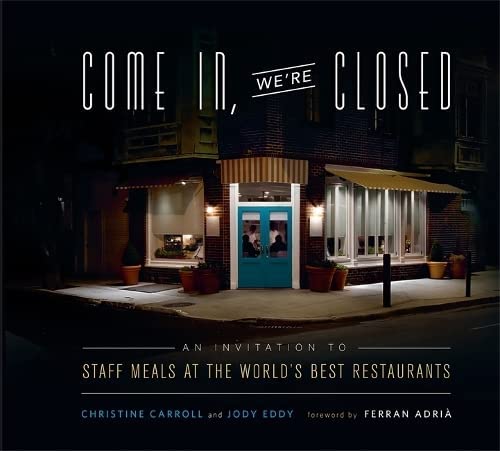
STAFF MEAL TELLS all you need to know about a restaurant. When the employees are fed with care and respect, when a family spirit is celebrated, a sense of well-being embraces everything about the places, and you feel it as a customer. This is why a chain restaurant feels like a Dickensian orphanage. Christine Carroll and Jody Eddy had the excellent idea of taking us behind the scenes to visit a couple of dozen staff dinners – with recipes – in Come In, We’re Closed (Running Press), although the first one, at Thomas Keller’s Ad Hoc, is a once-a-week staff banquet with a ritual requirement of paying compliments to one another, reminding me why I’ll never live in northern California. All of the chosen eateries are somewhat rarefied; thus, from Montreal’s Au Pied de Cochcon, for instance, comes “creamy smoked sturgeon pappardelle,” but that’s redeemed by McCrady’s, in South Carolina, and its offerings of a double-stack cheeseburger and beef-fat fries. Excellent narrative content, with insightful chef interviews as well.

Friday, December 09, 2022

Going Whole Hog

EVER CONTEMPLATED “CHUCKING IT ALL” and moving to a farm? Shrugging off the heavy mantle of living and working in the corporate world in order to get back to the earth sounds wonderfully noble and romantic, allowing you to glory in the knowledge that you’re providing healthy food for yourself and your neighbors. I know people who have done this. They knew they were in for a work schedule unlike anything they’d known in the nine-to-five world. They just didn’t anticipate how punishing it would be.

Ellyn Gaydos chronicles three years of active farm work in Pig Years, a poetic, insightful memoir that skillfully balances her personal growth with an honest account of the toil and turmoil of farm life. By the time the book begins, in the spring of 2017, she was no stranger to the challenges: At 18 she worked on a beef and dairy farm; the following year, on a berry farm. From there she went to another dairy farm, then to a vegetable farm. But, as Pig Years begins, “I had just turned twenty-four and fallen deeply in love, I had little money, was a transient worker, and was increasingly afflicted with the desire to have a child. All of this became like a conversation with the fields, animals, and various towns that surrounded me.”

I’m no fan of the type of memoir in which an eager diarist with little self-awareness chronicles an egocentric journey through what usually turns out to be the scorn of an unsympathetic world. This is emphatically not that kind of book. There’s no hand-wringing; likewise, there’s no feel-good cliché-mongering or strident preaching. But it is a story of growth and revelation. Gaydos tells it in a deceptively simple, matter-of-fact manner, her first-person perspective giving a sense of immediacy to the story.