Search This Blog

Friday, November 25, 2022

Some Like It Hot

It’s not as if we were pandemic-demoralized; far from it. We’ve learned to live reclusively and are quite happy in this social cocoon. However, Thanksgiving invited us to re-think the holiday menu and treat our handful of guests to something rather unprecedented for this event: Szechuan Hot Pot, also known as Steamboat or Shabu-Shabu. The menu is below; our slide show of Thanksgiving menus past is here.

Friday, November 18, 2022

Making the Most of Mozart

From the Theater Vault Dept.: Back in 1984, when the University at Albany had a theater department of some standing, they offered an ambitious series of productions. Amadeus was still something of an undiscovered item until the movie came out that year, which coincided with the production described below, first in an eager advance, then in a disappointed review.


PIANIST ALFRED BRENDEL, a world-class performer of Mozart's music, dismissed the hit play Amadeus quite simply: “It’s not an accurate portrait of the man. The playwright took his material from a few letters Mozart wrote to his sister, letters that were very playful, and very scatological.”

Saltzmann and Strolle in Amadeus
Much of the music world, which isn’t known for restrained opinions, has come down hard on this theatrical depiction of one of the gods of music; the recent release of the movie has fanned the flames of controversy, with the dowdy New York Times leading the pack of throat-clearers.

On the other hand, a friend of mine who has long insisted that she’d rather be boiled in oil than listen to opera confessed that the opera sequences in the film of Amadeus weren’t bad at all! That kind of influence is worth the whinnying of a dozen stuffy newspapers.

There’s no doubt that the film plays up Mozart’s manic side, and it’s that very quality that SUNYA’s Bill Leone thinks needn’t be overdone for the theater: “Mozart is a man who knew his society, he just had moments of insensitivity.” Leone is following his recent success with Shakespeare at SUNYA with a production of Peter Shaffer’s Amadeus, which Leone will direct and (for half of the run) act in. Leone has described the themes of the play as ‘being about “uniqueness and irresponsibility of talent. The struggle between a man and his god.” It opens at SUNYA’s Lab Theater on Tuesday for a two-week run.

Friday, November 11, 2022

The New Fable of the Speedy Sprite

Guest Blogger Dept.: We have heard your cries: “More Ade! More Ade!” And here he is, with one of the longer fables he was pleased to write following the great success of their too-brief predecessors. He got some extra mileage out of this one, as it also appeared in the Indianapolis Star under the title The New Fable of the Sprightly Sprite.


ONE MONDAY MORNING a rangy and well-conditioned Elfin of the Young Unmarried Set, yclept Loretta, emerged into the Sunlight and hit the Concrete Path with a ringing Heel. This uncrowned Empress of the 18th Ward was a she-Progressive assaying 98 per cent. pure Ginger. Instead of trailing the ever onward Parade, she juggled the Baton at the head of the Push.

In the crisp introductory hours of the Wash-Day already woven into the Plot, Loretta trolleyed herself down into the Noise Belt.

She went to the office of the exclusive Kennel Club and entered the Chow Ki-Yi for the next Bench Show. At the Clearing House for K. M.'s she filed a loud call for a Cook who could cook. Then she cashed a check, ordered a pound of Salted Nuts (to be delivered by Special Wagon at once), enveloped a ball of Ice Cream gooed with Chocolate, and soon, greatly refreshed, swept down on a Department Store.

A Chenille Massacre was in full swing on the 3d floor, just between the Porch Furniture and Special Clothing for Airmen. Loretta took a run and jump into the heaving mass of the gentler Division. She came out at 10.53 with her Sky Piece badly listed to Port and her toes flattened out, but she was 17 cents to the Good. Three hearty Cheers!

Friday, November 04, 2022

Hubbard of (Blue) Note

WHICH ARTIST IS BEST? Which album? Which movie? The lamentable practice of ranking artistic achievements one against the other has boomed in the Internet Age, with Top Ten lists swelling into the hundreds as paid-by-the-word scribblers duck the process of actual criticism and offer up rankings instead. Thus with trumpeter Freddie Hubbard: How does he rank against Clifford Brown or Miles Davis? The answer: Stop ranking. He is a giant who sits alongside those other giants in his own original way.

Mosaic Records has collected the ten albums recorded under Hubbard’s name as leader for Blue Note and Impulse between 1960 and 1966, a varied array of sessions and sidemen showcasing the amazing versatility of Hubbard’s tone and technique. He was 22 during the first of these sessions, already making a name for himself in New York through performances with Sonny Rollins and Eric Dolphy, among others. And he would soon nab a steady gig with Art Blakey’s Jazz Messengers.

The first session on this set, for the Blue Note release “Open Sesame,” serves as a kind of launching pad for what’s to follow. “But Beautiful” gives us Hubbard’s sleek, soulful ballad sound, while “Hub’s Nub” is all about Hub’s bop voice, his cascading lines nicely supported by a rhythm section of pianist McCoy Tyner, Clifford Jarvis (drums), and Sam Jones (bass). “Gypsy Blue” settles into an amiable Latin groove, with Hubbard in harmony with saxist Tina Brooks for the theme statements, and swapping solos with him elsewhere (and throughout the five other selections).

Friday, October 28, 2022

Dan Levinson: A Profile

IF IT WOULD BE POSSIBLE for a virtuoso reedman to step out of a jazz 78 in a kind of “Purple Rose of Cairo” move, that person would be clarinetist Dan Levinson. He has been performing for over 30 years, but he has been performing music that dates back to the ‘teens (the 1910s, that is), faithfully recreating the original styles even as he adds his own original voice to the mix. That’s why the New York-based musician has been in international demand, a jewel in any ensemble that hires him.

Dan Levinson
Photo by Dino Petrocelli

He’s also a leader in his own right, his versatility proved by recordings with his Canary Cottage Dance Orchestra, specializing in “rag-a-jazz’ from the early 1900s; the Roof Garden Jass Band, saluting the Original Dixieland Jazz Band, the Louisiana Five, the New Orleans Rhythm Kings and others from that era; “At the Codfish Ball,” with a Swing-Era reminiscent of Tommy Dorsey’s Clambake Seven; and CDs saluting Bix Beiderbecke, Artie Shaw, and other notables. Many of these recordings feature vocalist Molly Ryan, whose deft way with a song is also in keeping with vintage jazz traditions. But let’s let Dan tell that story:

“Molly is from Roseville, California, which is about 20 minutes outside of Sacramento. And I was performing with the Reynolds Brothers Rhythm Rascals, which was led by Ralf Reynolds and John Reynolds, who are the grandchildren of Zasu Pitts. I performed with them from the late 80s to the early 2000s. This was at the Sacramento Jazz Jubilee, where Molly’s father was a volunteer sound engineer. She’d been coming to that festival since she was about ten years old. And the Reynolds brothers knew her and had invited her to sing with the band. So I met her when she was sitting in with them.

Friday, October 21, 2022

Waste Not . . .

SO DISGUSTING AND PERVASIVE is the odor of hog waste that a researcher who was hired to take measurements of particulate evidence in and around a number of massive hog barns is still exuding the noxious stink for many days after he returned home. He obsessively washes himself and his clothing, but even after two weeks there’s a lingering smell. Until he realizes it’s clinging to his eyeglasses, which he then has to throw away.

Novelist Corban Addison turned to non-fiction in his recent book Wastelands: The True Story of Farm Country on Trial, but it has all the edge-of-your-seat pacing of a crime thriller. Which, in effect, it is, although you know the outcome if you’ve paid attention to agricultural news during the past couple of years. Even so, you’ll find yourself sharing the uncertainty of the participants as you’re taken through a series of some of the most momentous trials Big Ag has gone through.

By rights, a story like this should be shaded in greys. Few human conflicts ever can be seen as purely black and white, yet this one, pitting pork giant Smithfield against a group of North Carolina residents, not only clearly marks its villains as such, but also reveals that the lawsuits divide plaintiffs and defendants by race.

Four counties in southern North Carolina – Bladen, Duplin, Pender, and Sampson – have a human population of about 200,000, most of them poor and Black. As the state’s hog-farming industry grew and consolidated during the ‘80s and ‘90s, this became the livestock epicenter, cramming some five million hogs into the area. 

Friday, October 14, 2022

Touching the Classics

TENOR SAX ICON SCOTT HAMILTON seems to lead as relaxed a life as his playing suggests. He’s based in Florence, Italy, playing festivals and club dates throughout Europe, occasionally visiting the U.S., where he was born in 1954. By the time he hit Manhattan in the 1970s, you’d have sworn he was born a few decades earlier, so much did his sound conjure the world of Ben Webster and Coleman Hawkins. He took up residence at Eddie Condon’s on 54th Street, recording on Chiaroscuro and Famous Door before being swept up by Concord Jazz both as leader and sideman.

He worked alongside so many jazz greats that it’s unnecessary to list them – it’s a history of the last half-century of jazz with some seeming anachronisms, like Scott’s stint with a late-career Benny Goodman band. But he’s always sounded at his best in a small-group setting, and that’s where he is in “Classics,” his latest international release. Pianist Jan Lundgren and bassist Hans Backenroth are both from Sweden; bassist Kristian Leth is Danish, as is the Stunt Records label. And the title acknowledges the fact that each of the nine numbers is based on a tune from the classical-music world.

As “Theme from Swan Lake” swings into a dark-hued, agitated beat, you’d swear it was a 40s standard, in the vein of “On Green Dolphin Street.” But it is, in fact, a familiar tune drawn from the Tchaikovsky ballet. After some ominous bass build-up, courtesy Backenroth, Hamilton states the theme in his trademark dark, breathy tone, giving the bridge to pianist Lundgren. Then it’s a nearly seven-minute exploration of the variation possibilities, including some bop-tinged choruses by Lundgren before Backenroth gets out his bow and channels his inner Paul Chambers.

Friday, October 07, 2022

Digging Further

WHAT’S MOST REMARKABLE about Jonathan Ward’s Excavated Shellac collection – a project he began on his website and which now has been issued as a four-CD, 100-track collection by Dust-to-Digital – is the familiarity of the music. Mind you, this is typically lo-fi material, recorded and pressed in countries untroubled by pop-market best-seller lists. Which means that the familiarity is scant to nil. Yet these songs were somebody’s favorites, and they’ll soon be yours.

The recordings have stories to tell, and, as an extra layer, Ward’s excellent liner notes tell fascinating stories about the recordings. The set kicks off with Reuben Caluza’s Double Quartet, a South African ensemble that was recorded in London in 1930, which Ward describes as “(a) sublime combination of traditional South African choral song, ragtime piano, and American-influenced minstrelsy ... from one of the first substantial sessions of black South African music ever recorded to disc.” Even more remarkably, considering the repression building in that country at the time, it’s a protest song, penned by Caluza, complaining of the brutality of the white South African police force.

From there we travel to central Mexico for Huasteco music, thence to Okinawa for a 1957 harvest song. Most of the songs have translated lyrics; all bear study for the internationally appropriate poetry and passions. Mozambique was still a Portuguese colony in 1953, when “O Ta Nikona” (“Come, I’m Available”) was recorded, a courtship song celebrating the accompanying music.

Friday, September 30, 2022

There in Black & White

MOSAIC RECORDS’ NEW COLLECTION of jazz sessions from the Black & White label nominally covers 1942-49, but a couple of Petrillo-led musicians-union strikes shut down so much recording activity that the real date range is 1944-47. Chronologically, it’s not a wide span. Musically, it was a time of amazing growth and changes in jazz styles, and this eleven-disc set charts those changes on two coasts (and a little in-between) featuring well-known players and should-have-been stars.

Black & White was founded in Brooklyn in 1942 but soon moved to Los Angeles as changes in ownership shifted its base. It also became a label that moved far beyond the precincts of jazz, listing hillbilly, novelty, polkas, spiritual, semi-classical, and even children's records among its offerings.

Part of the challenge was moot: the label already issued the work of T-Bone Walker, Black & White's biggest star, in 1990. Here we get the rest of it, on 11 richly populated CDs. The rest of it, that is, as chosen by Mosaic producer Scott Wenzel, who, in the detailed accompanying booklet, notes the difficulties he faced “since many sides fall in a grey area between pop vocals backed by jazz musicians (in a strictly accompaniment role) and those sessions in a rhythm and blues context.” With no single artist to focus on, they had to hand-pick their way through a huge amount of material, and then see if they could even find a copy of each record selected.

Friday, September 23, 2022

USDA Lays an Egg

IN AUGUST 2022, the US Department of Agriculture released a new draft rule which they insist will bring organic egg and livestock companies into stricter compliance with the rules while assuring a level playing field for competitors.

Mark Kastel, co-founder and executive director of Wisconsin-based advocacy group Organic Eye, cries foul. And he has a history with this process. At a recent press conference, he said, “When we lobbied Congress to pass the Organic Foods Production Act as part of the 1990 Farm Bill, the USDA testified against the bill. They didn’t want any part of regulating organics. What we had envisioned as a unique public-private partnership has devolved into an adversarial relationship and it has been this way during every administration since the laws passed, Republican and Democrat.”

Mark Kastel
Looking at organic egg production, the majority takes place on commercial operations – commonly with 20,000-30,000 birds per building – and with some of the largest operating certified organic houses with as many as 200,000 chickens per building and over a million birds on individual “farms.” Alternative sources are the family-scale farms.

As Kastel notes, “The big shots at Bayer, Monsanto, and Syngenta don’t really like organics and their – I don’t want to say minions, but their partners at the USDA have created a hostile situation. At first, corporate agribusiness attacked organics. Then they bought organics, bought most of the major brands, and they produce most of the ‘organic’ eggs.”

Friday, September 16, 2022

The Social Life of the Newt

Guest Blogger Dept.: As we near the end of summer, let’s remind ourselves that this year’s disastrous attempts at muscling into what passes for the Smart Set in our various communities, with those starry-eyed hopes of love attached, are put to shame by our slithery friends, as described below by Robert Benchley.


IT IS NOT GENERALLY KNOWN that the newt, although one of the smallest of our North American animals, has an extremely happy home-life. It is just one of those facts which never get bruited about.

Prof. Otto Strudlehoff
I first became interested in the social phenomena of newt life early in the spring of 1913, shortly after I had finished my researches in sexual differentiation among amÅ“ba. Since that time I have practically lived among newts, jotting down observations, making lantern-slides, watching them in their work and in their play (and you may rest assured that the little rogues have their play—as who does not?) until, from much lying in a research posture on my stomach, over the inclosure in which they were confined, I found myself developing what I feared might be rudimentary creepers. And so, late this autumn, I stood erect and walked into my house, where I immediately set about the compilation of the notes I had made.

So much for the non-technical introduction. The remainder of this article bids fair to be fairly scientific.

In studying the more intimate phases of newt life, one is chiefly impressed with the methods by means of which the males force their attentions upon the females, with matrimony as an object. For the newt is, after all, only a newt, and has his weaknesses just as any of the rest of us. And I, for one, would not have it different. There is little enough fun in the world as it is.

Friday, September 09, 2022

The Threat of Perfection

From the Classical Vault Dept.: I’m guessing that Julia Fischer is now priced out of the range of small-city chamber-music programs, so I hang on to the treasured memory of the three performances of hers I saw at Schenectady’s Union College. (And here’s a link to my reviews of the other two.)


I HEARD VIOLINIST JULIA FISCHER play one wrong note – and only one – during her recital last week at Union College’s Memorial Chapel. It was during a busy section of Prokofiev’s Sonata No. 1, and it was a small and unremarkable moment. Nevertheless, it should suffice to satisfy George Bernard Shaw’s advice to the young Jascha Heifetz, in 1920, that he should play one wrong note every night before going to bed to appease a jealous god.

Julia Fischer and Milana Chernyavska
Fischer’s playing is similarly faultless. She is daunted by no technical difficulty; her interpretive depth – she’s only 26! – is similarly astonishing. Chief among the many recordings she has issued is a version of Bach’s Sonatas and Partitas, the most interpretively forbidding works in the repertory, that displays a sense of heartbreak and nuance far beyond her years.

For her third Union College Concert Series appearance, with her equally amazing pianist Milana Chernyavska, Fischer performed four sonatas that complemented one another beautifully.

Prokofiev’s classical-era roots resonated nicely with the Mozart and Beethoven sonatas flanking his piece; Bohuslav Martinů’s Sonata No. 3, which concluded the concert, is like the Prokofiev on steroids.

Friday, September 02, 2022

Cuisine of the Sun

From the Food Vault Dept.: To have chef Roger Vergé visit Albany in 1987 was a Very Big Deal. I was already a fan by way of his book Cuisine of the South of France, and was delighted to cover that visit in the piece below. As you’ll notice, I also got to taste some excellent food and wine into the bargain.


WHEN ROGER VERGÉ was five years old, his aunt Celestine bought him a small bench so that he could see over the top of the kitchen counter. It’s a view – and a point of view – that stayed with him for the next half-century.

Roger Vergé
Vergé – one of the very few chefs with a three-star rating from France’s prestigious Michelin guide – was at the Desmond Americana Saturday to introduce a new line of wine that bears his name, an occasion honored with a dinner by the local chapter of the Chaine des Rotisseurs.

“It is very important to have kids in the kitchen,” says Vergé, who cites tales of his own children’s cookery. “My daughter was eight and we were preparing some dessert tarts. I watched as she filled a tart with honey and then sprinkled sugar on top. ‘Why did you do that?’ I asked her. ‘How else are you going to cook the sugar?’ she said.”

He calls his cooking “Cuisine of the Sun.” He emphasizes freshness and creative seasoning. “I like to cook with herbs,” be explains, “and it is very important to have a mixture of fresh vegetables on the table, too. These are all sun products.” At his restaurant in France, Le Moulin de Mougins, he offers a menu not only crafted around what’s available and fresh any given day, but one that also stresses a harmonious blend of food and wine.

Friday, August 26, 2022

Not-So-North of the Border

A MOLCAJETE IS A THREE-LEGGED BOWL, traditionally made of basalt, which has been used as a mortar for food-grinding for thousands of years in Mesoamerican cultures. Because it retains heat for a very long time, it’s also used for food presentation, and you’ll find it as the centerpiece of a spectacular entrée at Greenane Farms in Meredith, NY.

Your molcajete arrives bubbling, earning its nickname of “volcano.” Ringed around its edge are strips of cactus and cheese, next to green onions, Mexican rice, and, hidden in the salsa verde, slices of very hot potatoes. Order the Volcan Vegetariano ($23) and there’s also grilled tofu in the mix, while the Volcan de Pollo ($25) features strips of chicken and a link of homemade chorizo.

At a recent visit, I ordered the Volcan de Res ($29), so the lip of my steaming molcajete sported strips of grilled Angus beef, still red in the center even as the heat kicked in to brown them some more. There’s a fresh, grassy flavor to pasture-raised beef that the elders among us still remember as the way beef is supposed to taste, and it becomes the joyous centerpiece of an array of complementary flavors, from the smoky bite of the chorizo to the mellow ease of those cactus strips.

Not only will you get one of the finest Mexican-cuisine meals you’ve ever enjoyed when you dine at Greenane Farms, but you’ll also have the satisfaction of knowing you’re dining on their own pasture-raised meats. This has been a passion of farm owner Patrick Rider – whose family has been in the area for eight generations – since he purchased the property in 2003. Now he owns 400 acres and leases over a thousand more, on which he raises 250 head of grass-fed Angus cattle as well as pigs, chickens, goats, sheep, and more.

Friday, August 19, 2022

Sardonic Salute

From the Classical Vault Dept.: William Bolcom’s Piano Concerto No. 2 was premiered in April of this year, by Igor Levit and the Mahler Chamber Orchestra conducted by Elim Chan. “Don’t bother asking whether the premiere took place in the United States,” wrote Seth Colter Walls in the New York Times, “where major presentations of music by Bolcom, an American, have fallen out of fashion. Instead, this new concerto was presented in Germany, at the Heidelberger Frühling Festival.” It wasn’t always that way. I first heard Bolcom’s first piano concerto in Saratoga in 1987, when Bolcom was composer-in-residence with the Philadelphia Orchestra at the Saratoga Performing Arts Center. Those days are long, long gone. Here’s my review of the evening.


WILLIAM BOLCOM’S PIANO CONCERTO, performed Friday night by soloist Emanuel Ax with the Philadelphia Orchestra, is a piece calculated to amuse and to offend. The last of a series of works by Bolcom performed at the Saratoga Performing Arts Center to honor him as composer-in-residence, it’s a piece you can point to and shout, “There! That’s a truly American work!”

William Bolcom
Photo by Peter Smith

Written in 1976, it reflects Bolcom’s concern with the bicentennial mania growing throughout the country, and manages to be critical and celebratory at the same time.

He is one of the very few contemporary American composers able to speak a native musical language without sounding condescending, which is in itself very refreshing and certainly prompts some nationalistic pride in the listening.

The work also closely examines the role of the piano in the concerto form, experimenting with different angles and settings. At times it was the aural equivalent of that old optical illusion of a drawing of a cube that points towards or away from you: Was the pianist dominating the orchestra or vice-versa? Coming as this piece did right after a Mozart concerto (No. 25 in C Major), it offered a stunning contrast to Mozart’s antique sweetness. Listening to the older work was an exercise in nostalgia; Bolcom’s concerto made a statement about our country, our century, and us as listeners.

Friday, August 12, 2022

Listening to the Land

AGRICULTURE IS NOW INEXTRICABLY LINKED TO CLIMATE CHANGE. The evidence is incontrovertible; the damage is already taking place. As Laura Lengnick observes in the opening pages of her updated and expanded book Resilient Agriculture, “Climate change is happening now. Climate change is changing everything.”

The first version of her book was written seven years ago, which turns out to be an eternity where climate effects are concerned. She profiled over two dozen farms in the U.S. that were coping not only with climate change but also with the transition of corporate agriculture to a style that’s more environmentally sound. In the new book you’ll find the stories of even more farmers and ranchers pursuing sustainable practices.

Even before she began researching the book, Lengnick worked on a USDA report recommending ways to cope with the new challenges of agriculture. It sounded an alarm many were unhappy to hear. But dramatic changes in the recent past persuaded her to re-interview original subjects, talk to even more, and add more climate-specific information. As she puts it, “It is difficult to grasp the reality of these times. That the weather changes we’ve experienced in the last decade are going to continue to grow more damaging. That the weather is not going to settle down into some new normal. It isn’t easy to fully understand the fact that spring and fall weather will continue to grow more variable, that both flooding rains and drought will grow more intense and will happen more often, and that record-breaking weather will become common. It’s even harder to realize what this means for the people who feed us.”

Thursday, August 04, 2022

In Search of Salvation

MATTERS OF RELIGIOUS FAITH inform the two one-act operas comprising “Double Bill” at the Glimmerglass Festival, productions that show how effectively a small cast, a versatile set, and a virtuoso orchestra can convey the emotionally fraught content of these pieces.

Michael Mayes and Jacquelyn Matava
Photo: Karli Cadel/The Glimmerglass Festival
“Taking up Serpents” is rooted in a rural charismatic church in Alabama, from which 25-year-old Kayla (Mary-Hollis Hundley) has fled. She's now working at a Save Mart drug store, where she gets the news that her preacher father has been bitten by a snake, perhaps fatally. This is her chance to say goodbye.

The relationship was too complicated for an easy farewell, as we learn in flashback scenes where the younger Kayla (a very effective Carly R. Carillo in a non-singing role) learns, from her father's aggressive efforts to impart fearlessness, to be anything but. As Daddy, Michael Mayes is appropriately flamboyant, sporting a big voice and shaking with frightening ecstasy in his shiny suit as he exhorts his congregants.

Although his wife, Nelda (Jacquelyn Matava) has learned to submit to his bullying, Kayla has rebelled. But her rebellion is emotionally incomplete, as the flashbacks reveal. This is where the tools of opera are most effective. Jerre Dye’s libretto is drawn from his own experience growing up amongst rural holy rollers, and offers a clear-eyed view of the consequences of that kind of cultish inculcation, where love becomes a bargaining unit.

Friday, July 29, 2022

Rossini Afloat

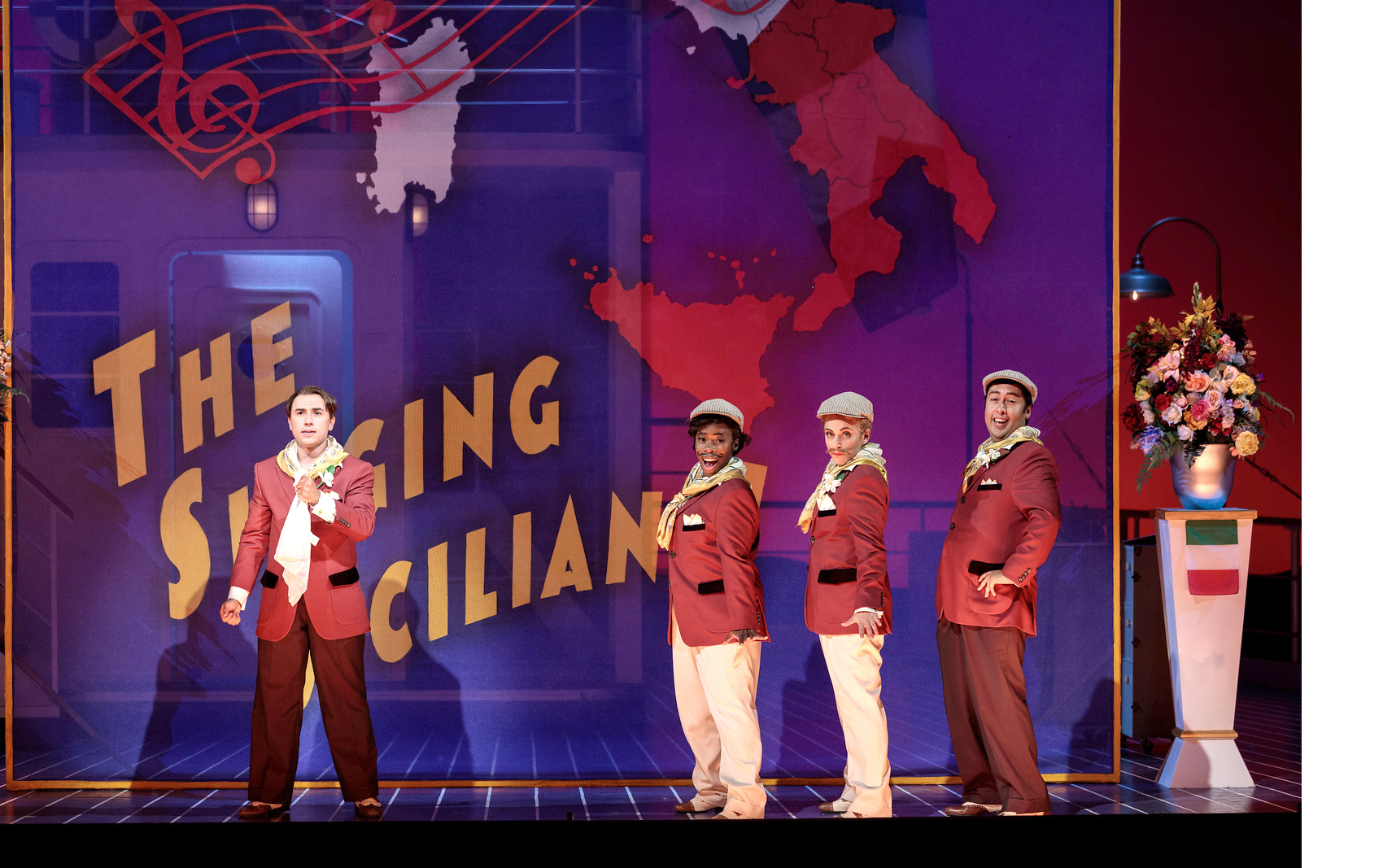
THE IDEA OF A JUKEBOX OPERA using Rossini’s music is a terrific one – so good, in fact, that the world-premiere production of Tenor Overboard at the Glimmerglass Festival left me wishing for more. I don’t think the piece went at all far enough in exploring the possibilities, yet it’s a good-enough production that it may seem sufficient to many.

Fran Daniel Laucerica as Dante, Jasmine
Habersham as Mimi, Reilly Nelson
as Gianna and Armando Contreras
as Luca. Photo: Karli Cadel/
The Glimmerglass Festival
The conceit is to get a handful of quarrelsome characters aboard a steamship bound for Italy, so that they may sort their differences in this classically confined space. Thus daughters Gianna (Reilly Nelson) and Mimi (Jasmine Habersham) are fleeing their overbearing father, Petronio (Stefano de Peppo) and end up winning places in a vocal quartet suddenly (and way too conveniently) shy a pair of members.

We began with a rousing version of the overture from La scala di seta, proving again that music director Joseph Colaneri and the Glimmerglass Festival Orchestra are potent forces, sending a rich, focused sound into the acoustically benevolent Alice Busch Opera Theater – and an especially great treat after last season’s lawn performances with piped-in music.

As an opera recital, Tenor Overboard succeeds brilliantly. Giving singers with excellent voices a best-of menu of Rossini arias and ensemble pieces all but guarantees a lovely experience. But there were two shows going on here, each in a different language. The plot, such as it was, was performed in English; the musical portions switched to Italian. Thus, as we learn of Petronio’s frustration with his independence-seeking daughters, he sings an aria (“Il lamento di Petronio”) drawn from the Thieving Magpie’s “M’affretto di mandarvi i contrassegni,” but re-lyricked for the occasion.

Friday, July 22, 2022

An Experiment With Policeman Hogan

Guest Blogger Dept.: Stephen Leacock insists that he’s been overlooked. No longer shall I allow this indignity to continue, so here’s one of his Literary Lapses, drawn from his first collection of essays. It also ties in with one of my most-consulted blog pieces, wherein I described my brush with noted graphologist Carlos Pedregal.


MR. SCALPER SITS WRITING in the reporters’ room of The Daily Eclipse. The paper has gone to press and he is alone; a wayward talented gentleman, this Mr. Scalper, and employed by The Eclipse as a delineator of character from handwriting. Any subscriber who forwards a specimen of his handwriting is treated to a prompt analysis of his character from Mr. Scalper’s facile pen. The literary genius has a little pile of correspondence beside him, and is engaged in the practice of his art. 

Outside the night is dark and rainy. The clock on the City Hall marks the hour of two. In front of the newspaper office Policeman Hogan walks drearily up and down his beat. The damp misery of Hogan is intense. A belated gentleman in clerical attire, returning home from a bed of sickness, gives him a side-look of timid pity and shivers past. Hogan follows the retreating figure with his eye; then draws forth a notebook and sits down on the steps of The Eclipse building to write in the light of the gas lamp. Gentlemen of nocturnal habits have often wondered what it is that Policeman Hogan and his brethren write in their little books. Here are the words that are fashioned by the big fist of the policeman:

“Two o’clock. All is well. There is a light in Mr. Scalper’s room above. The night is very wet and I am unhappy and cannot sleep—my fourth night of insomnia. Suspicious-looking individual just passed. Alas, how melancholy is my life! Will the dawn never break! Oh, moist, moist stone.”

Friday, July 15, 2022

Summer Sides

From the Food Vault: It’s outdoor dining weather, and Metroland magazine used to devote an annual issue to the topic, wheedling ad dollars from businesses with any possible association to that topic. Here’s my contribution to a 2000 issue.


OUTDOOR DINING AT MY HOUSE invariably revolves around the grill, but we don't limit our party meals to the traditional menus of chicken and ribs, burgers and dogs. Sometimes the sides can steal the show.

Photo by B. A. Nilsson
Good side dishes require preparation. Anyone can slop mayo onto a mound of macaroni and call it salad, but why not enjoy a dish that lights up the palate? Here's the first tip: Make your own mayonnaise. There's no comparison between homemade and store-bought.

At heart, it's an oil and water emulsion, the water derived from an egg yolk, and lemon juice or vinegar. The egg yolk is also the emulsifier, binding the oil and water. And what your mayonnaise will include, unlike commercial types, is good olive oil (or, at the least, canola oil – try to stick with a monounsaturated oil, which is better for your health).

Food processor mayo is a dream to make. You drop in ingredients, whirr, and it's done. I get my eggs from a private source, and don't worry about salmonella; if you're concerned, do the first part of this over a stove to get the yolk mixture to a salmonella-killing 160 degrees for one minute.