Search This Blog

Friday, March 28, 2025

The Once and Future Ormandy

THREE MASSIVE BOX SETS have given us nearly 300 CDs of Eugene Ormandy conducting the Philadelphia Orchestra in recordings made between 1944 and 1968, which is the entirety of his recordings for the Columbia label. Ormandy decamped to RCA, according to a 1967 New York Times piece, with mixed feelings, laying the decision at the feet of the orchestra’s board. But, according to the article, Columbia’s then-president Clive Davis “indicated that a dispute over the repertory Mr. Ormandy had been permitted to record figured heavily in the split.” The article finished with Ormandy recalling his earlier years with RCA, implying that he had more freedom then.

We had a look at what’s almost the earliest of Ormandy as a conductor with the 11-CD box of Minneapolis Symphony recordings, presenting an astonishing amount of repertory recorded in January 1934 and January 1935, including a terrific Mahler 2. Now we can explore the conductor’s first steps with the Philadelphia Orchestra, where he succeeded Leopold Stokowski on the podium – as thankless a challenge as could be imagined.

Stokowski, after all, was handsome, dynamic, and relentlessly charming, probably the only symphony conductor ever impersonated by Bugs Bunny. And he’d shaped the orchestra into an ensemble that easily sat alongside the bands in Boston and New York. Ormandy co-conducted for a couple of years before taking over the job completely, and the two co-recorded during that time as well. (Sony should consider issuing a box set of Stokowski’s Philadelphia work.)

Friday, March 21, 2025

Finish Lines

ONE OF THE STANZAS of “Crooked Foot Lane,” the opening track of Amy Engelhardt’s new album “Finish What,” runs

Downloaded directions / How to escape / Wrapped all of his fractures / In surgical tape

and is part of a compact paean to aspects of disability and acceptance. But the phrase “surgical tape” has a special resonance here. Engelhardt’s lyrics carry the incisiveness of a surgical operation, and I’m mired in enough of the past to decide that the tape in question could also be a strip of magnetic recording tape, once the usual vehicle for an audio recording.

In which case this entire collection of eight songs and an instrumental could be filed under “surgical tape.” The lyrics pierce more skillfully through the epidermis of our emotional lives than I’m accustomed to encountering, even as they dance to catchy tunes presented in inventive arrangements – and there’s a story behind that that we’ll get to shortly.

Engelhardt harbors an impressive nexus of talent, developed as she went from musical-theater kid to in-demand singer to songwriter to playwright/performer. A recent manifestation of the last-named is her solo show “Impact,” which I saw at the Edinburgh Fringe Festival and wrote about here.

Friday, March 14, 2025

Lash Resort


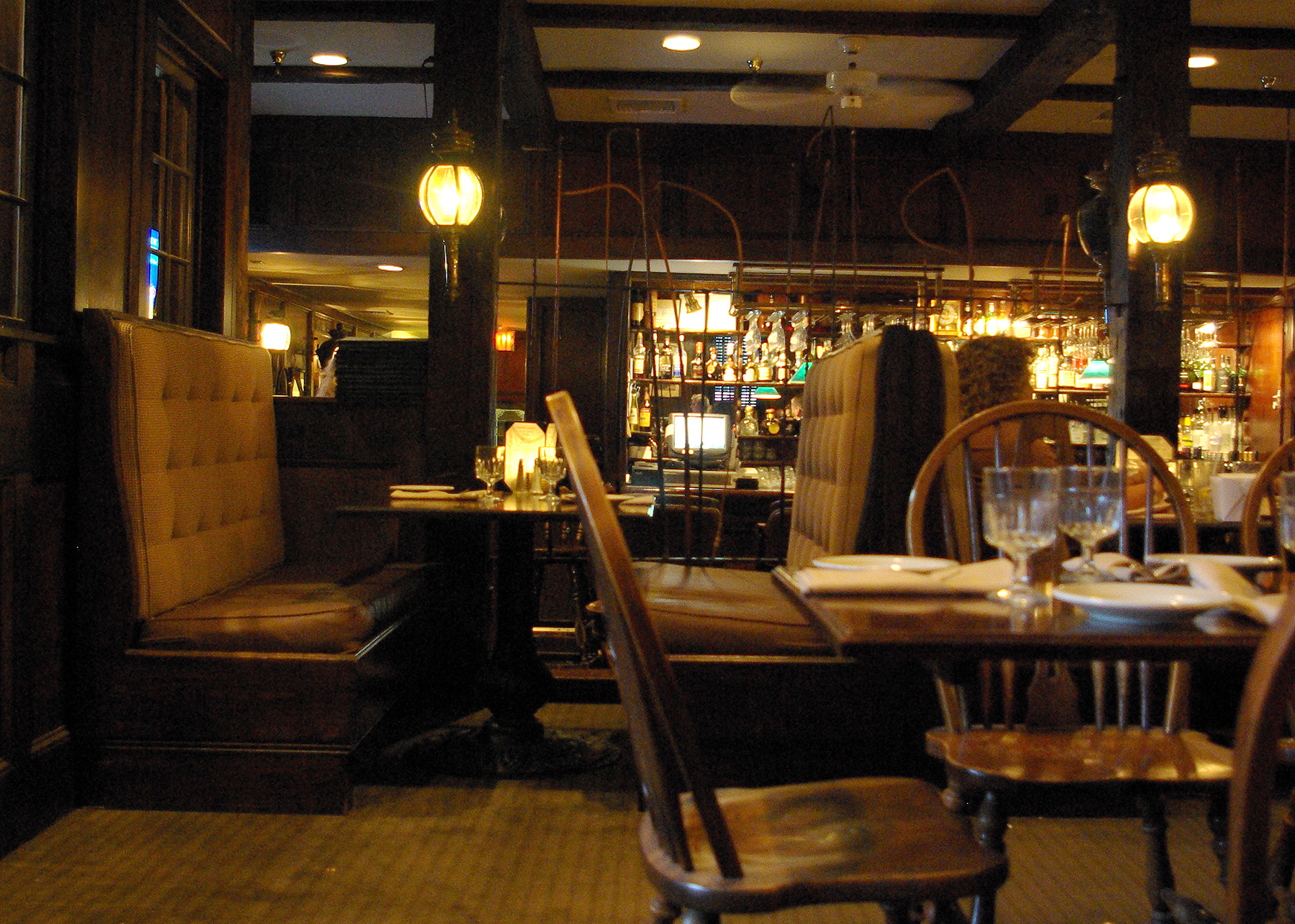
From the Food Vault Dept.: Speaking of Vermont, as was the case with the last two posts, here’s a journey back some 17 years to revisit the piece I wrote about The Whip Bar & Grill, a restaurant at Stowe, Vermont’s Green Mountain Inn. It’s still in business, although no longer serving lunch. Keep in mind the menu and, especially, prices have changed since I wrote this piece. But don’t let it affect your appetite.


DRIVE UP STOWE’S MOUNT MANSFIELD (or, if you have a constitution more rugged than mine, bicycle or walk) and, when you near the peak, clamber in and around the paths and boulders that constitute Smuggler’s Notch. Imagine the forbidden cattle being herded over that mountaintop, cattle from Canada, forbidden because conflict with Canada-friendly Britain was a defining feature of early 19th-century politics.

And agriculture was a defining Stowe industry, and politics be damned: cranky Vermonters needed their animal trade.

Mt. Mansfield dominates the town: it’s the highest peak in the state, and has given rise to the tourism upon which the area now thrives. Hikers, campers and, especially, skiers show up when it’s warm or cold; foliage draws tourists in fall.

Lodges humble and swanky flank the road to the mountain, but in the center of the charming village of Stowe sits the Green Mountain Inn, one of the first structures listed on the National Register of Historic Places, with an 1833-vintage building at its heart. Other buildings have been added over the years, and the complex now offers tasteful accommodations ranging from a single queen bed to a two-bedroom, multi-story townhouse – over 100 rooms in all.

Friday, March 07, 2025

Latchis Past and Present

USUALLY WHEN A KID RUNS OFF with the family money, it’s for a nefarious purpose. We expect the kid to come to no good, to crawl back, if he’s lucky, and beg forgiveness. This was not the fate of Peter Latchis. His father, Demetrius, emigrated from Greece to New Hampshire at the start of the last century, operating a pushcart from which to sell produce. He grew his enterprise and did well enough to amass a tantalizing amount of cash. His son suggested that the family invest in the up-and-coming film industry. Dad refused, so Peter took it on his own initiative to help himself to some of that money and build a movie theater, opening it as the country (and the movie business) entered the no-holds-barred 1920s.

The theater was enough of a success to inspire the family – Peter had six brothers – to build more, eventually running a chain of 20 of them throughout New England, along with hotels and restaurants. And movies were a good business: Despite the Wall Street crash of 1929, the family remained financially unscathed.

In 1938, the Latchis brothers opened a grand memorial to their late father in Brattleboro, Vermont. It was what they termed “A Town within a Town All under One Roof,” including a hotel, restaurant, ballroom, and a lavish 700-plus-seat theater. The first movie shown there was the Sonja Henie comedy “My Lucky Star,” but the theater was designed to host live entertainment as well; among the performers were the Trapp Family (pre-”Sound of Music”), pianist Rudolf Serkin, all the big-name big bands, singers from the Metropolitan Opera, and, more recently, Don McLean, Roger McGuinn, Al Di Meola, the Brattleboro Concert Choir, the Windham Philharmonic, Paula Poundstone, and even operas by Wagner.

Friday, February 28, 2025

Getting Sirius at The Latchis

DATING, AS IT DOES, FROM 1938, Brattleboro’s Latchis Hotel is the kind of small-city gem that was built to welcome big-city escapees seeking a rural(ish) retreat without sacrificing the luxuries to which they were accustomed. The luxuries are still here, even if the guests now arrive by car instead of train. And the hotel is also host to three theaters that offer first-run and specialty films as well as live performances.

The hotel’s International Music Series presented the Sirius String Quartet in its Main Theater tonight, an ensemble that has been around since 1994 and quickly evolved a personality that bypasses the mainstream quartet repertory in favor of personal expressions and explorations. “We write and arrange our own music” cellist Jeremy Harman explained as the quartet took us through a program much of which is featured on their new CD (and streaming collection) “Incantations,” which I’ll get back to in a few paragraphs.

My wife insists that she found a soothing aspect to the concert, but she’s much better than I am at taking music at face value. I’m busily trying to untangle structure and harmony as I seek to contextualize what I’m hearing in a framework in which the music of this ensemble will never fit. They’ve collected elements from free jazz and Eastern Europe and vintage pop and more and synthesized them into sounds that test the limits of their instruments.

Friday, February 21, 2025

Ormandy Reigns Supreme - Again

FROM THE OPENING MOMENTS of the first CD in this collection, Bach’s “Easter Oratorio,” you’re whisked back to a time before historically informed performances roamed the land. It was recorded in April 1963, a year after Nicholas Harnoncourt’s Concentus Musicus Wien made its debut, but well before those arrow-like violin bows and valve-less brass spread into mainstream concert halls and recordings. With the HIP sound firmly tamped into my ears, I was shocked by the size of the orchestra and the operatic aspect of the soloists. Yet, if we were to hear this work at all back when it first was issued, this is how it would sound.

Massive orchestral forces do not diminish Bach’s music, nor do such beyond-reproach singers as Judith Raskin and Maureen Forrester. With this in mind, skip ahead to Ormandy’s recording of the “St. John Passion,” again with Raskin and Forrester, again with the mighty Philadelphians (and cover art by Paul Davis). The strings play hypnotically as one – as they do throughout the recordings in this set – and the Columbia engineers were able to mic the brass and winds to give them a stunning presence.

This is the second of Sony’s Columbia Stereo Collections devoted to Ormandy, and the third large set when you count the 120-CD set devoted to mono recordings. This present set, a long box of 94 discs, runs from 1964 to 1983, although that’s a bit disingenuous. The recordings in this set actually run from 1961 to 1968, with some languishing until 1975 for release.

Friday, February 14, 2025

The Free Lance

THERE’S A REJOINDER common to gigging freelance musicians, when invited to play a job for no money but with guaranteed “exposure”: “People die of exposure.”

I’ve had my share of such entreaties. I was naive enough – oh, let’s just say stupid enough – to think there might be credibility in that offer. There never was. It was just a horseshit move by a promoter or head of an entertainment committee or other such booking agent figuring that the place to save money was on the performers.

Because it’s tough to get catering on the cheap, and printers and other event-adjacent workers don’t make a habit of cutting their fees for the magic allure of “exposure.” By extension, of course, plumbers and electricians and other similar professionals have to make a living off what they do – but when it’s some manner of entertainer being considered, there’s a too-prevalent mindset that doesn’t take that seriously as a career choice. If you’re a professional in an entertainment field, I’m preaching to the choir. If you’re the kind of asshole who seeks to short-change your gig-workers, I’ll never convince you.

As I noted here a couple of weeks ago, I pursued a kind of literary piecework forty years ago, writing arts-related stories for Albany, NY-area publications. It started when a touring production of “Sweeney Todd” arrived at Proctor’s in Schenectady and I couldn’t afford tickets. I had a failed marriage (but remained married) and a new girlfriend. I was working the afternoon shift for an AM radio station that played second-generation big-band music and easygoing jazz; because of its daytime-only license, I had to shut down the station at dusk, which arrived earlier and earlier as the year waned and meant that my hourly wage paycheck diminished accordingly.

Friday, February 07, 2025

The Vanguard of Classic Swing

“JUST RELAX AND PLAY,” (John) Hammond instructed them. “No engineers in sight, no flashing lights – nothing but music. Only, please keep cigarettes off the piano.” The musicians grinned and began warming up on “I Can’t Get Started.” “This is the rarest kind of jazz today,” (Nat) Hentoff informed us as we followed him and Hammond to seats in the middle of the hall. “These guys are caught in no man’s land, somewhere between the people who think jazz died with Johnny Dodds and the people who think it began with Stan Kenton.”

Thus wrote Lillian Ross in a New Yorker “Talk of the Town” piece, profiling a session that took place on July 1, 1954. John Hammond had become a busy man at this point, simultaneously helping to organize the inaugural Newport Jazz Festival that summer (it debuted on July 17) and continuing his work as a music critic. He’d just come from six years as vice-president of Mercury Records, where he recorded both jazz and classical artists, and a failed Benny Goodman-Louis Armstrong tour (the two leaders decided they didn’t get along).

But Hammond’s five years at Vanguard offers a snapshot of an underappreciated time and place in the history of jazz. Hammond was a fan of swing, and his earlier efforts had brought Benny Goodman and Fletcher Henderson together, and had helped raise Count Basie’s band from a provincial group into national fame, so it was natural for him to bring to the studio players working in that style. By 1953, of course, jazz was surging into other distinctive styles, but the first Vanguard session featured swing veteran Vic Dickenson as leader of a group of sympathetic sidemen.

Trombonist Dickenson, who had played with Benny Carter, Count Basie, and Eddie Heywood, among many others, was a busy freelancer at this point. He answered Hammond’s invitation by assembling septets for two sessions that included Ruby Braff, Ed Hall, Sir Charles Thompson, and Walter Page, among others. Jo Jones reunites with Basie bandmate Walter Page for Dickenson’s session two.

Friday, January 31, 2025

Stage Directions

From the Vault Dept.: Who doesn’t occasionally succumb to thoughts of “what was I doing ten years ago at this time?” Or twenty. Or, in the case of what’s printed below, forty. Forty! I was previewing and reviewing theater for Albany’s Metroland magazine under the name George Gordon (a literary joke) because the Albany Knickerbocker News, for which I also was writing, demanded exclusivity – an arrogant demand when you consider that they started out paying me twenty bucks per review. I’ll deal with that topic in a subsequent post. Here’s what appeared in Metroland under my phony byline exactly two score years ago.


Shrew, Quilters to Open
by George Gordon

THEATER FOR 1985 SWINGS INTO HIGH gear this weekend with three openings by local groups and a stop at Proctor’s by a national tour.

Martha Schlamme
On Saturday, the Empire State Institute for the Performing Arts will hold a gala opening for Shakespeare’s “The Taming of the Shrew,” (which he was reportedly inspired to write after seeing Cole Porter’s “Kiss Me Kate”). The opening is to benefit the scholarship fund of Citizens for ESIPA.

“This will be a special sort of happening,” said Elisabeth A. Ruthman, president of the group, “with magic, music, juggling, food, wine, flowers, and an auction.” Flower vendors and bread peddlers have been brought in from 15th-century Italy to work the lounges of the Egg; there will be performances by juggling team Brussels and Sprout (which hails either from Belgium or the Valley of the Jolly Green Giant), magic by Jim Snack and song by the SUNYA Chamber Singers. Also on hand: a selection of foods, including gourmet cheeses.

The play itself, directed by Terence Lamude, is described by the director as being “very modern –  but I’m not trying to wrench it into the present. It’s set in 1455 during the early Renaissance.” Although often regarded as nothing more than a dramatic tribute to misogyny, Lamude has promised that his version will reveal the play’s true intent: to depict the mutual taming of Kate and Petruchio.

Friday, January 24, 2025

Civilization ... Dies with Chaos

ACCORDING TO Dmitri A. Borgmann’s 1967 book Beyond Language, the most likely explanation for the “the” in front of “The Congo,” was that it, like “The” Sudan, “The” Transvaal, “The” Ukraine, and other such definitely articled locations, was once a site of imperialistic adventure – “patriotic adventure,” as Borgmann wryly puts it, especially as advanced by the British.

In the case of “The” Congo, it was Belgium or France that did the adventuring, depending on which Congo you have in mind. The former French territory, which lies northwest of the Congo River, is now  Republic of the Congo or Congo-Brazzaville. Its larger neighbor to the east is now the Democratic Republic of the Congo or, simply, Congo. That area had been seized in 1885 by King Leopold II of Belgium, who named it the Congo Free State even as he carried out typically brutal aggressions against its natives while helping himself to its abundant natural resources.

In 1908 it was annexed as a Belgian colony. Like so much colonialization, this was rationalized as being good for the natives even as the rubber exports enriched the mother country – and would continue to prove enriching through two world wars. Alongside which uranium, which had been discovered in Shinkolobwe (southern Congo) in 1915, became far more vital, first to the failed German nuclear program, then in the Manhattan Project and all subsequent bomb-building in the U.S.

*

Friday, January 17, 2025

Jazz manouche

 MY GRASP OF FRENCH is tenuous, and that puts it generously. I’m good at classic French dishes and ingredients and the titles of Debussy songs, alongside enough tourist-type phrases to get me in trouble should I ever land in downtown Paris. The thing is, though, that I wish more than anything to visit downtown Paris, not to mention other choice areas of France, and to that end I’ve been trying to teach myself the language. I’ve been using print and online resources, which is how it came to pass, a year or so ago, that the moon and the stars and the YouTube algorithms lined up to suggest videos of Tatiana Eva-Marie and the Avalon Jazz Band.

Gabe Terracciano, Max O’Rourke (hidden),
Tatiana Eva-Marie, and Wallace Stelzer.
Photo by B.A. Nilsson
And you know, if you’ve found her too, this becomes an addictive pursuit. Her singing is so endearing, so effortless, that I forget that I don’t know the words. And her musicians are extraordinary. They’re following the tradition of Django Reinhardt and Stephane Grappelli and their legacy at the Hot Club of Paris, who gained a national following performing a mixture of gypsy music and swing. Tatiana was born in Switzerland to a violinist mother and composer father, and she grew up there and in France before settling – where else? – in Brooklyn.

Caffè Lena in Saratoga Springs, NY, is presenting a series of events, the Bright Series, aimed at bringing reputable performers to the café who’ve never appeared there before. It turned out to be a wonderful venue for Tatiana Eva-Marie and the Avalon Jazz Band, who presented two sets there on December 5. “Je t’aime,” the opening number, is Reinhardt and Grappelli’s “Swing 39" with lyrics by Jacques Larue, originally championed by Irène de Trébert and perfectly suited to Eva-Marie’s seductive style.

Friday, January 10, 2025

Small-Group Victories

SO MUCH MUSICAL WEALTH bursts from the grooves of Mosaic’s 11-CD set of jazz V-Discs that you’ll be forgiven for forgetting that the 263 sides presented herein are but a fraction of what was offered during the V-Disc era. But what’s here has been carefully chosen to fill those discs with the best small-group jazz that you were likely to hear in New York and, to a lesser extent, Los Angeles between 1943 and 1948.

The artists alone should inspire you to reach for your wallet. They include Louis Armstrong (briefly), Jack Teagarden, Nat King Cole, an Eddie Condon unit, Bud Freeman, Hot Lips Page, Teddy Wilson, Art Tatum, Fats Waller, Bobby Hackett, Meade “Lux” Lewis, Hazel Scott, André Previn (wearing his jazz hat, of course), John Kirby, Woody Herman, Bob Haggart, Gene Krupa, Red Norvo, and Lennie Tristano. Vocalists include Martha Tilton, Connee Boswell, Jo Stafford, Mildred Bailey, and Ella Fitzgerald. A charming bonus is that, per the V-Disc tradition, many of the session leaders introduce one or more of their discs, although that task also was jobbed out to such other showbiz talent as Eddie “Rochester” Anderson, Phil Harris, and Red Skelton.

What’s extra significant about the first year of V-Disc sessions was that no commercial recordings were being made in the U.S. at that time, a story that makes some of these discs all the more special.

Friday, January 03, 2025

Tell Me What You Eat

THE FINEST FOOD MOVIE probably of this or any other century sneaked into release last year, obscured, as is too often the case, by the blood and bombs and general nastiness that seems to attract a contemporary audience. I can’t say for sure; I quit those ranks decades ago. Right around the time I began cooking professionally.

And that’s part of the appeal of what’s been Englished as “The Taste of Things,” although the novel from which it drew inspiration is titled La Vie et la passion de Dodin-Bouffant, written by  Marcel Rouff in 1924, itself Englished as The Passionate Epicure. We’ll get back to that.

If you’re a passionate cinéaste, you already have your favorites. If your list is topped by anything other than “The Taste of Things,” it means only that you haven’t seen that movie yet. I have no argument with the superior nature of “Big Night” (1996), which previously topped my list, followed closely by “Tampopo” (1985) (and look for co-star Kôji Yakusho in the recent “Pleasant Days”), “Babette’s Feast” (1987), and “A Chef in Love” (1996), which boasts convincing work of versatile comedian Pierre Richard, himself a restaurant owner.

Thursday, December 26, 2024

Santa's Little Yelpers

From the Holly-Bedecked Vault Dept.: Here’s a Metroland piece from 1990, posted on this blog in 2011 (I’ve been at it that long?) and encored here because it’s the season and I can’t think of a more appropriate way of re-celebrating. Besides, it’ll score me points with my wife, which can be helpful if my gift-giving proves to fall short. Yes, those are the pooches that shared my household 34 years ago.


MY PARENTS FORCED ME into a photo session with Santa when I was four and I have resented them for it ever since. The traditional revenge, of course, is to inflict the punishment on your own children, but I haven't got any. So when the Clifton Country Mall announced its second annual “Pet Day with Santa,” it seemed like a good opportunity to give the brutes a road trip and sooth my damaged sensibilities.

Asta and Bud with Santa
Photo by Meera Shankar

It also would answer an important question: Who in their right minds wants to wrestle a beast into Santa's lap? The cruel truth is that, holiday mangers notwithstanding, animals care nothing for Christmas.

Malls are traditionally petless places and we felt very out of place leading our animals through the corridor. Bud Collyer, my two-year-old black Labrador, has never been taught to walk on a leash and zigzagged in front of me as he chased what must have been some splendid smells. Susan led Asta, an eight-month-old mix of Australian Blue Heeler and neighborhood hound.

This was the dog that barked at the occupants of every passing car, with special eagerness at stop lights. She barked at the people in the mall; she even barked at her own reflection in the shop windows.

Friday, December 20, 2024

Ives Gets You Under His Skin

THE HUNDREDTH ANNIVERSARY of the birth of Charles Ives was celebrated in and around Danbury, Connecticut, where he was born and raised and eventually settled. These celebrations took place in 1974. I was a year out of high school, living one town south. My exposure to Ives’s music was probably more robust than that of my coevals, but we had a hip high-school music teacher, Joe Celli, one of whose adventurous programs was a concert that included a multimedia presentation of “The Unanswered Question.” I played amidst a terrified section of fellow violinists, our fingers way the hell up on the E string, offering, as the composer put it, “The Silence of the Druids, Who Know, See, and Hear Nothing.” It’s one of Ives’s most-accessible works, a terrific introduction both to his music and his way of thinking, and two recordings of it are part of the 22-CD RCA and Columbia Album Anthology, focusing on what those labels issued on LP between 1945 and 1976.

Although Ives’s music was known, during his lifetime, to a few fellow-composers like Henry Cowell and performers like pianist John Kirkpatrick, it was otherwise neglected. By the early decades of the last century, the classical-music audience had been conditioned to seek pleasant-sounding works in the European tradition, although even Debussy had a struggle. A concurrent splinter group, primed by Stravinsky, began supporting the outré experiments of Schoenberg and his followers, and this flowed into Academia. Insecure critics (and critics are always nervous) took up the atonal cause and we sailed through the mid-20th century under the misapprehension that Tchaikovsky and his ilk were old hat, while atonal and aleatory music was the stuff that smart people enjoyed. Even Stravinsky wandered into twelve-tone territory.

Friday, December 13, 2024

Passages to Marseilles

A VISIT TO FRANCE is high on my agenda, and it has to include a stop in Marseilles. I’m prepared to be disappointed – I take it for granted – because my expectations have been honed by three movies written by Marcel Pagnol and filmed between 1931 and 1936, which places the first of them right at the advent of sound. And that’s what inspired successful playwright Pagnol to expand into cinema. Like Sacha Guitry, his compatriot, who also was an acclaimed playwright, Pagnol wasn’t interested in the medium until it included his own particular medium: words.

Pierre Fresnay and Orane Demazis
Which led to the accusation, especially after World War Two, that Pagnol’s movies were merely filmed plays, static and therefore uninteresting. The same criticism was lobbed at Guitry; not coincidentally, both Guitry and Pagnol were accused and subsequently cleared of being collaborationists with the occupying army during the war. Passions ran high!

Toward the end of the 1940s, Francois Truffaut spearheaded a critical reassessment of Pagnol’s work, but the effort was dampened by the lousy quality of what prints of those films were still available. Over time, however, a new generation of filmmakers, like Bertrand Tavernier, helped spark a greater resurgence of interest and even, eventually, the restoration of Pagnol’s most-important titles.

Friday, December 06, 2024

Hello, He Must Be Going

IT WAS ONLY AFTER I watched some Marx Brothers imitators at work that I realized there was a quality about the original quartet that’s impossible to reproduce: the sense of family that the brothers shared. They’re in character – they were always in character when in the public eye – they’re in situations that place them at odds with one another, yet you sense a special attachment, an easy familiarity. A bond that was set in place as their ambitious mother sent them, five brothers in various combinations, through the rough-and-tumble world of vaudeville, which would culminate in Broadway and Hollywood. Which makes the Zeppo paradox all the more poignant.

He was the youngest of the five, born Herbert Marx in 1901. Leonard (Chico) was 14 when he was born; Julius (Groucho) and Adolph (Harpo) were two and four years younger than Leonard. Milton (Gummo) was born in 1892. The oldest three were soon enough established as a working unit, but mother Minnie wanted “The Four Marx Brothers” on the bill, so Milton was conscripted into service.

The original foursome acquired their nicknames in 1914 thanks to a fellow-vaudevillian named Art Fisher, who came up with the monikers during a poker game. When queried about their switch to these names, Groucho responded, “We want to be different and attract unusual attention.” Herbert acquired his nickname three years later, and the most plausible story behind it was his resemblance to a sideshow performer known as Zip the Pinhead, Zip, in Herbert’s case, soon morphing into Zeppo. He gave other origin stories through the years, suggesting that he wanted to dissociate himself from the freak-show aspect, yet he (along with all his brothers) never stopped using the memorable name.

Thursday, November 28, 2024

Hellenic Hullabaloo

Overindulgence Dept.: It's Thanksgiving again, and, although I swore I wasn't going to spend several days in menu planning and meal preparation . . . well, you can see the menu below. And there's a slide-show of past menus here. Just don't expect this again next year.


Friday, November 22, 2024

Cutting Classical

From the Classical Vault Dept.: I’ve grown much more hopeful about the state of large orchestras in the 32 years since I wrote the piece below. For one thing, the survivors are holding their own. Adventurous programming has very much increased, and the efflorescence of social media and alternative music distribution systems have, so to speak, spread the word. On the other hand, as the pandemic years proved, salaries for orchestral musicians are abysmal and some of those players are hanging by a thread. As for the Albany Symphony, my daughter is now working for that outfit, so I’m glimpsing more of its viscera than had been the case before, and I like what I’m seeing. And hearing, of course.


WATCHING A LARGE ORCHESTRA fold up and die is like seeing a stately old mansion collapse: You know it’s irreplaceable, and that with its demise goes a taste of the era in which it was built.

In our general area, we’ve seen recent season cancellations by the Syracuse and Hartford symphonies, and the Albany and Utica orchestras are doing pretty badly. But the problem is hardly confined to this region.

And it’s hardly surprising. Federal and state arts support has long carried the burden of supporting these musical behemoths, and that support has all but dried up. The audience for these orchestras is small, and even though it comprises an area’s wealthiest, to carry the brunt of the financing would force these folks to pay, in effect, hundreds of dollars a ticket to see their favorite ensemble saw through another all-Tchaikovsky evening.

In other words, the orchestras are now being forced to confront the fact that nobody—no appreciable majority, that is—really wants to hear them. The sooner they acknowledge this and bow out of existence, the sooner classical music stands a chance of coming back to life in this country.

Friday, November 15, 2024

On the March – Again

From the Pages of History Dept.: I blog-posted the piece below more than a decade ago, by which time they had become footnotes to an admirably sane settling-in of society – or so it seemed to naive me. The forces of horrific paternalism were arming themselves, so that soon the Supreme Court could be stacked with its worst-ever appointments by our worst-ever President. And, sure enough, Roe v Wade was overturned and women are once again dying because their reproductive rights are denied. With the clown car about to pull up to the White House once again, I’m reposting this piece as a reminder that our most important duty now is to resist the hopelessness that comes with so awful a political fate as this country soon will suffer. It’s my report on the March for Women’s Equality and Women’s Lives that took place in Washington, D.C., on April 9, 1989.


Photo by Michael Ackerman
“FREE BARBARA BUSH!”

It became the surprise rallying cry of the march, as a crowd estimated at between 300,000 and 600,000 chanted the slogan from pedestrian-packed Pennsylvania Ave., Constitution Ave., 1st St., 3rd St. and the steps and lawn of the Capitol itself.

 The march offically began Sunday morning on the north lawn of the Washington Monument, but for many Albany-area residents, the march began late Saturday as they boarded buses sponsored by local affiliates of the National Organization for Women, the National Abortion Rights Action League and Planned Parenthood.

At 10:30 PM, three Greyhound buses idle their engines in a parking lot at the State Office Campus. During the next few minutes the scene resembles a workday morning as car after car arrives, parks, unloads. Just as it seems that the crowd will overwhelm the bus capacity, six more buses pull in and circle the lot in formation before joining the caravan. There’s a happy sense of a picnic or vacation, but buoyed by the energy of a crowd met to fight – or, in this case, affirm. The group is varied in age, but there’s an obvious socio-economic homogeneity. These are middle-class buses, carrying a segment of society that has been accused of too much complacency during the past administration.