Search This Blog

Friday, March 31, 2023

In the Neighborhood

From the Food Vault Dept.: We look back twenty years to a Schenectady neighborhood (and a bit beyond) where the city’s Italian heritage was culinarily honored. But there have been changes since I wrote this piece. Garofalo’s closed in 2018, when an internecine family dispute led to its demise. La Gioia Deli closed in June 2022, but a niece of the founders reopened it four months later, so it’s still there to keep you stocked in Italian specialty items. Saddest of all, Cappiello closed its retail store in 2022, after 101 years in business. Perreca’s thrives, however, and Maria Papa not only opened a restaurant next door but also took over management of nearby Cornell’s, a restaurant at 39 North Jay Street.


SCHENECTADY HAS AN AMBITIOUS REVITALIZATION PROJECT on tap that seeks to throw money at various parts of the city to see if magic beanstalks grow. Like the Jay Street pedestrian mall, Center City and the moat around Proctor’s, it probably looks good on paper. But no amount of fancy construction has created a downtown that can sustain a fine-dining restaurant. That’s because there are no people to support it.

A fresh Perreca's loaf emerges
Photo by B. A. Nilsson

Schenectady’s strength has long been its neighborhoods and sense of family, cultivated when the city was a one-company town, now eroded into tiny pockets of such cohesion. One such pocket is the North Jay Street area, now targeted to become the city’s Little Italy.

In truth, it’s been that for a while, although shifting population centers have depleted the neighborhood. The Sons of Italy is headquartered nearby, but what really give life to the area are the markets.

Begin at a small storefront at 33 North Jay St., easy to recognize by the many bread loaves in the window. Inside, if you visit early enough in the day, you’ll be drenched in the yeasty aroma of the emerging batch. Breadmaking technology hasn’t changed much over the past centuries, and part of Perreca’s success is its simplicity: a couple of ingredients, hand-formed loaves and a trip through the coal-fired oven.

Friday, March 24, 2023

Iberian Melodies

From the Concert Vault Dept.: 81-year-old Jordi Savall is still going strong, still exploring corners of the musical world typically neglected by the classical, folk, traditional, jazz – you name it – worlds. He ties together ancient musical trends in an attempt to remind us that peace and harmony are the default pursuits of the human race. He should have won a Nobel Peace Prize decades ago. Here’s my 2007 review of an appearance he and his ensemble made at Tanglewood.


THE FLORENCE GOULD AUDITORIUM is a lovely, lively venue in handsome Seiji Ozawa Hall, itself overlooking one of Tanglewood’s lush lawns. Folks in the very full house were obviously pleased with the performance, but this wasn’t really the place for the program presented by Jordi Savall’s Hésperion XXI.

Jordi Savall and members of Hésperion XXI
“The Sephardic Diaspora” gave us a rich series of songs, both instrumental and vocal, from one of the richest musical melting pots of antiquity – 15th-century Iberia. The songs are plaintive, sometimes sarcastic, always deeply affecting, characterized by a melisma-rich minor-key modality.

Which is why this concert should have been given in a blues club. And when percussionist David Mayoral got two or three drums going, his fingers a blur over the different-sized skins as in “Nastaran,” a song from Sofia, we’d clearly settled into a boozy, late-night groove.

Friday, March 17, 2023

In a Terrific Jam

NINE CONCERTS; 31 jazz legends; 86 different songs; twelve hours of music on ten CDs. The statistics are staggering. These are the long-neglected 1950s Jazz at the Philharmonic concerts that Norman Granz presented, by then following a well-worn formula that had served him since 1944. That’s when he conceived the idea of putting his favorite jazz musicians on stage in a jam-session setting, which proved successful both in concert and on record.

As John McDonough’s exhaustive liner notes point out, the initial six years were documented in a 10-CD set issued in 1998 by Verve (a label Granz founded). It’s out of print, but a decent copy won’t bankrupt you. Once a Mosaic set goes out of print, however, the price tends to skyrocket, so if you have neither, I’d start with this one. True, you won’t have Billie Holiday or Charlie Parker or even Charlie Ventura, but ‘40s JATP veterans Coleman Hawkins, Charlie Shavers,  Bill Harris, Illinois Jacquet, Flip Phillips, Hank Jones, Ray Brown, and Jo Jones are all here. And Oscar Peterson, who was just dipping his toe in the JATP water in 1949, plays his butt off on most of the sessions in this Mosaic set.

The recordings are drawn from nine concerts given at venues ranging from Carnegie Hall to the Hollywood Bowl. As the box-set title reminds us, these are “Classic,” not “Complete,” a distinction that gives Mosaic latitude to cherry-pick the best of a bunch. And ownership issues prevented including all or part of some of the 1950s JATP concerts. Granz originally issued much of this material on labels he created but ultimately sold, and those sales seem to have gone every which way.

Friday, March 10, 2023

Over the Moon

From the Food Vault Dept.: Against all odds, this unique little restaurant endures. It’s a world unto itself, offering creative vegan and vegetarian food choices in a place where you will like as not end up chatting with your table-neighbors – if you’re not digging the live music that’s a regular feature. Not a lot has changed since I wrote this piece 15 years ago except the prices. Check them out at this website.


SHORTLY AFTER WE ARRIVED, a spirited discussion broke out at the counter about personal philosophy, reminding me that it’s been a dog’s age since I’ve heard any self-definition beyond “I’m a Mets a fan” or “Yeah, I’m a Democrat. Wanna make something of it?”

Photo by B. A. Nilsson
This discussion soon veered towards food, a natural segue both because of the good food served at Moon & River and because there’s something ’60s-enough about the vibe here that it should inspire one to recall that “you are what you eat.”

Moon & River Café opened three years ago at what was long ago a shabby deli on Front Street in Schenectady’s charming Stockade area. It’s been refurbished to a fare-thee-well and appointed with living room-like furnishings that should remind some customers of a place called Mother Earth Café that once thrived in Albany.

That’s because they’re the same furnishings. “I put them in storage when I closed Mother Earth,” says Richard Genest, “and now they’ve found a new home.” This means that you can sit at tables, at a counter, in an armchair; you can play board games, read the paper. You can observe, as we did, the darkening skies of a summer thunderstorm while nursing a good beverage (my own cup of tea was appropriately soothing, but my daughter’s cup of creamy, aromatic chocolatl ($2, styled as “Aztec hot cocoa with sweet spices”) seemed more appropriate to the changing weather.

Friday, March 03, 2023

The Goose Hangs High

From the Opera Vault Dept.: The Berkshire Opera, in its earliest years, aspired to a Glyndebourne feel. And there were some eight summers of truly marvelous productions in a former chapel on the grounds of a posh resort before the company had to scramble to find venues. Productions remained good, but that Glyndebourne magic was gone. Here’s my review of a double-bill from the company’s second summer that included the first professional production of a Mozart one-act. And you can find the wonderful soprano Maureen O’Flynn mentioned over here as well.


STOCKBRIDGE NATIVE MAUREEN O’FLYNN, now a soprano with the New York City Opera, returned home in glorious voice Tuesday night. It was the opening-night gala of the Berkshire Opera Company, a 2-year-old group whose quality work should herald many more seasons. The audience braved squalls and felled limbs to make it to the Pierce Theatre, where two one-act operas comprised the delightful bill.

Maureen O'Flynn
Mozart’s The Goose of Cairo" is an under-performed gem, complete with father-frustrated lovers and uppity servants and a mechanical contrivance, the titular goose, that threatens to steal the end of the show. This production easily could have been titled “Road to Cairo,” thanks to stage director Thomas Lee Rindge’s Hope-and-Crosby-ish irreverence.

Comic opera is a challenge for the director: how much can be added to the humor of the music and text? Rindge was not afraid to take risks and was probably 90 percent successful.

The plot gives us lecherous old Don Pippo, grumpy papa of Celidora (O’Flynn). As played by Adrij Dobriansky, he has the funny befuddlement of Hugh Herbert, the “woo-woo” man of the old Busby Berkeley films.

Even as he prepares for his wedding to the young Lavina (Judith Gray), Don Pippo flirts with his maid, Auretta (Karen Smith). Naturally, this enrages Auretta’s sweetheart, the servant Chichibio (Vaughan Fritts), whose puffed-out chest seems to achieve more buoyancy the more he gets upset.

Friday, February 24, 2023

The Play’s the Thing

From the Theatrical Vault Dept.: Here’s another orphan piece, orphaned insofar that I can’t find any indication that it ever ran in any of the publications that used to publish me. So I offer it as a snapshot not only of what I chose to write about in 2006, but also the kind of cultural offerings that came to the Albany area – in this case, to a school that badly needed such things.


IT HAS BECOME the most daunting of theatrical roles, one that has enticed and destroyed actors for four centuries. Because the bar is perceived to have risen so high, Hamlet’s famous “To be or not to be” soliloquy is the bane of many an actor.

Tom Wells
Yet Shakespeare’s masterpiece continues to be the most-performed play in the Western world, has been translated into every major language, and has been the subject of dozens of films and operas. The version presented Mon., Feb. 6, at Watervliet High School by Lenox, Massachusetts-based Shakespeare & Co. is a 90-minute, seven-character touring production tailored for use with school groups.

As such, it probably will serve its audiences as a first glimpse of this formidable play and can, in that context, be judged as something of a success. It moves quickly; it held the attention of a restive audience; it played up elements of Hamlet’s character that remain resonant with teenagers.

As a theater piece, this production bears the stamp of Shakespeare & Co. in its kinetic staging and energetic approach to vocal delivery. Too often, however, this energy got in the way of the play. “Speak the speech,” Hamlet is famously quoted, “trippingly on the tongue.” The youthful cast in this production tended to mistake outright yelling for passion, and, instead of tripping, sometimes fell.

Friday, February 17, 2023

This Mulligan is a Gimme

From the CD Vault Dept.: Here’s a trio of CD reviews from 23006 that I found languishing in a single file (computer, that is, not physical) no doubt intended for Metroland magazine. But I don’t think they were published. I find no record of them in my sent-to-Metroland directory. Jazz, old-timey folk, and pseudo-opera are considered. So, in the spirit of exhuming anything and everything to which I put my digital pen, I offer them here and now.


MOSAIC RECORDS has an admirable history of issuing the finest series of jazz compilations you’ll ever want to invest in. They’re a joy to own and listen to, and once each limited-run pressing goes out of print, its collectible value skyrockets. Typically ranging from four to ten CDs in an attractive box with very detailed program notes, they sport about the best remastering I’ve ever heard, and the scope of each defines a particular jazz artist and/or label during a particular scope of time.

Recently they initiated a new line of reissues under the title Mosaic Select, each a three-CD set that focuses on (typically) a more recently active artist. Not as exhaustive in scope as the big sets, they allow more of surgical strike on the artist’s catalogue. Thus we have Art Pepper from 1956, some 1957 Bob Brookmeyer sessions (complementing Mosaic’s now out-of-print Jimmy Giuffre set), live Dexter Gordon club date recordings from 1978-79, plus sets by Randy Weston, Bennie Green and many more – 22 of them as of this writing.

Number 21 fits in nicely with the series, presenting Gerry Mulligan in a number of different settings (and contrasting with Mosaic set no. 221, which features Mulligan’s Concert Band recordings from 1960-62).

Friday, February 10, 2023

Back to the Classics

From the Musical Vault Dept.: Keith Jarrett was a little grumpy when I got him on the phone. This was in 1985, and I called to interview him in advance of his appearance in Troy, NY, playing classical Baroque-era selections. Or maybe I came across as a jerk and pissed him off. Either is a possible explanation as to why I didn’t get very much out of him and resorted to quotes from others to fill out the piece below. Nevertheless, I was looking forward to seeing his performance, but he cancelled at the last minute. Five years ago he suffered a pair of strokes that have ended his performing career. So this remains my only in-person brush with the man, although I unreservedly recommend his recording of Shostakovich’s Preludes and Fugues. I’ve left the piece below in its entirety, including a glimpse of other arts events in the area.


IT LOOKS LIKE an abrupt change of career, but Keith Jarrett’s recent switch to playing the classics is really a sort of coming home for the pianist, whose early studies included rigorous classical training. Referring to this change, Jarrett told one interviewer last year, “It seems sudden, but several years have been involved. I won't call it a shift. It’s more a choice for the music.”

Keith Jarrett
This makes sense when you realize that Jarrett considers himself not so much an improvisor at the keyboard but a voice for the music he plays, leading him to observe, “It’s appropriate for me to play music that already exists. I’m redirecting the same energies.”

On Saturday, Jarrett brings a program of music by Bach, Handel, and Scarlatti to the Troy Savings Bank Music Hall for an 8 PM concert. Those three composers are being feted this year for sharing the same year of birth three centuries ago. Did this fact motivate Jarrett’s programming? “It’s fortunate that this 300th birthday happened at a time when I might have done this anyway. It’s nice to know that it works out. But I also feel, for example, that Handel’s keyboard music needs to be played more often.”

Friday, February 03, 2023

Coca Nuts

From the Theater Vault Dept.: The madcap excesses of the “Barber of Seville” we discussed last week reminded me of a very different, very funny musical: “On the 20th Century.” I saw it in 1987, when the Broadway tour came to Schenectady. The musical opened on Broadway in 1978, where Judy Kaye replaced Madeline Kahn after a few performances, and it made Kaye’s career. Also in that cast was Imogene Coca, the incredibly funny foil to Sid Caesar for so many years. We were fortunate to have both Kaye and Coca in the cast of this tour, as noted below.


THE DROP THIS TOURING COMPANY USES for a curtain has giant postcards painted thereon, as if written on board the Twentieth Century, a train that once connected New York and Chicago. The portraits cleverly used on the stamps are of the songwriters responsible for the musicalization of this vintage play: composer Cy Coleman and librettists Betty Comden and Adolph Green.

Imogene Coca
Might as well be so bold as to display their faces. It needed a team this good to take an already good play and make an entirely convincing musical out of it.

It started as “Napoleon of Broadway” by Bruce Millholland. Charles MacArthur and Ben Hecht fashioned it into “Twentieth Century,” placing the emphasis on board the train.

Comden and Green added lyrics and some dramatic touches of their own, with a Coleman score that is a throwback to the operetta-ish stuff of Jerome Kern’s day.

The spectres of great actors hang over this show. Thanks to the 1934 movie, it’s easy to recall John Barrymore and Carole Lombard as the irascible producer and mercurial star. Which gives Frank Gorshin and Judy Kaye a hell of a tradition to top, but they did so with gusto.

Friday, January 27, 2023

Savoring “Seville”

From the Vocal Vault Dept.: We’re traveling back to 1985, when I was still finding my feet as a music critic, and a brief review I wrote of Texas Opera Theater’s visit to Schenectady’s Proctor’s Theater with a delightful “Barber of Seville.” (And this was before I began complaining about staging an opera’s overture.) The melancholy aspect, in retrospect, is that director James Atherton died two years later of an AIDS-related illness. He was a tenor with the Santa Fe Opera from 1973 to 1978, and made his Metropolitan Opera debut in “Boris Godunov” in 1977. He would go on to sing 277 performances there in a repertory of 17 roles. In recent years, he had branched into directing, of which this “Barber” was a shining example. He was 44 years old and lived in St. Louis when he died, where he served as artistic director of the opera studio at the St. Louis Conservatory. But let’s find him, still alive, in Schenectady.


THE AUDIENCE AT – and cast of –  Thursday night's Texas Opera Theatre production of “The Barber of Seville” had so much fun at Proctor's that it is easy to speculate that this was the kind of presentation that originally boosted Rossini’s opera to the prominence it now enjoys.

James Atherton
The opera was played strictly for comedy, low and high, with the kind of talent and zeal that makes for a great evening at the theatre.

Much of the humor originally was based on what was considered a shocking play in its time: Beaumarchais’s script mocked relations between masters and servants so savagely that productions were banned in parts of Europe. Today, of course, the subject is antiquated into quaintness. Rossini’s score added a magic of its own, and, as the Texas Opera production attests, the potential for enduring fun.

Tenor James Atherton turned stage director for this version, leading the cast through comic turns which might tax the imagination of film director Richard Lester. The scenic design, by Eduardo Sicango, used fans as a motif; fans decorated costumes and stage; there were giant folding fans on each side of the stage; and a large fan-shaped drop served as curtain. During the overture we met the principal characters with a silent commedia dell’arte-style prologue, a delightful use of those minutes.

Friday, January 20, 2023

Gieseking of the Keys

AS A LIFE-LONG INSOMNIAC, I grew up dependent on overnight radio listening to ease the struggle to get to sleep. But you know me. I sought classical-music stations for solace. And, because I grew up in the New York metropolitan area, I had a choice of several. That is, until WNBC-FM abandoned the format, followed pretty much by WBAI. WFUV and WKCR were only sporadically classical by the time I discovered them, and WRVR was bizarrely unpredictable. That left WNYC, which intruded too many public-affairs programs for my taste, WNCN, and WQXR. (There was also Bridgeport, Conn., anomaly WJZZ, profiled here.) And the overnight programming I liked best was anything offered by Bill Watson, a silken-voiced polymath with very specific tastes who gypsied from station to station. (You can hear a recording of him here.)

Watson was particularly fond of tenor Jussi Bjoerling and pianist Walter Gieseking, and Gieseking’s Mozart especially grabbed my ear. The combination of his gentle but no-nonsense performances and the warm recorded sound was hypnotic. While working for a classical radio station in 1981, I cassette-taped an eleven-LP set of Mozart piano music that Gieseking recorded in London in 1953-54. I transferred the cassettes to minidiscs (o much-missed format!) 20 years later, and not long after that sent them to a hard drive. Those journeys weren’t always kind.

Which is intended to explain my fanatical joy at receiving the 48-CD boxset of Gieseking’s “Columbia Graphophone Recordings,” covering the bulk of the studio recordings he made between 1923 and 1956, when he died suddenly. That’s a lot of listening, only somewhat ameliorated by the fact that he revisited some of the repertory here more than once, so you may wish to ration yourself.

Friday, January 13, 2023

Pass on the Salmon, Please

THAT BRIGHT PINK FISH became a centerpiece of our diet, its health benefits aggressively promoted, its resultant appeal so great that it even gave its name to a trendy color. You know what they say about All Good Things, and so it is with our favorite seafood. Turns out not only that farmed salmon is bad for you, it also is raised in such a horrific manner that the die-off rate is spectacular – and it’s also killing wild salmon.

Salmon Wars, by Douglas Franz and Catherine Collins, is an unsparing study of a brutal industry. How valid are their research and conclusions? Sebastian Belle, president of the National Aquaculture Association, an industry advocacy group, took umbrage at an excerpt of Salmon Wars that was printed in Time magazine. Without bothering to read the book itself, he wrote to the magazine’s editor in protest.

“There is a war being waged against science by activists that would prefer decisions be based on politics, anecdotes and shameless misrepresentations,” he insisted, “and the authors deliver on this approach by basing their arguments on false factoids pulled from the news or discredited old studies in place of real facts.” This appears in an article on the website globalseafood.org.

False factoids pulled from the news? Discredited old studies? Hardly. The book reflects the top-flight credentials of the husband-and-wife authors, whose journalist credentials include work for the New York Times and the Los Angeles Times.

Salmon Wars is a methodical study, well-researched and footnoted to a fare-thee-well. Its unpleasant conclusion is revealed at the start; what’s left is a lengthy journey to amass facts in the face of considerable industry opposition.

Friday, January 06, 2023

The Actor

I BEGAN MY cabaret-style performing in duet with Tom Savoy, a brilliant singer-composer-pianist whom I met in 1980. We discovered a shared love of some arcane types of music, and soon decided that we should write a musical comedy together. You have to audition a thing like that for producers, so we made the rounds locally and discovered that (A:) they couldn’t have cared less, and (B:) we really enjoyed singing together. We joined forces with Malcolm Kogut around 1984, and put together a cabaret show program featuring material such as you’ll find on my YouTube channel, including several sung with Tom. He and I stopped performing together only because he moved to North Carolina ten years ago, and that’s where he died last November. That first musical he and I wrote together was titled “Presenting Lily Mars,” based on a Booth Tarkington novel. It captured the world of Broadway theater back in the Nineteen Aughts, when Tarkington had success as a playwright – introducing Helen Hayes and Alfred Lunt, among others, to Broadway. Here’s one piece of our juvenalia, a song titled “The Actor.” This was recorded on Dec. 31, 2022, at Steamer 10 Theatre in Albany, NY.

Friday, December 30, 2022

The Fate of the Best of 2002

From the Food Vault Dept.: Metroland magazine published a “Best of” issue at the end of every year – or the beginning of the subsequent one – for which I contributed my notion of what restaurants literally and figuratively served me well during the preceding twelvemonth. Here we go back two decades, to what I considered the Best of 2002. And then I’m going to rejoin you at the end of the piece to learn what’s become of these eateries.


IT’S EASY TO SEE MY PREJUDICES AT WORK when looking over the best of the past twelve months’ worth of restaurant visits. I like them plain; I like them fancy. Less obvious is that I like them to be original, to offer something nobody else provides. Or, if it’s the same old fare, to offer it in an appealing manner.

O'Leary's Pub & Grill
Photo by B. A. Nilsson

Consider first the fancy joints. What are they offering that’s so unique? In the case of the absolute best – Chez Sophie Bistro and the Cambridge Hotel – it’s a combination of food, service and ambiance that makes dining a transcendent experience. And that’s usually the result of the personalities involved.

In the case of Chez Sophie Bistro (2853 Route 9, Malta Ridge), it’s the confluence of the skills of chef Tonya Mahar and owners Paul Parker and Cheryl Clark. As I noted in the earlier review, Mahar has captured the spirit of Sophie Parker’s food and eased it into a direction that I think would please Sophie, who was not an easy-to-please person. The food is inspired by classic French cooking, the setting – a classic silver diner – adds a note of delightful incongruity to the picture. And the newsletter, e-mailed weekly, is always joyous, as anything to do with food should be.

Friday, December 23, 2022

The Last Laugh

 We're back on stage! Malcolm Kogut and I will tread the boards at Steamer No. 10 Theatre (500 Western Avenue, Albany, NY) at 7 PM on New Year's Eve. Below is a promo video we made to celebrate the season. More info? Go to our Songs to Amuse website.

Friday, December 16, 2022

The Staff of Life

From the Cookbook Shelf Dept.: Every December, for many years, Metroland magazine would court advertisers by putting out buying guides. As the house restaurant reviewer, I chose my favorite cookbooks of the waning year, trying to avoid the excessively celebrity-driven. Here’s what was on my plate, so to speak, a decade ago.


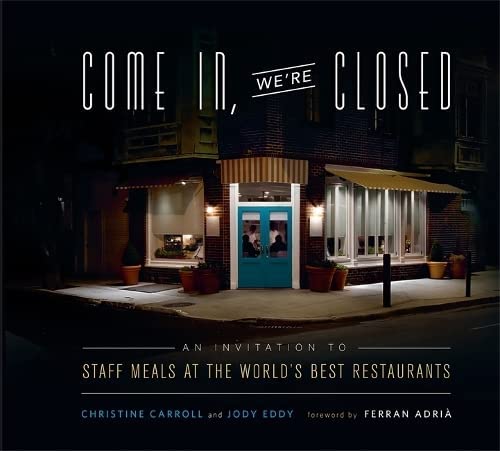
STAFF MEAL TELLS all you need to know about a restaurant. When the employees are fed with care and respect, when a family spirit is celebrated, a sense of well-being embraces everything about the places, and you feel it as a customer. This is why a chain restaurant feels like a Dickensian orphanage. Christine Carroll and Jody Eddy had the excellent idea of taking us behind the scenes to visit a couple of dozen staff dinners – with recipes – in Come In, We’re Closed (Running Press), although the first one, at Thomas Keller’s Ad Hoc, is a once-a-week staff banquet with a ritual requirement of paying compliments to one another, reminding me why I’ll never live in northern California. All of the chosen eateries are somewhat rarefied; thus, from Montreal’s Au Pied de Cochcon, for instance, comes “creamy smoked sturgeon pappardelle,” but that’s redeemed by McCrady’s, in South Carolina, and its offerings of a double-stack cheeseburger and beef-fat fries. Excellent narrative content, with insightful chef interviews as well.

Friday, December 09, 2022

Going Whole Hog

EVER CONTEMPLATED “CHUCKING IT ALL” and moving to a farm? Shrugging off the heavy mantle of living and working in the corporate world in order to get back to the earth sounds wonderfully noble and romantic, allowing you to glory in the knowledge that you’re providing healthy food for yourself and your neighbors. I know people who have done this. They knew they were in for a work schedule unlike anything they’d known in the nine-to-five world. They just didn’t anticipate how punishing it would be.

Ellyn Gaydos chronicles three years of active farm work in Pig Years, a poetic, insightful memoir that skillfully balances her personal growth with an honest account of the toil and turmoil of farm life. By the time the book begins, in the spring of 2017, she was no stranger to the challenges: At 18 she worked on a beef and dairy farm; the following year, on a berry farm. From there she went to another dairy farm, then to a vegetable farm. But, as Pig Years begins, “I had just turned twenty-four and fallen deeply in love, I had little money, was a transient worker, and was increasingly afflicted with the desire to have a child. All of this became like a conversation with the fields, animals, and various towns that surrounded me.”

I’m no fan of the type of memoir in which an eager diarist with little self-awareness chronicles an egocentric journey through what usually turns out to be the scorn of an unsympathetic world. This is emphatically not that kind of book. There’s no hand-wringing; likewise, there’s no feel-good cliché-mongering or strident preaching. But it is a story of growth and revelation. Gaydos tells it in a deceptively simple, matter-of-fact manner, her first-person perspective giving a sense of immediacy to the story.

Friday, December 02, 2022

Breaking the Silence

TRY TO RECALL a dinner or other social event at which you felt entranced, uplifted. You either were falling in love or listening to a fascinating party guest, the kind who has captivating stories to tell and knows how to deliver a punch line.

Susan Fleming Marx was clearly that kind of party guest. She quit a mediocre but promising movie career to wed Harpo Marx, and they had one of those marriages that defies statistics (and the matrimonial track records of Harpo’s brothers).

“To my mother’s lasting mortification, I was born in Brooklyn, New York. That was not classy,” is how she begins her well-told tale. She was born in 1908. As a teenager, she enrolled in Ned Wayburn’s School of Dance where she and her new friend Paulette Goddard were the favorites. Both were tapped to be in the chorus of a Ziegfeld unit that opened in Florida in January 1926, and by June of hat year, she was in a Broadway edition of the revue titled “No Foolin’” (which ran in a theater just down the street from “The Cocoanuts,” starring the Marx Brothers).

Just as quickly, she entered the movies. “There had to be at least a half-dozen girls in that chorus with a burning ambition to act. I was not one of them.” Nevertheless, she was selected by Adolph Menjou to star with him in his movie “The Ace of Cads.” “I’ve since learned that (it) is now a lot film. Well, thank heaven for small miracles! I’d shudder to think of anyone actually seeing me in this thing.”

Friday, November 25, 2022

Some Like It Hot

It’s not as if we were pandemic-demoralized; far from it. We’ve learned to live reclusively and are quite happy in this social cocoon. However, Thanksgiving invited us to re-think the holiday menu and treat our handful of guests to something rather unprecedented for this event: Szechuan Hot Pot, also known as Steamboat or Shabu-Shabu. The menu is below; our slide show of Thanksgiving menus past is here.

Friday, November 18, 2022

Making the Most of Mozart

From the Theater Vault Dept.: Back in 1984, when the University at Albany had a theater department of some standing, they offered an ambitious series of productions. Amadeus was still something of an undiscovered item until the movie came out that year, which coincided with the production described below, first in an eager advance, then in a disappointed review.


PIANIST ALFRED BRENDEL, a world-class performer of Mozart's music, dismissed the hit play Amadeus quite simply: “It’s not an accurate portrait of the man. The playwright took his material from a few letters Mozart wrote to his sister, letters that were very playful, and very scatological.”

Saltzmann and Strolle in Amadeus
Much of the music world, which isn’t known for restrained opinions, has come down hard on this theatrical depiction of one of the gods of music; the recent release of the movie has fanned the flames of controversy, with the dowdy New York Times leading the pack of throat-clearers.

On the other hand, a friend of mine who has long insisted that she’d rather be boiled in oil than listen to opera confessed that the opera sequences in the film of Amadeus weren’t bad at all! That kind of influence is worth the whinnying of a dozen stuffy newspapers.

There’s no doubt that the film plays up Mozart’s manic side, and it’s that very quality that SUNYA’s Bill Leone thinks needn’t be overdone for the theater: “Mozart is a man who knew his society, he just had moments of insensitivity.” Leone is following his recent success with Shakespeare at SUNYA with a production of Peter Shaffer’s Amadeus, which Leone will direct and (for half of the run) act in. Leone has described the themes of the play as ‘being about “uniqueness and irresponsibility of talent. The struggle between a man and his god.” It opens at SUNYA’s Lab Theater on Tuesday for a two-week run.