Search This Blog

Friday, August 26, 2022

Not-So-North of the Border

A MOLCAJETE IS A THREE-LEGGED BOWL, traditionally made of basalt, which has been used as a mortar for food-grinding for thousands of years in Mesoamerican cultures. Because it retains heat for a very long time, it’s also used for food presentation, and you’ll find it as the centerpiece of a spectacular entrée at Greenane Farms in Meredith, NY.

Your molcajete arrives bubbling, earning its nickname of “volcano.” Ringed around its edge are strips of cactus and cheese, next to green onions, Mexican rice, and, hidden in the salsa verde, slices of very hot potatoes. Order the Volcan Vegetariano ($23) and there’s also grilled tofu in the mix, while the Volcan de Pollo ($25) features strips of chicken and a link of homemade chorizo.

At a recent visit, I ordered the Volcan de Res ($29), so the lip of my steaming molcajete sported strips of grilled Angus beef, still red in the center even as the heat kicked in to brown them some more. There’s a fresh, grassy flavor to pasture-raised beef that the elders among us still remember as the way beef is supposed to taste, and it becomes the joyous centerpiece of an array of complementary flavors, from the smoky bite of the chorizo to the mellow ease of those cactus strips.

Not only will you get one of the finest Mexican-cuisine meals you’ve ever enjoyed when you dine at Greenane Farms, but you’ll also have the satisfaction of knowing you’re dining on their own pasture-raised meats. This has been a passion of farm owner Patrick Rider – whose family has been in the area for eight generations – since he purchased the property in 2003. Now he owns 400 acres and leases over a thousand more, on which he raises 250 head of grass-fed Angus cattle as well as pigs, chickens, goats, sheep, and more.

Friday, August 19, 2022

Sardonic Salute

From the Classical Vault Dept.: William Bolcom’s Piano Concerto No. 2 was premiered in April of this year, by Igor Levit and the Mahler Chamber Orchestra conducted by Elim Chan. “Don’t bother asking whether the premiere took place in the United States,” wrote Seth Colter Walls in the New York Times, “where major presentations of music by Bolcom, an American, have fallen out of fashion. Instead, this new concerto was presented in Germany, at the Heidelberger Frühling Festival.” It wasn’t always that way. I first heard Bolcom’s first piano concerto in Saratoga in 1987, when Bolcom was composer-in-residence with the Philadelphia Orchestra at the Saratoga Performing Arts Center. Those days are long, long gone. Here’s my review of the evening.


WILLIAM BOLCOM’S PIANO CONCERTO, performed Friday night by soloist Emanuel Ax with the Philadelphia Orchestra, is a piece calculated to amuse and to offend. The last of a series of works by Bolcom performed at the Saratoga Performing Arts Center to honor him as composer-in-residence, it’s a piece you can point to and shout, “There! That’s a truly American work!”

William Bolcom
Photo by Peter Smith

Written in 1976, it reflects Bolcom’s concern with the bicentennial mania growing throughout the country, and manages to be critical and celebratory at the same time.

He is one of the very few contemporary American composers able to speak a native musical language without sounding condescending, which is in itself very refreshing and certainly prompts some nationalistic pride in the listening.

The work also closely examines the role of the piano in the concerto form, experimenting with different angles and settings. At times it was the aural equivalent of that old optical illusion of a drawing of a cube that points towards or away from you: Was the pianist dominating the orchestra or vice-versa? Coming as this piece did right after a Mozart concerto (No. 25 in C Major), it offered a stunning contrast to Mozart’s antique sweetness. Listening to the older work was an exercise in nostalgia; Bolcom’s concerto made a statement about our country, our century, and us as listeners.

Friday, August 12, 2022

Listening to the Land

AGRICULTURE IS NOW INEXTRICABLY LINKED TO CLIMATE CHANGE. The evidence is incontrovertible; the damage is already taking place. As Laura Lengnick observes in the opening pages of her updated and expanded book Resilient Agriculture, “Climate change is happening now. Climate change is changing everything.”

The first version of her book was written seven years ago, which turns out to be an eternity where climate effects are concerned. She profiled over two dozen farms in the U.S. that were coping not only with climate change but also with the transition of corporate agriculture to a style that’s more environmentally sound. In the new book you’ll find the stories of even more farmers and ranchers pursuing sustainable practices.

Even before she began researching the book, Lengnick worked on a USDA report recommending ways to cope with the new challenges of agriculture. It sounded an alarm many were unhappy to hear. But dramatic changes in the recent past persuaded her to re-interview original subjects, talk to even more, and add more climate-specific information. As she puts it, “It is difficult to grasp the reality of these times. That the weather changes we’ve experienced in the last decade are going to continue to grow more damaging. That the weather is not going to settle down into some new normal. It isn’t easy to fully understand the fact that spring and fall weather will continue to grow more variable, that both flooding rains and drought will grow more intense and will happen more often, and that record-breaking weather will become common. It’s even harder to realize what this means for the people who feed us.”

Thursday, August 04, 2022

In Search of Salvation

MATTERS OF RELIGIOUS FAITH inform the two one-act operas comprising “Double Bill” at the Glimmerglass Festival, productions that show how effectively a small cast, a versatile set, and a virtuoso orchestra can convey the emotionally fraught content of these pieces.

Michael Mayes and Jacquelyn Matava
Photo: Karli Cadel/The Glimmerglass Festival
“Taking up Serpents” is rooted in a rural charismatic church in Alabama, from which 25-year-old Kayla (Mary-Hollis Hundley) has fled. She's now working at a Save Mart drug store, where she gets the news that her preacher father has been bitten by a snake, perhaps fatally. This is her chance to say goodbye.

The relationship was too complicated for an easy farewell, as we learn in flashback scenes where the younger Kayla (a very effective Carly R. Carillo in a non-singing role) learns, from her father's aggressive efforts to impart fearlessness, to be anything but. As Daddy, Michael Mayes is appropriately flamboyant, sporting a big voice and shaking with frightening ecstasy in his shiny suit as he exhorts his congregants.

Although his wife, Nelda (Jacquelyn Matava) has learned to submit to his bullying, Kayla has rebelled. But her rebellion is emotionally incomplete, as the flashbacks reveal. This is where the tools of opera are most effective. Jerre Dye’s libretto is drawn from his own experience growing up amongst rural holy rollers, and offers a clear-eyed view of the consequences of that kind of cultish inculcation, where love becomes a bargaining unit.

Friday, July 29, 2022

Rossini Afloat

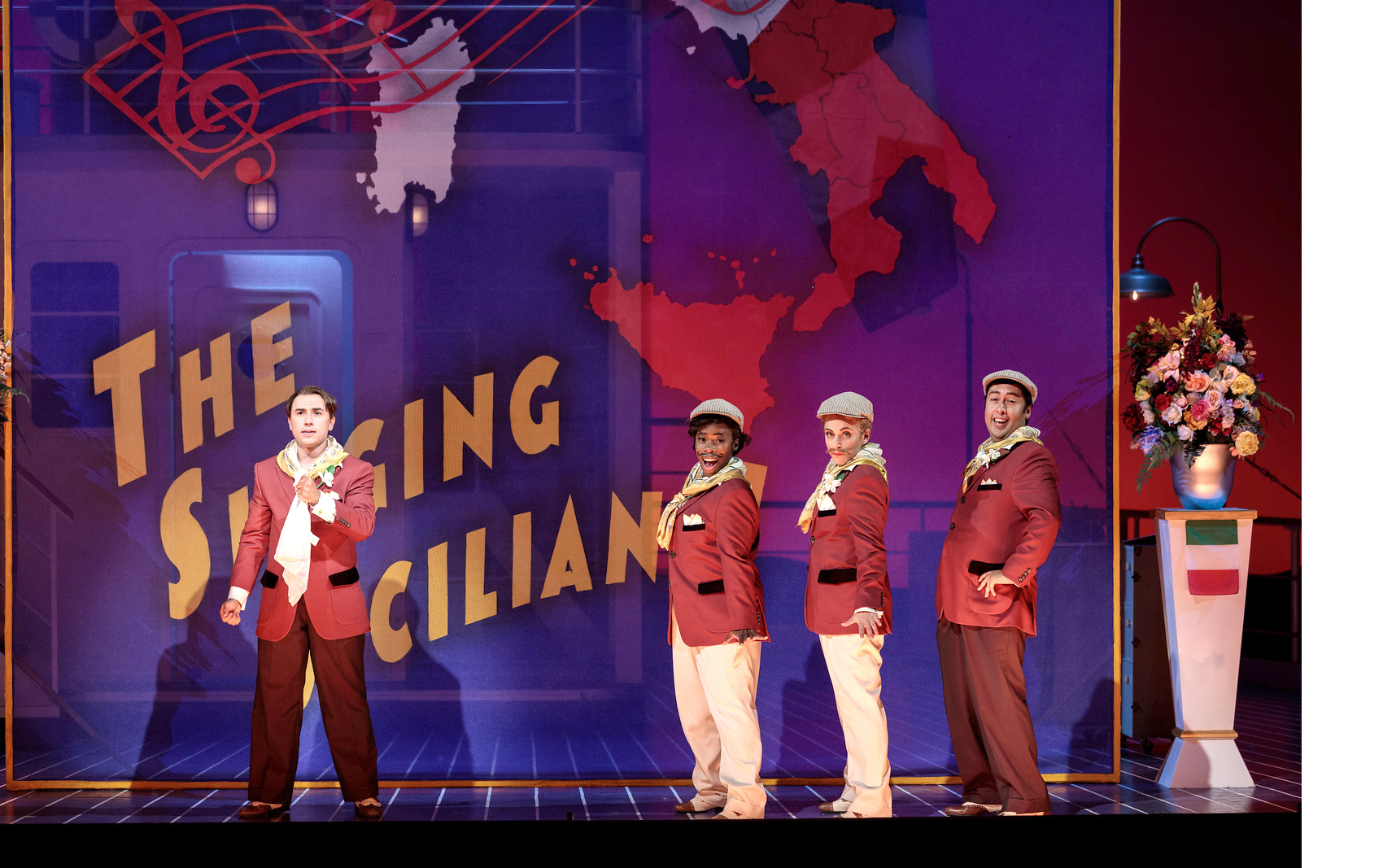
THE IDEA OF A JUKEBOX OPERA using Rossini’s music is a terrific one – so good, in fact, that the world-premiere production of Tenor Overboard at the Glimmerglass Festival left me wishing for more. I don’t think the piece went at all far enough in exploring the possibilities, yet it’s a good-enough production that it may seem sufficient to many.

Fran Daniel Laucerica as Dante, Jasmine
Habersham as Mimi, Reilly Nelson
as Gianna and Armando Contreras
as Luca. Photo: Karli Cadel/
The Glimmerglass Festival
The conceit is to get a handful of quarrelsome characters aboard a steamship bound for Italy, so that they may sort their differences in this classically confined space. Thus daughters Gianna (Reilly Nelson) and Mimi (Jasmine Habersham) are fleeing their overbearing father, Petronio (Stefano de Peppo) and end up winning places in a vocal quartet suddenly (and way too conveniently) shy a pair of members.

We began with a rousing version of the overture from La scala di seta, proving again that music director Joseph Colaneri and the Glimmerglass Festival Orchestra are potent forces, sending a rich, focused sound into the acoustically benevolent Alice Busch Opera Theater – and an especially great treat after last season’s lawn performances with piped-in music.

As an opera recital, Tenor Overboard succeeds brilliantly. Giving singers with excellent voices a best-of menu of Rossini arias and ensemble pieces all but guarantees a lovely experience. But there were two shows going on here, each in a different language. The plot, such as it was, was performed in English; the musical portions switched to Italian. Thus, as we learn of Petronio’s frustration with his independence-seeking daughters, he sings an aria (“Il lamento di Petronio”) drawn from the Thieving Magpie’s “M’affretto di mandarvi i contrassegni,” but re-lyricked for the occasion.

Friday, July 22, 2022

An Experiment With Policeman Hogan

Guest Blogger Dept.: Stephen Leacock insists that he’s been overlooked. No longer shall I allow this indignity to continue, so here’s one of his Literary Lapses, drawn from his first collection of essays. It also ties in with one of my most-consulted blog pieces, wherein I described my brush with noted graphologist Carlos Pedregal.


MR. SCALPER SITS WRITING in the reporters’ room of The Daily Eclipse. The paper has gone to press and he is alone; a wayward talented gentleman, this Mr. Scalper, and employed by The Eclipse as a delineator of character from handwriting. Any subscriber who forwards a specimen of his handwriting is treated to a prompt analysis of his character from Mr. Scalper’s facile pen. The literary genius has a little pile of correspondence beside him, and is engaged in the practice of his art. 

Outside the night is dark and rainy. The clock on the City Hall marks the hour of two. In front of the newspaper office Policeman Hogan walks drearily up and down his beat. The damp misery of Hogan is intense. A belated gentleman in clerical attire, returning home from a bed of sickness, gives him a side-look of timid pity and shivers past. Hogan follows the retreating figure with his eye; then draws forth a notebook and sits down on the steps of The Eclipse building to write in the light of the gas lamp. Gentlemen of nocturnal habits have often wondered what it is that Policeman Hogan and his brethren write in their little books. Here are the words that are fashioned by the big fist of the policeman:

“Two o’clock. All is well. There is a light in Mr. Scalper’s room above. The night is very wet and I am unhappy and cannot sleep—my fourth night of insomnia. Suspicious-looking individual just passed. Alas, how melancholy is my life! Will the dawn never break! Oh, moist, moist stone.”

Friday, July 15, 2022

Summer Sides

From the Food Vault: It’s outdoor dining weather, and Metroland magazine used to devote an annual issue to the topic, wheedling ad dollars from businesses with any possible association to that topic. Here’s my contribution to a 2000 issue.


OUTDOOR DINING AT MY HOUSE invariably revolves around the grill, but we don't limit our party meals to the traditional menus of chicken and ribs, burgers and dogs. Sometimes the sides can steal the show.

Photo by B. A. Nilsson
Good side dishes require preparation. Anyone can slop mayo onto a mound of macaroni and call it salad, but why not enjoy a dish that lights up the palate? Here's the first tip: Make your own mayonnaise. There's no comparison between homemade and store-bought.

At heart, it's an oil and water emulsion, the water derived from an egg yolk, and lemon juice or vinegar. The egg yolk is also the emulsifier, binding the oil and water. And what your mayonnaise will include, unlike commercial types, is good olive oil (or, at the least, canola oil – try to stick with a monounsaturated oil, which is better for your health).

Food processor mayo is a dream to make. You drop in ingredients, whirr, and it's done. I get my eggs from a private source, and don't worry about salmonella; if you're concerned, do the first part of this over a stove to get the yolk mixture to a salmonella-killing 160 degrees for one minute.

Friday, July 08, 2022

Why Your Food Ate That Stuff

From the Very Soil Dept.: This is a companion piece to my review of What Your Food Ate, the incredibly compelling new book by David Montgomery and Anne Biklé, a piece you can read here. Then come back to this interview for more insight into their thoughts and processes.


What Your Food Ate, the new book by David Montgomery and Anne Biklé, is so self-explanatory that there’s not much left to say to them, aside from “You must have put a hell of a lot of work into this” and “Do you think it’ll help?” But I caught up with the busy authors, who are married, by phone at their Seattle-area home, and spent a pleasant half-hour in conversation.

David Montgomery and Anne Biklé
“It’s an inspirational and depressing book,” I suggested, noting that I had reviewed their earlier books, The Hidden Half of Nature and Growing a Revolution, I was somewhat prepared for the journey from deep inside the soil to deep inside your body, following the path of vital micronutrients. But this is a carefully reasoned study, supported by source material that spills from the back of the back over to the book’s website.

“We read a ton of stuff, literally,” says David. “There are about a thousand articles that were source material. And for the final version of the book, we decided to put that material online. There was a lot of homework that went into this. I think you can understand why. In contrast to the other two books you mentioned, we believed that this book really had to be underpinned with documentation of how we arrived at these ideas and how arrived at what we're saying. Because the ideas and the information in this book isn’t going to be flattering to everybody.” Could he be referring to the big chemical fertilizer companies. David laughs. “I’m not sure they’re gonna love this book.”

Friday, July 01, 2022

The Pit of Deliciousness

From the Food Vault Dept.: Things have been getting a little too healthy around here, so here’s a review I wrote in 2013 about a barbecue joint in nearby Cohoes. I revisited the place a few times – it really was the best in the area – but I’m saddened that it closed earlier this year.


TRANSPLANTED TEXAN DAVID FRAZIER has seen a considerable amount of change where barbecue is concerned. He moved to the Capital Region in 1992, when grilled meat was incorrectly termed barbecue.

Photo by B. A. Nilsson
I last wrote about him in 1995, when he had a joint on Colvin Ave. and was trying to bring true religion to the area masses. “Good barbecue is more than just a well-wrought recipe,” I wrote back then. “It’s a sociological phenomenon.” The challenge has eased considerably since then as a succession of eateries have fired up the smokers and offered varying shades of barbecue, and Frazier particularly welcomed the arrival of Dinosaur BBQ in Troy two years ago.

“Business has gone way up since they opened,” he says, noting also that he was helped by his move three years ago from downtown Cohoes to a larger, easy-to-find building just off 787.

Frazier grew up in Texas and thus was nicknamed “Tex,” and got a masters in marketing from University of Texas. But barbecue was a way of life down there that he wasn’t prepared to leave behind.

Friday, June 24, 2022

What’s Eating You Is What You’re Eating

WHAT YOUR FOOD ATE is the startlingly portentous title of a new study by the married team of David Montgomery and Anne Biklé, a book that takes a remarkably thorough look at how and why humans interact with food and how that food interacts with other substances. Folk wisdom declares that the dirt you inadvertently consume serves to keep you healthier; this book reveals that there’s more truth in that than you might suspect.

Except that you don’t have to eat dirt to get those benefits – you just have to eat minimally processed food that has been allowed to grow in a healthy, natural environment. Trouble is, that food is becoming ever more difficult to find.

Montgomery, who is a professor of Geomorphology, and Biklé, a biologist, have covered these topics in their previous books, The Hidden Half of Nature, Dirt: The Erosion of Civilizations, and Growing a Revolution: Bringing Our Soil Back To Life, each of which has been reviewed on this site. But their new book not only weaves together a more complete overview of those topics, it also provides sound scientific study to support their conclusions, enough, I hope, to persuade those who might still be skeptical about the conclusions found herein.

The conclusions are simple. And profound. Our bodies have an innate nutritional wisdom. We figured out, through the trial-and-error that informs evolution, what kind of diet is needed to maintain health and fight disease. We began farming and penning animals ten thousand years ago and our bodies adapted to the dietary changes. Now, in this most modern of modern ages, we’re more likely to suffer from micronutrient malnutrition and resultant disease.

Friday, June 17, 2022

Rags Are Riches

WILLIAM BOLCOM’S INTEREST IN RAGTIME began in 1967, when he learned of a vanished ragtime opera by Scott Joplin – a name he’d never heard – and discovered that Queens College associate Rudi Blesch had a vocal score of it. Blesch was co-author of They All Played Ragtime, the definitive book on the topic, and soon Bolcom was learning and performing the ragtime repertory. I think we can credit him with planting the seed that grew into the ragtime revival: he played some Joplin for Joshua Rifkin, who went on to record excellent interpretations of Joplin rags on Nonesuch LPs. The records sold well, and when film director George Roy Hill heard one of them, he decided to use Joplin’s music in the “The Sting” in 1973. The world became ragtime-suffused, to the point where I saw Benny Goodman mock “The Entertainer” at a late-‘70s Carnegie Hall concert.

Even as he was performing classic ragtime pieces, Bolcom began writing his own take on the genre, joining a number of fellow composers in the late ’60s to renew the literature of this engaging form. At first, he pieces were Joplin-like, but very soon he branched out into more Bolcom-esque works.

A somewhat heavy-handed recording of the then-complete Bolcom rags played by John Murphy came out in 1998; Spencer Myer released a single-disc collection of 16 Bolcom rags in 2017, and it’s a fine recording, but Marc-André Hamelin has just released a two-CD set that not only gives you everything Bolcom considers a rag but also presents them in a thoroughly idiomatic way. Hamelin sounds like he’s channeling Joplin by way of Bolcom, a testament to the skill both of composer and performer.

The 27 pieces included on these discs were written between 1968 and 2015, the majority of them before 1972. “Incineratorag,” one of the earliest, could pass for a 1902 piece except for some of the unusual (for that time) harmonies. In keeping with Joplin’s own admonitions, the sheet music for this one is headed, “For Heaven’s sake, not too fast!”

Friday, June 10, 2022

I’ve Got a Secret

RUSS WALTER’S BUSINESS MODEL probably would send an economics consultant screaming out of the room. Walter has been writing and selling The Secret Guide to Computers for 50 years, revising it frequently to keep up with changing technology. But he doesn’t sell it through the usual outlets – he sells it himself. And he gives exponential discounts when you buy multiple copies, and lets go of earlier editions for a song. And he offers free tech support. Like the big companies, it’s available any time of the day or night; unlike them, he takes the calls himself.

The book itself is packed with text, laid out on a two-column page with little of the usual relief for the eye. But you’ll want it by your computer or your bedside or somewhere very convenient. Let me tell you how invaluable this book is.

I got pushed into the world of personal computers in 1985. The magazine I was writing for no longer wished to transcript typescript, so the publisher worked up a deal to get his staff and writers a discount on the purchase of an Epson machine running the latest iteration of the Intel 8088 chip and offering two 5 1/4-inch floppy disk drives. If this means nothing to you, you’re in good company. It meant nothing to me at the time, and, because the damn thing just sat there blinking its stupid green “A:” prompt, I decided to get rid of it.

“Other people have learned to use these things,” my wife observed. “Why can’t you?” With my intelligence thus impugned, I sought help. From books, my usual educational conduit, and computer-oriented magazines that lately had been appearing on the newsstands. In one such magazine, I read a review of The Secret Guide to Computers, a review noting that Walter sold the book himself, alongside offering free tech support by phone any time of the day or night. I called and ordered the book.

Friday, June 03, 2022

The Fable of Paducah’s Favorite Comedians and the Mildewed Stunt

 Guest Blogger Dept.: It’s George Ade again, a regular visitor to these e-pages, with another fable in slang. It describes details of the vaudeville era, and names some of its stars. I’ll save you the trouble of looking them up: Francis Wilson was a singer and comedian who started in minstrel shows. He was founding president of Actors Equity. Nat Goodwin moved between stage shows and vaudeville, and played Fagin in a 1912 film of “Oliver Twist.” British-born Richard Mansfield was renowned for his Shakespeare performances, and his too-convincing portrayal of “Dr. Jekyll and Mr. Hyde” in 1888 led people to suspect he could be Jack the Ripper. And a burgoo picnic remains a popular Kentucky outing, in which a free-form stew is the culinary center of the event.


ONCE UPON A TIME there was a Specialty Team doing Seventeen Minutes. The Props used in the Act included a Hatchet, a Brick, a Seltzer Bottle, two inflated Bladders and a Slap-Stick. The Name of the Team was Zoroaster and Zendavesta.

These two Troupers began their Professional Career with a Road Circus, working on Canvas in the Morning, and then doing a Refined Knockabout in the Grand Concert or Afterpiece taking place in the Main Arena immediately after the big Show is over.

When each of them could Kick Himself in the Eye and Slattery had pickled his Face so that Stebbins could walk on it, they decided that they were too good to show under a Round Top, so they became Artists. They wanted a Swell Name for the Team, so the Side-Show Announcer, who was something of a Kidder and had attended a Unitarian College, gave them Zoroaster and Zendavesta. They were Stuck on it, and had a Job Printer do some Cards for them.

By utilizing two of Pat Rooney’s Songs and stealing a few Gags, they put together Seventeen Minutes and began to play Dates and Combinations.

Zoroaster bought a Cane with a Silver Dog’s Head on it, and Zendavesta had a Watch Charm that pulled the Buttonholes out of his Vest.

Friday, May 27, 2022

57 Channels and Nothin’ On

From the End of Humanity As We Know It Vault: Bill McKibben is best known for his prophetic and tireless fight to promote climate awareness, but he also explored an area close to my heart: television. Specifically, the toxic nature of the medium, which he and I discussed in 1992 to welcome the publication of his book The Age of Missing Information.


A CHILLY MIST shrouds the tops of the mountains surrounding Bill McKibben's Warren County home. As is true of most large old rural houses, his has a front door as well as a door that everybody uses. That one’s around the back.

Bill McKibben
Tall and wiry, with close-cropped hair and an high forehead, he looks like any area farmer. Boots, jeans and a plaid flannel shirt added a touch of North Country ease. “Didn’t expect it to be so cold out today,” he says. “I’m sorry you can’t see the mountains. Come on in and have some soup with me.”

McKibben, once a staff writer for The New Yorker who also ran a small homeless shelter in Manhattan, has now spent several years in what might seem like rural seclusion. But it was logical and necessary choice, explained in his books The End of Nature and, just recently, The Age of Missing Information.

“I had to do this experiment,” he explains, “and see what came of it. I was hoping for a book, but I had very few preconceptions, fewer than usual.” The experiment placed him in front of a television set for several months, auditing over a thousand hours of television programming – everything that was available on each of the hundred cable stations in Fairfax, Virginia, during the 24 hours of May 3, 1990.

Friday, May 20, 2022

In the Soup

STUNG WITH AN ATTACK of middle-class guilt, Stephen Henderson sought to expiate by helping to cook meals at a variety of soup kitchens around the world. Bringing a home-gourmet sensibility to these excursions, when placed in charge he designed menus not necessarily conducive to catering or soup-kitchen tastes, so his home-cooking-based efforts tended to throw him into high-pressure on-the-job training. But as his catering-kitchen skills grew, so did his self-awareness. And he tells his stories so endearingly that The 24-Hour Soup Kitchen will win your heart. It’s an entertaining and enlightening book.

The genesis is straightforward enough. Henderson is a travel writer who likes to cook. He’s living well enough to acquire an aging co-op in New York City. It needs a new kitchen. So he buys a new stove, a top-of-the-line Lacanche. He’s too tasteful to mention a price, but those ranges run at least $10,000 today. Henderson visits the manufacturing facility in France, and, while dining with its director, learns about Alexis Soyer, a famous chef during the 19th century, a man renowned both for his lavish way of life and his invention of the soup-kitchen concept.

It’s a concept that seems more necessary than ever, and Soyer’s life (and lingering Lacanche guilt) inspired him to travel around the world to a variety of soup kitchens, large and small, and learn about them by working at them.

Henderson’s odyssey begins at Gurdwara Bangla Sahib, a massive Sikh temple in Delhi that grew from a 17th-century bungalow to the large, ornate structure you’ll find today. He was there to help with langar, a tradition among Sufi Muslims that offers food, served in a communal dining area, to anyone of any religion who wishes to partake. Gurdwara Bangla Sahib feeds about 20,000 people a day, 600 at a time, and those who work or eat there are required to do so barefoot. Biswajit Singh, the only paid employee at the kitchen, organizes the prep and cooking with no foreknowledge of the supplies he’d be working with – they are donations that arrive based on the whim of the benefactor, such as a flatbed truck loaded with cauliflower.

Friday, May 13, 2022

A Bridge Not Far Enough

From the Theater Vault Dept.: After seeing an incredible performance by Michael Fischetti in “Glengarry Glen Ross” at Capital Rep the season before, I was eager to see what he’d do with the challenging lead in “A View from the Bridge.” He did excellently, but the rest of the production seemed a little limp, almost as if the production team wasn’t prepared to fully commit to the play’s place and time. Here’s what I wrote about it, taking us back to a chilly night in 1987.


THE BRIDGE IN QUESTION is one of those gloriously metaphorical items that spans the literal and metaphysical: it joins boroughs, countries; it joins aspects of law and aspects of morality.

Arthur Miller wrote “A View from the Bridge” in 1955 as a one-acter and expanded it when it proved successful. As with so much of the playwright's work, there is a strong central character in the process of conflict and self-discovery who nevertheless is doomed.

Michael Fischetti and Sully Boyer
With Eddie Carbone, it is a conflict between loyalty and sexual feeling that brings him down. He is attracted to his just-come-of-age niece; he also is attracted to the man she wants to marry.

This is in Brooklyn of the late '40s, so Eddie, a longshoreman, doesn't have a very sophisticated language with which to express his varied feelings, never mind that he's dealing with such great taboos.

Such subjects are now the stuff of television soap operas, so today there isn’t a lot of shock value in Eddie’s dilemma. What keeps a production of “Bridge” interesting are rich portraits of Eddie, his friends and family.

Friday, May 06, 2022

Jazzing the Menu

From the Food Vault Dept.: It’s difficult to tell what’s going on at Schenectady’s Van Dyck Restaurant these days. It turned into the Mad Jack Brewing Co. a few years ago, and seems to have weathered Covid in that guise, but the only menu offerings on the website are a few pizzas and, even though its Facebook page sports the famous “Great Day in Harlem” photograph, there hasn’t been any significant jazz near the place in many years. Here’s one of five reviews I wrote of the place over the years, this one from 25 years ago. There’s a more current one, from 2009, that I’ll post in the weeks to come.


BESIDES BEING A CHARMING BUILDING in Schenectady’s Stockade area, the Van Dyck has also hosted appearances by legendary jazz musicians. During my own time in Schenectady, I’ve seen Earl Hines and Red Norvo at the club, among many others. It was sad to see the business close a few years ago, but the decline had been steady and apparent. With a fresh emphasis on food, a new brewery component, and extensive remodeling, the restaurant reopened under new ownership in late March.

One of the shrewdest moves was to lure chef Dimitri Cruz from Siro’s, the seasonal Saratoga gourmet restaurant. Cruz, a Round Lake native, brings a wealth of commendable experience to the job, with a special love of Asian cookery learned during a stint at Manhattan’s Noho Star restaurant.

Other good ideas include a refurbished bar twice the size of the old one, yet still comfortable and intimate, and moving the jazz room to the second floor. The lineup of players, including upcoming appearances by Marian McPartland and Mose Allison, also gives the reassuring message that music is being taken seriously here again.

Friday, April 29, 2022

A Re-Sounding Success

From the Tech Vault Dept.: There can’t possibly be a more technologically dated piece in my files than this one. Here I am, in 1995, telling you how to hook up your computer’s audio output to your home stereo system. Who does that any more? As a matter of fact, I do. If there’s an indignity involved, it’s the horrific rewrite some subeditor put my piece through, so I’m satisfying my still-bruised ego by posting it here in its original form. (Photos by John Popplewell.)


MY IDEA OF AUDIO HELL is the multimedia section of any computer show. There’s something about the output of all those tiny, tinny speakers that makes my back teeth think of fingernails on a chalkboard. Because most of those loudspeakers sound terrible. When it comes to any multimedia enterprise – I’m thinking especially of television now – audio tends to get short-shrifted. A few manufacturers are offering terrific computer speakers, but they’re not cheap. And chances are that right now you’re listening to a possible solution to the computer audio problem.

Let’s say that you recently picked up a multimedia kit for your computer. Which means you probably did what I did: shopped around for the right CD-ROM player and sound card combo, and then went along with whatever speakers were thrown in. Try this simple test: Heft one of the speakers in your hand. If it weighs about the same as this magazine, don’t look for your audiophile friends to swoon at the sound of it..

There are alternatives at hand. First and easiest is a pair of headphones. They sound better than those cheap speakers, and they bother nobody else. But headphones will always be a secondary technique, because nothing takes the place of being able to crank that music! You’ve got a good stereo system playing – so route the sound from that sound card into your stereo and enjoy the assault of real amplifier muscle. Or fire up a round of Doom and enjoy the assault.

Monday, April 18, 2022

I’ll Give You a Camera

I’VE NEVER LIKED having my picture taken. Of course, it’s required when pursuing and promoting entertainment gigs, but I’ve learned to endure it much the same way as I endure dental work. When I was five years old, my family lived in the northern New Jersey town of Glen Rock in what seemed to be a large house on South Maple Avenue. It turned out that Duncan Butler, our next-door neighbor had a photography studio in town, where my younger brother and I had our portraits taken, attired in little-boy suits and 60s-thin bow ties. Even – or perhaps especially – at that age, I was embarrassed by my visage.

I believe that the middle photo on the right
is a Dunc Butler shot. There are more in
the LP set's booklet, which I no longer own.

All of this I mentioned in a piece I posted here a decade ago, and it appears to be the only mention you’ll internet-find when searching for the photographer. (You can also find a few credits here at discogs.com, but they don’t show up on general searches.) As a result of that blog post, I recently heard from a man who, while researching writer-composer Paul Bowles, came across a Discogs listing for a ten-inch Atlantic LP titled “Haiti Dances,” for which Bowles wrote liner notes. And Butler is credited for the cover photo. Imagine the poor researcher’s bafflement when all he could discover was that old blog post of mine! He sent me a message, and I told him the rest of the story, which I’ll now tell you.

In my teens, I liberated myself away from the pop-music hits and discovered the wonders of classical and jazz, among other poorly named styles, and began obsessively collecting records. Records, mind you, those 12 by 12-inch long-playing marvels that captured wonderful music in their grooves and offered an education on their rear covers.