Search This Blog

Friday, June 24, 2022

What’s Eating You Is What You’re Eating

WHAT YOUR FOOD ATE is the startlingly portentous title of a new study by the married team of David Montgomery and Anne Biklé, a book that takes a remarkably thorough look at how and why humans interact with food and how that food interacts with other substances. Folk wisdom declares that the dirt you inadvertently consume serves to keep you healthier; this book reveals that there’s more truth in that than you might suspect.

Except that you don’t have to eat dirt to get those benefits – you just have to eat minimally processed food that has been allowed to grow in a healthy, natural environment. Trouble is, that food is becoming ever more difficult to find.

Montgomery, who is a professor of Geomorphology, and Biklé, a biologist, have covered these topics in their previous books, The Hidden Half of Nature, Dirt: The Erosion of Civilizations, and Growing a Revolution: Bringing Our Soil Back To Life, each of which has been reviewed on this site. But their new book not only weaves together a more complete overview of those topics, it also provides sound scientific study to support their conclusions, enough, I hope, to persuade those who might still be skeptical about the conclusions found herein.

The conclusions are simple. And profound. Our bodies have an innate nutritional wisdom. We figured out, through the trial-and-error that informs evolution, what kind of diet is needed to maintain health and fight disease. We began farming and penning animals ten thousand years ago and our bodies adapted to the dietary changes. Now, in this most modern of modern ages, we’re more likely to suffer from micronutrient malnutrition and resultant disease.

Friday, June 17, 2022

Rags Are Riches

WILLIAM BOLCOM’S INTEREST IN RAGTIME began in 1967, when he learned of a vanished ragtime opera by Scott Joplin – a name he’d never heard – and discovered that Queens College associate Rudi Blesch had a vocal score of it. Blesch was co-author of They All Played Ragtime, the definitive book on the topic, and soon Bolcom was learning and performing the ragtime repertory. I think we can credit him with planting the seed that grew into the ragtime revival: he played some Joplin for Joshua Rifkin, who went on to record excellent interpretations of Joplin rags on Nonesuch LPs. The records sold well, and when film director George Roy Hill heard one of them, he decided to use Joplin’s music in the “The Sting” in 1973. The world became ragtime-suffused, to the point where I saw Benny Goodman mock “The Entertainer” at a late-‘70s Carnegie Hall concert.

Even as he was performing classic ragtime pieces, Bolcom began writing his own take on the genre, joining a number of fellow composers in the late ’60s to renew the literature of this engaging form. At first, he pieces were Joplin-like, but very soon he branched out into more Bolcom-esque works.

A somewhat heavy-handed recording of the then-complete Bolcom rags played by John Murphy came out in 1998; Spencer Myer released a single-disc collection of 16 Bolcom rags in 2017, and it’s a fine recording, but Marc-André Hamelin has just released a two-CD set that not only gives you everything Bolcom considers a rag but also presents them in a thoroughly idiomatic way. Hamelin sounds like he’s channeling Joplin by way of Bolcom, a testament to the skill both of composer and performer.

The 27 pieces included on these discs were written between 1968 and 2015, the majority of them before 1972. “Incineratorag,” one of the earliest, could pass for a 1902 piece except for some of the unusual (for that time) harmonies. In keeping with Joplin’s own admonitions, the sheet music for this one is headed, “For Heaven’s sake, not too fast!”

Friday, June 10, 2022

I’ve Got a Secret

RUSS WALTER’S BUSINESS MODEL probably would send an economics consultant screaming out of the room. Walter has been writing and selling The Secret Guide to Computers for 50 years, revising it frequently to keep up with changing technology. But he doesn’t sell it through the usual outlets – he sells it himself. And he gives exponential discounts when you buy multiple copies, and lets go of earlier editions for a song. And he offers free tech support. Like the big companies, it’s available any time of the day or night; unlike them, he takes the calls himself.

The book itself is packed with text, laid out on a two-column page with little of the usual relief for the eye. But you’ll want it by your computer or your bedside or somewhere very convenient. Let me tell you how invaluable this book is.

I got pushed into the world of personal computers in 1985. The magazine I was writing for no longer wished to transcript typescript, so the publisher worked up a deal to get his staff and writers a discount on the purchase of an Epson machine running the latest iteration of the Intel 8088 chip and offering two 5 1/4-inch floppy disk drives. If this means nothing to you, you’re in good company. It meant nothing to me at the time, and, because the damn thing just sat there blinking its stupid green “A:” prompt, I decided to get rid of it.

“Other people have learned to use these things,” my wife observed. “Why can’t you?” With my intelligence thus impugned, I sought help. From books, my usual educational conduit, and computer-oriented magazines that lately had been appearing on the newsstands. In one such magazine, I read a review of The Secret Guide to Computers, a review noting that Walter sold the book himself, alongside offering free tech support by phone any time of the day or night. I called and ordered the book.

Friday, June 03, 2022

The Fable of Paducah’s Favorite Comedians and the Mildewed Stunt

 Guest Blogger Dept.: It’s George Ade again, a regular visitor to these e-pages, with another fable in slang. It describes details of the vaudeville era, and names some of its stars. I’ll save you the trouble of looking them up: Francis Wilson was a singer and comedian who started in minstrel shows. He was founding president of Actors Equity. Nat Goodwin moved between stage shows and vaudeville, and played Fagin in a 1912 film of “Oliver Twist.” British-born Richard Mansfield was renowned for his Shakespeare performances, and his too-convincing portrayal of “Dr. Jekyll and Mr. Hyde” in 1888 led people to suspect he could be Jack the Ripper. And a burgoo picnic remains a popular Kentucky outing, in which a free-form stew is the culinary center of the event.


ONCE UPON A TIME there was a Specialty Team doing Seventeen Minutes. The Props used in the Act included a Hatchet, a Brick, a Seltzer Bottle, two inflated Bladders and a Slap-Stick. The Name of the Team was Zoroaster and Zendavesta.

These two Troupers began their Professional Career with a Road Circus, working on Canvas in the Morning, and then doing a Refined Knockabout in the Grand Concert or Afterpiece taking place in the Main Arena immediately after the big Show is over.

When each of them could Kick Himself in the Eye and Slattery had pickled his Face so that Stebbins could walk on it, they decided that they were too good to show under a Round Top, so they became Artists. They wanted a Swell Name for the Team, so the Side-Show Announcer, who was something of a Kidder and had attended a Unitarian College, gave them Zoroaster and Zendavesta. They were Stuck on it, and had a Job Printer do some Cards for them.

By utilizing two of Pat Rooney’s Songs and stealing a few Gags, they put together Seventeen Minutes and began to play Dates and Combinations.

Zoroaster bought a Cane with a Silver Dog’s Head on it, and Zendavesta had a Watch Charm that pulled the Buttonholes out of his Vest.

Friday, May 27, 2022

57 Channels and Nothin’ On

From the End of Humanity As We Know It Vault: Bill McKibben is best known for his prophetic and tireless fight to promote climate awareness, but he also explored an area close to my heart: television. Specifically, the toxic nature of the medium, which he and I discussed in 1992 to welcome the publication of his book The Age of Missing Information.


A CHILLY MIST shrouds the tops of the mountains surrounding Bill McKibben's Warren County home. As is true of most large old rural houses, his has a front door as well as a door that everybody uses. That one’s around the back.

Bill McKibben
Tall and wiry, with close-cropped hair and an high forehead, he looks like any area farmer. Boots, jeans and a plaid flannel shirt added a touch of North Country ease. “Didn’t expect it to be so cold out today,” he says. “I’m sorry you can’t see the mountains. Come on in and have some soup with me.”

McKibben, once a staff writer for The New Yorker who also ran a small homeless shelter in Manhattan, has now spent several years in what might seem like rural seclusion. But it was logical and necessary choice, explained in his books The End of Nature and, just recently, The Age of Missing Information.

“I had to do this experiment,” he explains, “and see what came of it. I was hoping for a book, but I had very few preconceptions, fewer than usual.” The experiment placed him in front of a television set for several months, auditing over a thousand hours of television programming – everything that was available on each of the hundred cable stations in Fairfax, Virginia, during the 24 hours of May 3, 1990.

Friday, May 20, 2022

In the Soup

STUNG WITH AN ATTACK of middle-class guilt, Stephen Henderson sought to expiate by helping to cook meals at a variety of soup kitchens around the world. Bringing a home-gourmet sensibility to these excursions, when placed in charge he designed menus not necessarily conducive to catering or soup-kitchen tastes, so his home-cooking-based efforts tended to throw him into high-pressure on-the-job training. But as his catering-kitchen skills grew, so did his self-awareness. And he tells his stories so endearingly that The 24-Hour Soup Kitchen will win your heart. It’s an entertaining and enlightening book.

The genesis is straightforward enough. Henderson is a travel writer who likes to cook. He’s living well enough to acquire an aging co-op in New York City. It needs a new kitchen. So he buys a new stove, a top-of-the-line Lacanche. He’s too tasteful to mention a price, but those ranges run at least $10,000 today. Henderson visits the manufacturing facility in France, and, while dining with its director, learns about Alexis Soyer, a famous chef during the 19th century, a man renowned both for his lavish way of life and his invention of the soup-kitchen concept.

It’s a concept that seems more necessary than ever, and Soyer’s life (and lingering Lacanche guilt) inspired him to travel around the world to a variety of soup kitchens, large and small, and learn about them by working at them.

Henderson’s odyssey begins at Gurdwara Bangla Sahib, a massive Sikh temple in Delhi that grew from a 17th-century bungalow to the large, ornate structure you’ll find today. He was there to help with langar, a tradition among Sufi Muslims that offers food, served in a communal dining area, to anyone of any religion who wishes to partake. Gurdwara Bangla Sahib feeds about 20,000 people a day, 600 at a time, and those who work or eat there are required to do so barefoot. Biswajit Singh, the only paid employee at the kitchen, organizes the prep and cooking with no foreknowledge of the supplies he’d be working with – they are donations that arrive based on the whim of the benefactor, such as a flatbed truck loaded with cauliflower.

Friday, May 13, 2022

A Bridge Not Far Enough

From the Theater Vault Dept.: After seeing an incredible performance by Michael Fischetti in “Glengarry Glen Ross” at Capital Rep the season before, I was eager to see what he’d do with the challenging lead in “A View from the Bridge.” He did excellently, but the rest of the production seemed a little limp, almost as if the production team wasn’t prepared to fully commit to the play’s place and time. Here’s what I wrote about it, taking us back to a chilly night in 1987.


THE BRIDGE IN QUESTION is one of those gloriously metaphorical items that spans the literal and metaphysical: it joins boroughs, countries; it joins aspects of law and aspects of morality.

Arthur Miller wrote “A View from the Bridge” in 1955 as a one-acter and expanded it when it proved successful. As with so much of the playwright's work, there is a strong central character in the process of conflict and self-discovery who nevertheless is doomed.

Michael Fischetti and Sully Boyer
With Eddie Carbone, it is a conflict between loyalty and sexual feeling that brings him down. He is attracted to his just-come-of-age niece; he also is attracted to the man she wants to marry.

This is in Brooklyn of the late '40s, so Eddie, a longshoreman, doesn't have a very sophisticated language with which to express his varied feelings, never mind that he's dealing with such great taboos.

Such subjects are now the stuff of television soap operas, so today there isn’t a lot of shock value in Eddie’s dilemma. What keeps a production of “Bridge” interesting are rich portraits of Eddie, his friends and family.

Friday, May 06, 2022

Jazzing the Menu

From the Food Vault Dept.: It’s difficult to tell what’s going on at Schenectady’s Van Dyck Restaurant these days. It turned into the Mad Jack Brewing Co. a few years ago, and seems to have weathered Covid in that guise, but the only menu offerings on the website are a few pizzas and, even though its Facebook page sports the famous “Great Day in Harlem” photograph, there hasn’t been any significant jazz near the place in many years. Here’s one of five reviews I wrote of the place over the years, this one from 25 years ago. There’s a more current one, from 2009, that I’ll post in the weeks to come.


BESIDES BEING A CHARMING BUILDING in Schenectady’s Stockade area, the Van Dyck has also hosted appearances by legendary jazz musicians. During my own time in Schenectady, I’ve seen Earl Hines and Red Norvo at the club, among many others. It was sad to see the business close a few years ago, but the decline had been steady and apparent. With a fresh emphasis on food, a new brewery component, and extensive remodeling, the restaurant reopened under new ownership in late March.

One of the shrewdest moves was to lure chef Dimitri Cruz from Siro’s, the seasonal Saratoga gourmet restaurant. Cruz, a Round Lake native, brings a wealth of commendable experience to the job, with a special love of Asian cookery learned during a stint at Manhattan’s Noho Star restaurant.

Other good ideas include a refurbished bar twice the size of the old one, yet still comfortable and intimate, and moving the jazz room to the second floor. The lineup of players, including upcoming appearances by Marian McPartland and Mose Allison, also gives the reassuring message that music is being taken seriously here again.

Friday, April 29, 2022

A Re-Sounding Success

From the Tech Vault Dept.: There can’t possibly be a more technologically dated piece in my files than this one. Here I am, in 1995, telling you how to hook up your computer’s audio output to your home stereo system. Who does that any more? As a matter of fact, I do. If there’s an indignity involved, it’s the horrific rewrite some subeditor put my piece through, so I’m satisfying my still-bruised ego by posting it here in its original form. (Photos by John Popplewell.)


MY IDEA OF AUDIO HELL is the multimedia section of any computer show. There’s something about the output of all those tiny, tinny speakers that makes my back teeth think of fingernails on a chalkboard. Because most of those loudspeakers sound terrible. When it comes to any multimedia enterprise – I’m thinking especially of television now – audio tends to get short-shrifted. A few manufacturers are offering terrific computer speakers, but they’re not cheap. And chances are that right now you’re listening to a possible solution to the computer audio problem.

Let’s say that you recently picked up a multimedia kit for your computer. Which means you probably did what I did: shopped around for the right CD-ROM player and sound card combo, and then went along with whatever speakers were thrown in. Try this simple test: Heft one of the speakers in your hand. If it weighs about the same as this magazine, don’t look for your audiophile friends to swoon at the sound of it..

There are alternatives at hand. First and easiest is a pair of headphones. They sound better than those cheap speakers, and they bother nobody else. But headphones will always be a secondary technique, because nothing takes the place of being able to crank that music! You’ve got a good stereo system playing – so route the sound from that sound card into your stereo and enjoy the assault of real amplifier muscle. Or fire up a round of Doom and enjoy the assault.

Monday, April 18, 2022

I’ll Give You a Camera

I’VE NEVER LIKED having my picture taken. Of course, it’s required when pursuing and promoting entertainment gigs, but I’ve learned to endure it much the same way as I endure dental work. When I was five years old, my family lived in the northern New Jersey town of Glen Rock in what seemed to be a large house on South Maple Avenue. It turned out that Duncan Butler, our next-door neighbor had a photography studio in town, where my younger brother and I had our portraits taken, attired in little-boy suits and 60s-thin bow ties. Even – or perhaps especially – at that age, I was embarrassed by my visage.

I believe that the middle photo on the right
is a Dunc Butler shot. There are more in
the LP set's booklet, which I no longer own.

All of this I mentioned in a piece I posted here a decade ago, and it appears to be the only mention you’ll internet-find when searching for the photographer. (You can also find a few credits here at discogs.com, but they don’t show up on general searches.) As a result of that blog post, I recently heard from a man who, while researching writer-composer Paul Bowles, came across a Discogs listing for a ten-inch Atlantic LP titled “Haiti Dances,” for which Bowles wrote liner notes. And Butler is credited for the cover photo. Imagine the poor researcher’s bafflement when all he could discover was that old blog post of mine! He sent me a message, and I told him the rest of the story, which I’ll now tell you.

In my teens, I liberated myself away from the pop-music hits and discovered the wonders of classical and jazz, among other poorly named styles, and began obsessively collecting records. Records, mind you, those 12 by 12-inch long-playing marvels that captured wonderful music in their grooves and offered an education on their rear covers.

Friday, April 15, 2022

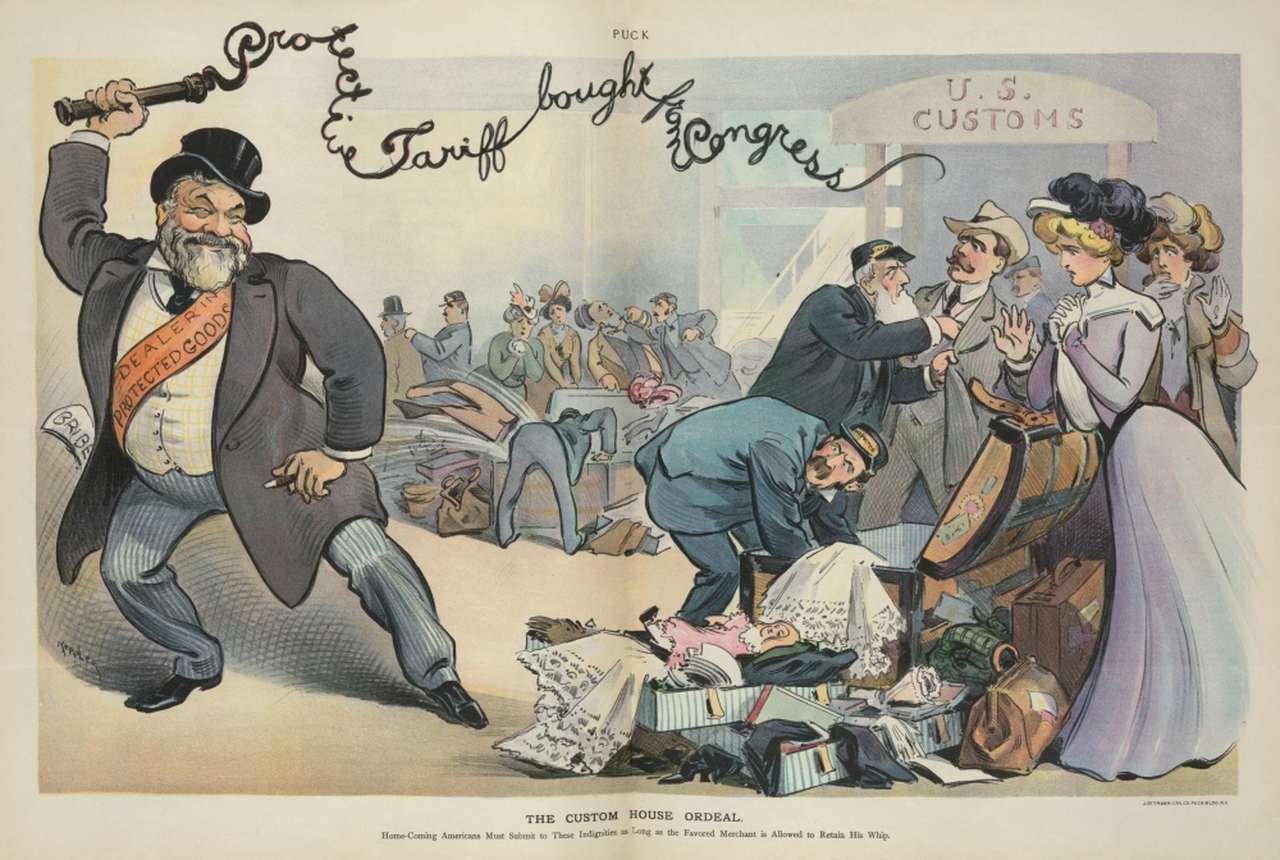
The Tariff Unmasked

It’s the Taxman Dept.: As you struggle to meet the IRS deadline today (actually, the deadline is next Monday, but today’s date has a mystical ethos about it), consider the hidden taxes we must pay, particularly the result of tariffs imposed on imported goods. When Robert Benchley wrote the piece below in 1922, the country was still reeling from the effects of World War I, during which President Wilson lowered or eliminated many tariffs, even while creating the Federal Reserve in order to centralize banking. His tariff-lowering Underwood-Simmons Act also re-established the federal income tax. By 1919, the Republicans had regained control of the House and Senate, and made news with their Emergency Tariff of 1921. No doubt this was on Benchley’s mind when he penned this essay. Still to come from the Republicans was the Smoot–Hawley Tariff Act of 1930, which helped worsen the Great Depression. Just thought you’d like to know.


LET US GET THIS TARIFF THING cleared up, once and for all. An explanation is due the American people, and obviously this is the place to make it.

Viewing the whole thing, schedule by schedule, we find it indefensible. In Schedule A alone the list of necessities on which the tax is to be raised includes Persian berries, extract of nutgalls and isinglass. Take isinglass alone. With prices shooting up in this market, what is to become of our picture post-cards? Where once for a nickel you could get a picture of the Woolworth Building ablaze with lights with the sun setting and the moon rising in the background, under the proposed tariff it will easily set you back fifteen cents. This is all very well for the rich who can get their picture post-cards at wholesale, but how are the poor to get their art?

Monday, April 11, 2022

The Ugly Duckling

From the Classical Vault Dept.: Thirty-five years later, Harlow Robinson’s Prokofiev biography is still the best of an ever-increasing shelf of such studies. But for the best overall picture of the composer and his life, read it alongside Robinson’s more recent volume of selected letters by Prokofiev – and then tackle the three-volume autobiography. And click here for my review of one of the concerts mentioned below.


TEN YEARS IN THE MAKING! Eight trips to the Soviet Union! What sounds like a spy thriller is in truth a biography of one of this century’s most popular and controversial composers, Sergei Prokofiev, written by SUNY-Albany professor Harlow Robinson.

In conjunction with the book, published last month by Viking Press, SUNYA is presenting a festival of Prokofiev’s music in concert and on film.

“I’m glad to be able to do something musical to tie in with it,” says Robinson, who had a hand in the programming of the two concerts.

Saturday at 8 PM pianist, William Jones is joined by a number of other artists at the SUNYA Recital Hall in a variety of Prokofiev’s chamber music. “Bill was very enthusiastic when he heard I was writing the book,” Robinson says. “And he supplied some of the material that’s in it. He studied piano with Alexander Barovsky, who wrote a nice personal portrait of Prokofiev in his memoirs. Unfortunately, those memoirs never got published, but Bill got a copy of them, in Russian, from Barovsky’s widow.”

As soloist, Jones will play Prokofiev’s Sonata No. 3 (“From Old Notebooks”) and selections from the Op. 12 collection. He will be joined by soprano Anne Turner in “Five Poems of Anna Akhmatova,” Op. 27, sung in Russian, and “The Ugly Duckling,” Op. 18.

Friday, April 08, 2022

Feeding the Crowd

From the Food Vault Dept.: I haven’t been back to the Saratoga Performing Arts Center for several years, not since a Philadelphia Orchestra concert I was reviewing there was made miserable by a drunken group of rowdies. But many visits before then had their own fillips of misery thanks to the awfulness of the concession stands, run by Aramark, a huge corporate entity that is taking over the entire world of concessions, it seems. The stands were never well-staffed, the pricing was atrocious, and the food put Stewart’s offerings on a gourmet plane. It wasn’t always like that at SPAC. At least, not in 1990, when the following interview took place.


THE DIVERSITY OF SARATOGA’S SUMMER THRONG is summed up by the food these people eat. It ranges from burgers to banquets, from the costly hot dogs grabbed at trackside to the elegant spreads at the Hall of Springs.

SPAC on a Good Day
Photo: AP/Hans Pennink

Those banquets are put together by Hall of Springs Catering Manager John Piccolo, but he easily sheds the black-tie look for a grillman’s cap. “I’m constantly searching out the market,” he says, explaining this diversity, “to see what the customer wants. To see what I can add to the foods I serve.”

He’s been doing so in Saratoga for nine years, but he’s been in the restaurant business for over a quarter-century. “I had my own place in Albany, and my family owned a little corner restaurant in Schenectady a hundred years ago.”

Like another notable SPAC employee, Piccolo went to college to be an accountant but changed over to foodservice with an emphasis on banquet preparation.

Monday, April 04, 2022

Training, Not Taming

From the Vault Dept.: From 1871 to 2017, the Ringling Bros. and Barnum & Bailey Circus toured the world, an ever-changing spectacle that weathered the many changes in travel, venue, and audience expectation until animal-rights controveries helped shutter it five years ago. Gunther Gebel-Williams was the star animal trainer there for over 20 years. After he retired, he became the organization’s Vice President of Animal Care. He died in Florida in 2001. I interviewed during that final tour in 1990.


IT’S THE LAST TOUR for Gunther Gebel-Williams. The 119th edition of the Ringling Brothers and Barnum & Bailey Circus has been designed to showcase the man who has been the star attraction for 20 years – with a career that went back another 20 years in Europe.

Who will replace him?

A lot of eyes are turning to Mark Gebel, 18-year-old son of the star. Gunther isn’t sure about completely turning over his mantle to the boy. Mark will take over the elephant and horse training when his father leaves the circus, but the tigers go back with Gunther to Florida. “(He) still has to get the trust to train tigers. He is still too young to do it himself,” Gunther says about his son. He’s worried, of course, about comparisons putting one or the other in an unjust light.

This retirement party began in late 1988 and will take in 92 cities before finishing in Pittsburgh in November. It adds one more city to the number racked up by Sarah Bernhardt during her two-year farewell tour in 1916.

The local legs of the journey are Albany and Glens Falls, with performances at 4 and 8 p.m. Tuesday and Wednesday at the Glens Falls Civic Center, and, when they pull into the Knickerbocker Arena, at 7:30 p.m. Friday and Saturday, May 11 and 12, 11 a.m. and 3:30 p.m. Saturday, and 1 and 5:30 p.m. Sunday.

Friday, April 01, 2022

And the Same to You

DUDLEY MOORE devised this piece for “Beyond the Fringe,” the 1960 revue that changed the face of comedy. As he tells it, he came up with it the night before opening night. I had the pleasure of seeing him perform it in the show “Good Evening,” which he and Peter Cook performed in the UK (where it was titled “Behind the Fridge”) and throughout the US. Here’s one of the better-quality YouTube versions.

Monday, March 28, 2022

Virtual Secretary

From the Tech Vault Dept.: Here’s another dinosaur of a piece that I found on an ancient hard drive, but can find no tearsheets in my files that would show me the published product. I’m guessing it ran in about mid-1995. If you find a copy in your mildewed archives, let me know. The chief attraction here is to see how far technology has driven us since I wrote the piece, almost every aspect of which, from a software-and-hardware perspective, has been supplanted.


MANAGING YOUR LIFE these days is like keeping track of a small business. You’ve got to keep track of people like doctors, bankers, brokers, and insurance sellers, not to mention trying to remember a birthday or two. If you’ve got kids, the names increase exponentially. Now let’s say you’re starting to third wave it, working at home a couple of days a week. You need to track who you’re calling and who called you. And if you’re not there to take a call, you don’t want to miss a message.

I do it all with my home computer. I’m too kindhearted ever to bark, “Get Chicago on the line!” to an employee, but I have no problem bossing around my modem. Combine one of the new multifunction modems with good support software and you’ve got yourself a virtual secretary.

If you’re planning to go anywhere near the Internet, you’ve probably already got your eye on a 28,800 bits-per-second modem. Because there’s such a high demand for them, manufacturers are offering all kinds of extras to sweeten the deal. You get faxing. You get voice mail. You even get Caller ID info.

Friday, March 25, 2022

Silk City Classic

From the Food Vault Dept.: I’m not sure where the reference to 1939 you’ll see below came from; according to fairly reliable sources, the structure we’re talking about arrived at 21 Frontage Road in Glenmont in 1962, a classic Silk City diner that initially was christened the Miss Glenmont. Then it became Johnny B’s in 2005, operating until 2020, when it became a pandemic victim. The building’s fate remains uncertain, with some locals wishing to save the structure even as a neighboring Stewart’s eyes it as an expansion site. Here’s what I found there 20 years ago.


WE ARRIVED ON THE HEELS of a party of six that clogged the entryway. Just ahead of them was a party of five, sitting at the counter. Servers bustled by us, arms laden with breakfast goodies. Most of the tables looked crowded. It seemed hopeless.

A recent Google Street View
view of the building.

The crowd shifted slightly. A table bobbed by us, carried by a server who used it to fashion room for six at a booth for four. And suddenly we were beckoned to a booth.

That we were placed between the party of six and the party of five was of little consequence. As I contemplated the menu, I didn’t succumb to the urge to reach behind me and grab the cell phone out of the numbskull’s hand (you’re dining with five others and you need to shout into a phone to somebody else?). Nor did I slap the child with the party of five who erupted into tears from time to time, impervious to his mom’s half-hearted there-theres. I was in too good of a mood.

Besides: It’s a diner. It’s Sunday. It’s slack-cutting time.

Monday, March 21, 2022

Stardust Memory

From the CD Vault Dept.: Back in what we didn’t realize were the waning days of compact discs, the major labels actually did us some favors by allowing quality talent to supervise the re-relase of recordings by quality talent of very bygone days. Dick Sudhalter was the right man to tap for the Hoagy Carmichael set I reviewed some twenty years ago.


HOAGY CARMICHAEL WAS HIP ENOUGH to record with Bix Beiderbecke in 1927 and with Art Pepper in 1956. His song “Star Dust” is a cornerstone of American popular music. He had an easygoing presence in movies, with notable roles in “To Have and Have Not” and “The Best Years of Our Lives.” And his songs have been covered by anyone who dips at all into the standards canon.

The cuts on Bluebird’s “Stardust Melody” were chosen by Richard Sudhalter, whose Carmichael biography recently was published. Although Carmichael was a compelling performer of his own material, others put more definitive stamps on the songs. But Carmichael’s roots were very much in the early years of jazz, and this collection mines the strengths of the RCA Victor catalogue to present versions that are more jazz- than vocal-driven, all recorded between 1925 and 1947. And the 1947 cut, a “Rockin’ Chair” by Louis Armstrong and His All-Stars, is a throwback to the pre-war style.

“Rockin’ Chair” makes two other appearances: in a small-group session with Mildred Bailey, who made a trademark out of the song, and in Hoagy’s own 1929 version. Although the latter, and its session-mate “March of the Hoodlums” are billed as previously unreleased, they in fact appeared with all the other Carmichael-featured cuts on a 1989 Bluebird CD (“Stardust and Much More”).

Friday, March 18, 2022

The Fable of the He-Gossip and the Man's Wife and the Man

Guest Blogger Dept.: I mean, how much of this stuff of mine can you take? Hence this relief, thanks to a return appearance by George Ade. Best known for his inventive Fables in Slang, this particular saga dates from before 1900. It might have been written yesterday.


ONCE UPON A TIME there was a He-Gossip named Cyrenius Bizzy. Mr. Bizzy was Middle-Aged and had a Set of dark Chinchillas. He carried a Gold-Headed Cane on Sunday. His Job on this Earth was to put on a pair of Pneumatic Sneakers every Morning and go out and Investigate Other People's Affairs.

The Scandal | Drawing by
Clyde J. Newman

He called himself a Reformer, and he did all his Sleuthing in the line of Duty.

If he heard of a Married Man going out Cab-Riding after Hours or playing Hearts for Ten Cents a Heart or putting a Strange Woman on the Car, he knew it was his Duty to edge around and slip the Information to some one who would carry it to the Wife. He was such a Good Man himself that he wanted all the other Men to wear long sable Belshazzars on the Sub-Maxillary and come to him for Moral Guidance. If they would not do it, the only Thing left for him to do was to Warn their Families now and then and get them into Hot Water, thus demonstrating that the Transgressor must expect Retribution to fall on him with quite a Crash.

Sometimes he would get behind a Board Fence to see the Wife of the Postmaster break off a Yellow Rose and pass it over the Gate to the Superintendent of the High School. Then he would Hustle out on his Beat and ask People if they had heard the Talk that was Going Around. Of course it Grieved him to be compelled to Peddle such Stories, but he had to do it in the Interests of Morality. If Folks did not have a Pious Protector to spot Worldly Sin and then get after it with a Sharp Stick, the Community would probably go to the Dogs in less than no time. When he had a Disagreeable Task to Perform, such as letting a Merchant know that his Business Partner had been seen slightly Sprung at a Picnic, he always wished to get through with it as quickly as possible, so usually he Ran. He did not want any one else to beat him there, because the Other Fellow might not get it Right.