Search This Blog

Friday, December 31, 2021

I’ve Heard That Song Before ...

WHAT DO BEETHOVEN, CHOPIN, Tchaikovsky, Schubert, Haydn, Dvořák, and Grieg have in common? You’ll find their music in vintage jazz recordings by the John Kirby Sextet, an infectiously bouncy little group that also swung its own versions of melodies by such less-known classical composers as Sinding, Toselli, Donizetti, Delibes, and Massenet. These were terrific versions, too. Listen to Evan L. Young’s arrangement of Schubert’s “Serenade” (“Ständchen,” D 957 #4), and marvel at how the song’s heartbreaking quality is maintained against the band’s swinging pulse.

Kirby believed that his sextet was the ideal size to give such pieces a “tasteful treatment,” as he put it, telling downbeat in 1939, “I believe that symphonic pieces can be handled by jazz groups in such a way that serious music lovers won’t throw their hands up in despair.”

But jazz ensembles large and small have been unable to resist the lure of the longhair, and we can enjoy everything from Duke Ellington and His Orchestra playing “The Nutcracker” to Eddie Lang’s solo guitar performance of Rachmaninoff’s Prelude in C-Sharp Minor.

That’s because music professionals don’t see rigid lines between different types of music. Strict boundaries have, however, been thrown up by others – especially those who market music to particular demographics, and thus it is that we’re inculcated with the canard that classical music is an elitist pursuit, and that those who pursue it merit scorn.

Tuesday, December 28, 2021

Silent Night

I'd like to share another of my video collaborations with Ann-Marie Barker Schwartz, this time realizing a project she suggested to honor her late mother. With Maria Riccio Bryce's arrangement of "Silent Night" as the heart of the piece, Florin Vlad and Natalia O'Connor Vlad created a lovely dance sequence, and it was captured by the skilled videographers at Chromoscope Pictures.

Friday, December 24, 2021

Mark Twain’s Christmas Elephant

Guest Blogger Dept.: Mark Twain’s recently published autobiography runs three volumes, or two and a half if you discount the padding at the end of the third book; but it’s in that book that we read the account of the gift of an elephant that he was supposed to receive for Christmas in 1908. He hired Isabel Lyon as his secretary in 1902 as his wife grew too infirm to handle his correspondence. Ralph Ashcroft was a business associate whom Lyon married in 1909.


TEN DAYS AGO Robert Collier wrote me that he had bought a baby elephant for my Christmas, and would send it as soon as he could secure a car for it and get the temporary loan of a trainer from Barnum and Bailey’s winter-quarters menagerie at Bridgeport. The cunning rascal knew the letter would never get to my hands, but would stop in Miss Lyon’s on the way and be suppressed. The letter would not have disturbed me, for I know Robert, and would have suspected a joke behind it; but it filled Miss Lyon with consternation – she taking it in earnest, just as he had expected she would. She and Ashcroft discussed the impending disaster together, and agreed that it must be kept from me at all costs. That is to say, they resolved to do the suffering and endure the insomnia and save me. They had no doubts about the elephant. They knew quite well that if Robert was inspired to do a kindness for a friend, he would not consider expense, but would buy elephants or any other costly rarity that might seem to him to meet the requirements.

Miss Lyon called up New York on the telephone and got into conversation with Robert. She timidly suggested that we had no way of taking care of an elephant here, it being used to a warm climate and –

“Oh, that’s all right, put him in the garage,” interrupted Robert cheerfully.

Monday, December 20, 2021

The Touches of Sweet Harmony

ONCE I DISCOVERED classical music, I was ineluctably set on a path that would keep me free of the ties of mainstream anything, particularly its so-called culture. Don’t get me wrong: I’m not a total snob. But at least three-quarters of me is suffused with a snobdom that I do try to hide when I’m out in public.

In any event, as a cash-strapped teen, my main source of music became the radio, and in the New York metropolitan area, there were three stations broadcasting fairly full schedules of the stuff I wanted to hear. WQXR AM and FM, the “radio stations of the New York Times,” as it was styled back then; WNCN-FM, which lived in its own rarefied universe; and WNYC, which was a Public Broadcasting affiliate, and thus required to add news and public affairs programs to its roster. (WRVR, WKCR, and WFUV sometimes aired classical works, as did Bridgeport’s WJZZ, so don’t complain that I’ve overlooked them.)

And there was a booming yet dulcet voice that issued from the speaker late at night over WQXR, and then on WNCN, and then on WBAI, depending on how fed up any of those stations had grown with Bill Watson. And vice-versa. He was peripatetic. He was opinionated. He was devoted to Walter Gieseking and Jussi Bjoerling, among others, and was inclined to favor their recordings, often in marathon sessions.

Friday, December 17, 2021

Caution (A Legend)

Guest Blogger Dept.: This blog is getting verse – specifically, another poem by P.G. Wodehouse. The creator of Jeeves and Lord Emsworth was also a renowned lyrist in his day, contributing the words to Jerome Kern’s tunes in a series of acclaimed pre-Gershwin musicals. But this predates even that, a tender ditty that creates its own music.


[How many a doctor or architect must own that his professional life consisted of two periods – one in which he was too young to be trusted, the other in which he was too old to be efficient. – Times’s leading article]

O, read my melancholy rhyme,
Peruse my mournful ditty,
Two men there dwelt upon a time
Within a certain city.
Both were distinctly men of parts,
Well versed in their respective arts.

To fell diseases of the kind
That everyone who can shuns,
One of this pair had turned his mind,
The other’s forte was mansions.
They were, as you’d no doubt expect,
A doctor and an architect.

The latter, when but twenty-nine,
Planned a Titanic building,
A house of wonderful design,
All marble, stone, and gilding.
Said he: “My fortune’s made, I wis,
Men can’t resist a thing like this.”

Monday, December 13, 2021

Instruments of Control

From the Soapbox Dept.: I suppose it was those first few years of concert-reviewing that inspired the piece below, as I was confronted with the appalling sameness of one classical-music concert after another. Now, twenty-four years later, most of my working days are spent with music in the background. But at least it’s music I chose to semi-listen to.


MUSIC HAS THE CAPACITY of being the least instrusive of the arts. That gives it the potential of being one of the most manipulative. Thanks to decades of proper conditioning – conditioning we’ve undergone since birth – we are no more aware of such manipulation than we are of our breathing. (Until a more obtrusive purpose is required and the political thrust of a hunk of music is made obvious. You know the sound of a protest song: it sounds stirring and is excitingly fun to sing.)

The musical identity of this country has its fussy heart in a generation-to-generation revision of values signified by the evolution of a tangled vine of musical stylings. It began at the beginning of the century, when jazz unseated the dry huffings of a boring crew of classical composers (slaves to a European tradition), and it ended with the end of the folk-song boom of 20 years ago.

Significantly, we’re once again listening to what the Europeans are saying – if we’re listening at all.

Continuity of music is found in celebration; change is fueled by rebellion. More drastic musical change was effected in the United States during this century than anywhere else in the world over any given time period, yet it’s a history so fraught with compartmentalization that a view of any appreciable scope must be sewn together from scattered ingredients.

Friday, December 10, 2021

To a Tee

From the Tech Vault Dept.: The evanescence of technology is such that nothing in the article below has any currency. The company that made those printers is gone, and you’re now able to design a T-shirt and upload the design to a company that will provide the finished product for far less than you’d invest for the products below. We’re going back twenty-five years, after all. (Photos by John Popplewell.)


LIFE’S SIGNIFICANT ACHIEVEMENTS are often marked with trophies and plaques and, more whimsically, clothing. Whether it’s your baseball team’s recent victory, your church choir’s tour, or simply surviving another year at work, there are celebratory messages to be worn.

The T-shirt-inscription business has flourished accordingly. Needless to say, there are folks who do very good work in this field, but you still have to relinquish control when you hire somebody else to do it for you. Thanks to your skill at the computer, though, that’s no longer the case. Anything you can render onscreen can be turned into a professional-looking tee with the help of Fargo Electronics’ PrimeraPro Color Printer and its special T-Shirt Transfer Paper. Design it, print it, iron it on. It’s that simple.

Once you make the investment in the printer, your per-shirt cost is much less than a commercial outfit charges, especially for a limited run. And the possibilities open up from there. Printed garments (let’s not forget sweatshirts) have great fund-raising potential. It’s nice and sentimental for your group to promote itself by sporting appropriately legible clothing; it’s often nicer and more profitable for your group to sell those shirts to its fans.

Ultimately, you’ll be able to make a business out of it. With a good graphics program, a creative eye, and a collection of headline typefaces, you already have the design tools. Add an entrepreneurial spirit and the PrimeraPro printer, and you’re ready to go. It’s a trade you should get into – if you’ll pardon my saying so – while the iron is hot.

Monday, December 06, 2021

Something to Believe In

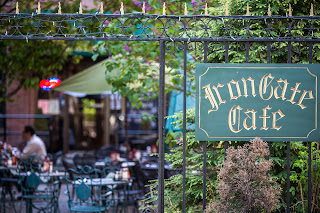
From the Food Vault Dept.: After the demise of Albany’s Metroland Magazine, there was a short-lived pseudo-alt-weekly that was published for a while under the hopeful name of The Alt. It had none of the alternative-news sensibility one expects from such a paper, and it was further hampered by its editor’s very limited cultural intelligence. I wrote some pieces for the mag during its brief existence; here’s one. As of this writing, the Iron Gate continues to thrive.


IT WAS AN UNLIKELY BIRTH for a restaurant. “I’ve always related to the Ramones,” Kevin Dively explains. “I bought my sister one of their albums for her birthday when she was, like, ten – because I wanted it – and it changed my life. I mean, at the time, what was the music out there? And here are the Ramones! So me and my brother and a neighbor decided that we could do this, and we started a band.”

Which meant he didn’t fit well into the nine-to-five employment paradigm. “When you’re doing the band thing, the one job you can always get is a restaurant job. So I bounced around a lot of restaurants.”

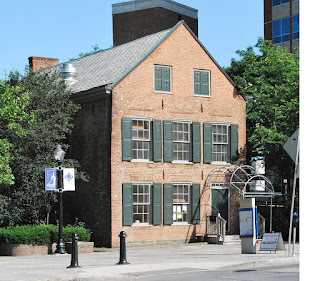
Meanwhile, his parents had bought and restored a four-story Victorian mansion in downtown Albany, the onetime School No. 10 that was owned by industrialist James Holroyd in the 1890s. The single-family structure came with a small office space attached, “but the people in there moved out because there wasn’t any parking. My dad didn’t know what he was going to do with it, so I said ‘Let’s put a little sandwich shop in there.’”

Friday, December 03, 2021

Mosaic on the Move

MOSAIC RECORDS WAS FOUNDED, nearly forty years ago, with the mission of reissuing great jazz recordings in a way that best showcases a particular artist or label. The reissues are prepared from the best source material that can be found, with skillful audio restoration to minimize noise while maintaining the music’s integrity. This is the Criterion Collection of recorded jazz. When one of the limited-edition box sets sells out, you’ll find it on eBay and elsewhere for far more than the original retail price.

Michael Cuscuna
As co-founder Michael Cuscuna wrote in 2017, “Charlie Lourie and I started Mosaic Records in 1982 and our first releases were in 1983. The company was almost an afterthought. The idea of definitive boxed sets of complete recordings by jazz masters at a crucial time in their careers was a small part of a proposal that we made to Capitol Records in 1982 to relaunch the Blue Note label. Even before Capitol turned us down, it occurred to me one night that the release of these boxed sets could be a business unto itself if we made them deluxe, hand-numbered limited editions sold directly to the public.” And so it has been, with each box set limited to a few thousand numbered copies, each boasting a booklet renowned for its scholarly essays and exhaustive discography.

Now, 271 box sets later, Mosaic is closing its offices. If you’re on the list, you got the e-mail. (If you’re not, you can sign up at mosaicrecords.com.) It sounded a little alarming, especially considering the financial perils the company has shared in the past. But Cuscuna assures us that it’s a positive step. The email also invited the record label’s fans to an open house. Not the first one that Mosaic has held, but this would be the last.

Monday, November 29, 2021

No Coincidence

From the Food Vault Dept.: It took over fifteen years to discover why there was a job opening that enabled me to get hired for my first job cooking in a professional kitchen. The piece below describes the reason. The Quackenbush house has since gone through several incarnations, including a couple of French-cuisine stints on into its current impression of an English pub.


HE MIGHT AS WELL HAVE BEEN reciting poetry. Everything Maurilio said as he described his menu and his restaurant agreed perfectly with my own ideas of excellent food. To properly appreciate the broad range of restaurants in existence requires a flexible standard, but what Maurilio Gregori has done to the Quackenbush House is exactly what I’d do were I to open my own place.

The Quackenbush House, in a
more recent view.

Although Marina, my literary companion, and I came in unannounced early last week, Maurilio lavished the kind of attention on us you’d expect would be reserved for a wealthy regular. When he got down to cases, describing the evening’s specials, I was astonished. A native of northern Italy, he shuns the pasta-and-sauce emphasis of much Italian-American cooking. “You could call this continental,” he says, “but I’d hate to have it labeled.”

“It’s exactly how I was taught to cook,” I told him, describing the Italian chef who gave me my start in the kitchen and insisted on the same care and consistency. And then this shared attitude turned out to be no coincidence at all: Maurilio got his start at the same restaurant, the Elms Inn in Ridgefield, Conn., several years before I worked there. The chef who proved so influential was a brilliant, temperamental man named Mario Scala, who taught us that a sincere passion for life was the only proper context for the love of food that lures you into the business. That celebration is a hallmark of Maurilio’s restaurant.

Thursday, November 25, 2021

Old Folks at Home

Our second pandemic-era Thanksgiving! How exciting! I didn’t think “frustration” was a sound culinary theme; instead, I decided to smoke a turkey but put alongside it some grilled picanha. On Thursday, the weather was vile enough that I forsook the smoker and roasted the bird instead, adding some smoked paprika to its seasonings to give it a hint of that outdoor flavor. The menu is pictured; our slide-show history of Thanksgiving menus is here.


Monday, November 22, 2021

Myth America

MANY, IF NOT MOST, of the stories you read here offer encouraging observations about people and places and the things they write and do that encourage or contribute to food safety. But sharing a look at André Leu’s book The Myths of Safe Pesticides is like making you watch a horrifying movie that ends badly. As has been said in many such movies, “They’re already here,” and the monstrosity of pesticides not only is all around us, it’s also within us as well.

So don’t look for an uplifting conclusion. “History will look back with amazement,” writes Leu in the book’s conclusion, “that no only did our regulatory authorities know that these substances were toxic, (but also) for decades they ignored a huge body of hundreds of credible scientific studies written by several hundred scientists that documented the multiple harmful effects they cause to humans and the environment.”

That’s it in a (probably poisonous) nutshell. He further points out that it can’t be ascribed to ignorance, as was the case with some of the lethal practices of ancient societies (drinking cups of lead, immortality pills of mercury). And he generously ponders the causes, offering “incompetence, laziness, corruption, protecting reputations ... or greed on the part of a few to generate great wealth at the expense of the many.” I’m willing to go pretty exclusively with that last one. Greed has always been the major motivator of any self-styled ruling class, and it shows itself clearly in the confusion fomented around our current pandemic.

Friday, November 19, 2021

Elizabeth’s Dream

Another collaboration I enjoyed with Musicians of Ma’alwyck offered the challenge to feature a 19th-century schoolhouse in Glenville, NY. We decided on a Civil War-era setting, and I devised a story in which a Quaker schoolteacher is confronted with something that was all-too-common on Quaker households back then.

Monday, November 15, 2021

Taking It in Stride

From the Theater Vault Dept.: During its brief tenure at the Cohoes Music Hall, Heritage Artists, under the inspired direction of Robert Tolan, turned out one fantastic production after another. If they’d been located in an area that appreciated the arts, they would have blossomed into something much bigger.


THERE IS A LONG, POIGNANT moment near the end of this play when Strider, a piebald horse, recognizes his former master, Prince Serpuhofsky. Both are old and disheveled, “put out to pasture.” Possessor and possession, each now lacks the necessary other. But only the one-time possession recognizes the tragedy of the situation.

Charles Turner

The moment lasts just long enough to make us nervous even as we wrestle with mixed feelings about our own self-defining material goods and abstractions. It’s a moment we only can experience in live theater, and if that moment moves and enlightens us, then this is what live theater is all about.

“Strider” sings a song that informed much of Tolstoy’s work, and this stage adaptation has the added zip of an attractive score with a very Russian flavor. Tolstoy was concerned with the serfdom system, and the allegory moves right into the 20th century with the use of a Black actor in the title role.

Charles Turner plays the part in a black-and-white costume with a streak of clown white across one side of his face. He is the oddity in the stable, the stallion who is not allowed to breed. But he is a stallion of noble lineage who can’t accept this system of possession, passed as he is from the Count (Doug Tompos) to a groom (Lloyd K. Waiwaiole). And he can’t separate breeding from loving, an emotion stirred by the mare Viazapurika (choreographer Deborah Stern). Strider competes for her attention by racing another stallion, Darling (Tompos), and wins the race even as he loses the mare to his treacherous opponent.

Friday, November 12, 2021

I Like Spike

JORDAN YOUNG DIDN’T HAVE TO write a new book about Spike Jones. He covered the topic quite adequately when he came out with the first-ever biography of the bandleader in 1984, and he expanded that book a decade later, and again a decade after that. But the latest, recently published fourth edition of Spike Jones off the Record (BearManor Media) is larger and more lavish still, nearly 500 pages of biography, analysis, anecdote, and discography.

I was already impressed with Young’s dedication to this purpose back when the second edition came out. I compared it to the earlier book and discovered that he rewrote sections to add information, correct errors, or streamline the text. I’m even more impressed with the transition to edition four (the third edition escaped me). Compare it with its predecessors and you find that all of the earlier chapter titles reappear, but in the decades between editions, lots of new info has come to light, and Young has been diligent about gathering it, alongside more photos and other memorabilia, which are reproduced in this volume more crisply than in the earlier editions. .

The new book has gone back to the large format book of the first edition – the second was eye-strainingly smaller – but it’s easier to read than both of the others, with a slightly larger typeface and good use of a two-column format.

Monday, November 08, 2021

The Yates Sisters

Ann-Marie Barker Schwartz, who founded and runs the chamber-music group Musicians of Ma’alwyck, likes to explore the history of composers, performers, and even buildings, so it’s natural that she should bring together these interests – in this case, in a video short constructed around the Yates Mansion in Glenville, NY. It’s a historic building undergoing renovation, so when we shot this piece, we had only a few feet of finished wall to work against. For me, these videos can become a family affair, as here, where my wife is working behind the scenes and that’s my daughter in blue.

Friday, November 05, 2021

A Bouquet of Ives

From the Classical Vault Dept.: Wondering what I might have been up to, culturally speaking, thirty-five years ago, I came upon this piece, written as an advance for the Schenectady Gazette, back in the day when newspapers felt a responsibility to promote classical concerts. Back when there were newspapers. I’m sorry I didn’t see the concert itself, and can’t remember why, but Drury has gone on to a significant career as a pianist and conductor who continues to champion comparatively recent works. Here’s his website.


“I offer a couple of kinds of ordinary programs.” says pianist Stephen Drury, “with pieces like some late Schubert sonatas and selections from Bach’s ‘Well-Tempered Clavier.’ I do a program that is half John Cage and half a collection of other American composers. But the people in Troy asked me for the all-Ives program, and I was happy to oblige.’

Stephen Drury
Drury is a rare kind of American pianist, one who eagerly supports the work of American composers. His recital at the Troy Music Hall at 3 p.m. Sunday consists of three sonatas by Charles Ives, the turn-of-the-century firebrand whose work is still only gradually being discovered and accepted by the concert-going public.

“I guess my interest in 20th-century music goes back to when I was in junior high school,” says Drury. “I happened upon a book on the subject by Peter Yates, and I started listening to records and playing the music. I was at the perfect age to discover the music, and it’s stayed with me.”

Drury’s Ives recital also features his own introductions to the pieces. “It seems always like a good idea to explain what’s going on. Even though the pieces were written 70 to 80 years ago, they’re still so unfamiliar to the lay listener that they lend themselves to some comments. If you’re not sure what to listen for with Ives it can sound pretty dissonant.”

Monday, November 01, 2021

The Fable of the Man Who Didn't Care for Storybooks

Guest Blogger Dept.: We need to hear again from George Ade, especially as we begin stockpiling books for the winter.


ONCE THERE WAS A BLUE DYSPEPTIC, who attempted to Kill Time by reading Novels, until he discovered that all Books of Fiction were a Mockery.

After a prolonged Experience he came to know that every Specimen of Light Reading belonged to one of the following Divisions:

1. The Book that Promises well until you reach the Plot, and then you Remember that you read it Summer before last.

2. The book with the Author's Picture as a Frontispiece. The Author is very Cocky. He has his Overcoat thrown back, so as to reveal the Silk Lining. That Settles it!

3. The Book that runs into a Snarl of Dialect on the third Page and never gets out.

4. The delectable Yarn about a Door-Mat Thief, who truly loves the Opium Fiend. Jolly Story of the Slums.

5. The Book that begins with a twenty-page Description of Sloppy Weather: "Long swirls of riven Rain beat somberly upon the misty Panes," etc., etc.

Friday, October 29, 2021

Witch

Scenes from Childhood Dept.: Here's a  re-run which first appeared here in 2009, but was initially published in Metroland Magazine in 1986, before it went all alt-weekly.


A KID UNDERSTANDS the importance of tracking down the neighborhood ghouls. The kid knows (as parents don’t) that those ghouls exist. It’s just a matter of finding them.

We had a witch on our street. I don’t know if we really saw her as someone who consorted with bats and such, although the movie “The Three Lives of Thomasina” gave witches a pretty good image. But we convinced ourselves that this lady was at least gently malevolent—and she certainly added a tinge of excitement to my afternoons.

It was our after-school ritual to tramp through the woods behind the houses on my street, back in a time before my Connecticut town annexed itself to New York City and lost its woodland to developers. Next-door neighbor Kenny, my brother, and I built primitive shelters and hacked at the bark of trees.

We discovered, on a neighbor’s property, an abandoned car. It sat in a woodsy corner of an otherwise immaculate lot, a hulk with the squatty wheelbase and sloped top of a vehicle in an old gangster movie, pale blue where any paint survived. At first we just sat in the smelly old thing, imagining it to be a limo or rocket or time machine. Than we got more rambunctious. I jumped on the roof, enjoying the bouncy resilience of the metal. My brother broke the windows, delighted with the reticulation of the old safety glass. Kenny peed on the engine.

Our games got noisy and attracted the property’s owner. She came after us waving a stick, like the lady on the old Dutch Cleanser can, careening across a quarter-acre of fresh-trimmed lawn to flush us from her rotting car.

We fled, in terror and giggles. Of course she was a witch! It wasn’t our noise that had attracted her, but a sixth sense or a crystal ball. The stick she wielded was a spell-casting wand. The car was a trap . . . .

Monday, October 25, 2021

Pastoral Song

JAMES REBANKS SNEAKS UP ON YOU. His prose is colorful and decisive. He’s writing about nature, which encourages lavish description, but he’s writing about the indignities humans have imposed on nature, which encourages hand-wringing. He does neither. He is a documentarian sharing a first-person farming experience in such a way that broader truths are easily perceived, and he is hopeful enough to keep it from seeming too apocalyptic.

Pastoral Song is Rebanks’s third book, following The Shepherd’s Life and The Shepherd’s View, both of which earned him deserved praise. Pastoral Song was published last year in the U.K as English Pastoral and promptly hit the best-seller lists. That in itself is hopeful, as this book takes aim at the horrific consequences of industrial farming, something that can be reversed only if enough people understand how they can participate in that change.

The story starts on a farm in the north of England, where a very young Rebanks learns to work the fields and livestock alongside his grandfather, a man who held new farming technologies in disdain. “There was something about working the land on foot behind a horse that seemed to make him see the world differently from the way later generations would see it from a powerful tractor. My grandfather knew our fields as if they were extensions of his body.”

It’s a portrait of his grandfather’s farm, but it’s also a portrait of England as an agricultural nation, struggling to keep up with 20th-century changes. “Time seemed to slow down around my grandad,” writes Rebanks, “He believed in watching carefully and taking time with his animals.” It’s a farm populated with the cows and sheep that Rebanks’s father and grandfather are managing, but it also boasts plenty of other fauna and flora that thrive in the wild. Not all of them benevolent, of course – there’s a passage describing the struggle to take down thistles using sickle and scythe – but all existing together in a natural and important harmony.