Search This Blog

Friday, October 29, 2021

Witch

Scenes from Childhood Dept.: Here's a  re-run which first appeared here in 2009, but was initially published in Metroland Magazine in 1986, before it went all alt-weekly.


A KID UNDERSTANDS the importance of tracking down the neighborhood ghouls. The kid knows (as parents don’t) that those ghouls exist. It’s just a matter of finding them.

We had a witch on our street. I don’t know if we really saw her as someone who consorted with bats and such, although the movie “The Three Lives of Thomasina” gave witches a pretty good image. But we convinced ourselves that this lady was at least gently malevolent—and she certainly added a tinge of excitement to my afternoons.

It was our after-school ritual to tramp through the woods behind the houses on my street, back in a time before my Connecticut town annexed itself to New York City and lost its woodland to developers. Next-door neighbor Kenny, my brother, and I built primitive shelters and hacked at the bark of trees.

We discovered, on a neighbor’s property, an abandoned car. It sat in a woodsy corner of an otherwise immaculate lot, a hulk with the squatty wheelbase and sloped top of a vehicle in an old gangster movie, pale blue where any paint survived. At first we just sat in the smelly old thing, imagining it to be a limo or rocket or time machine. Than we got more rambunctious. I jumped on the roof, enjoying the bouncy resilience of the metal. My brother broke the windows, delighted with the reticulation of the old safety glass. Kenny peed on the engine.

Our games got noisy and attracted the property’s owner. She came after us waving a stick, like the lady on the old Dutch Cleanser can, careening across a quarter-acre of fresh-trimmed lawn to flush us from her rotting car.

We fled, in terror and giggles. Of course she was a witch! It wasn’t our noise that had attracted her, but a sixth sense or a crystal ball. The stick she wielded was a spell-casting wand. The car was a trap . . . .

Monday, October 25, 2021

Pastoral Song

JAMES REBANKS SNEAKS UP ON YOU. His prose is colorful and decisive. He’s writing about nature, which encourages lavish description, but he’s writing about the indignities humans have imposed on nature, which encourages hand-wringing. He does neither. He is a documentarian sharing a first-person farming experience in such a way that broader truths are easily perceived, and he is hopeful enough to keep it from seeming too apocalyptic.

Pastoral Song is Rebanks’s third book, following The Shepherd’s Life and The Shepherd’s View, both of which earned him deserved praise. Pastoral Song was published last year in the U.K as English Pastoral and promptly hit the best-seller lists. That in itself is hopeful, as this book takes aim at the horrific consequences of industrial farming, something that can be reversed only if enough people understand how they can participate in that change.

The story starts on a farm in the north of England, where a very young Rebanks learns to work the fields and livestock alongside his grandfather, a man who held new farming technologies in disdain. “There was something about working the land on foot behind a horse that seemed to make him see the world differently from the way later generations would see it from a powerful tractor. My grandfather knew our fields as if they were extensions of his body.”

It’s a portrait of his grandfather’s farm, but it’s also a portrait of England as an agricultural nation, struggling to keep up with 20th-century changes. “Time seemed to slow down around my grandad,” writes Rebanks, “He believed in watching carefully and taking time with his animals.” It’s a farm populated with the cows and sheep that Rebanks’s father and grandfather are managing, but it also boasts plenty of other fauna and flora that thrive in the wild. Not all of them benevolent, of course – there’s a passage describing the struggle to take down thistles using sickle and scythe – but all existing together in a natural and important harmony.

Friday, October 22, 2021

The Main Events

From the Food Vault Dept.: The restaurant visit described below took place twenty years ago. It turns out that the space we visited has seen a tumult of eateries within, going back at least to the 1970s, when it was the Capitol Restaurant. In 1997 it became Zoie’s; three years later it became Fifty-Five Main, but that lasted only two years, at which point it became Milan at 55 Main, under which aegis it had a six-year run. In 2008 it started an eleven-year run as The Hub, until Mark Meehan and Debra Morandi bought it and renamed it the Capitol, as which it still operates ... but the place is for sale. Here’s what we found there in 2001.


WITH THAT ARRAY of once-dark factory buildings now bustling with light and art as the Massachusetts Museum of Contemporary Art (Mass MoCA), the old industrial town of North Adams, Mass., is easing back to life. It couldn’t be a more pleasant drive than now, with colorful trees accompanying your journey past Troy and through Williamstown, and the museum has so much to offer that your afternoon will be well filled.

The property at 55 Main, in a
much more recent view.

Then you’ll want something to eat.

The short stretch of Main St. is a short walk from the museum, and tucked away in the storefronts, between an excellent used book store and a small live-performance theater, is a restaurant whose name is its address, 55 Main. Ray Arsenault quit the computer business to open the place, and he bustles between the bar and the door, greeting and seating, making sure folks feel welcome and happy.

As befits a restaurant in a town newly defined by art, the place is decorated with an array of sculpture and design. Make sure you check out the kitchen area, in full view of the floor, to see the unique design elements there, protecting chef Susannah Warren.

Tables are small and undraped with linen, which works just fine – they’re handsome and fit well with the design. The menu, too, is sleek and brisk, with a good array of New American offerings.

Monday, October 18, 2021

Norwegian Rhubarb

“NORWAY BECAME OIL-RICH in the 1970s, so our view of the country is as a prosperous place on the right side of human rights,” said Darra Goldstein, introducing a talk about Norwegian culinary practices. “But before that they were seen as poor, and the Swedes and Danes looked down on them.”

We were assembled at the Lunder Center at the Clark Art Institute in Williamstown, Mass., at an array of tables where each place was set with a slice of rhubarb Tosca cake. Darra Goldstein is Professor of Russian, Emerita at Williams College and founding editor of Gastronomica: The Journal of Food and Culture, which was named the 2012 Publication of the Year by the James Beard Foundation.

She also currently serves on the Kitchen Cabinet of the Smithsonian’s National Museum of American History and on the Advisory Board of the Julia Child Foundation for Gastronomy and the Culinary Arts. She’s been a featured speaker at the institute many times before, and this time was tasked with tying in a look at Norway’s food with the Clark’s exhibition of the art of Norwegian painter (and farmer) Nikolai Astrup.

“It’s a difficult country to farm,” Goldstein said. “Only three percent of the land is arable. Many farmers concentrate on raising cows and goats for dairy products – I’m sure you’re familiar with Jarlsberg, which is the least interesting of their cheeses – while many more make a living from the sea.”

Friday, October 15, 2021

The Immortal Story

Early in the summer of 2021, I had the pleasure of crafting a new libretto for a one-act opera titled “The Ship’s Captain.” It was originally created in around 1820 by Carl Blum, a German composer, who in this case borrowed the pastiche style of “The Beggar’s Opera” and set lyrics to what would have been well-known tunes. I kept the tunes but had to craft all-new lyrics for this delightfully silly tale of two sisters competing for the hand of a man they’ve yet to meet, even as they flirt with his supposed emissary. Here’s one of the songs, a trio exploring the lessons of mythology. The singers are soprano Yvonne Trobe, baritone Charles Eaton, and mezzo-soprano Joelle Lachance, performing with the Musicians of Ma’alwyck, recorded live at Hyde Hall in Cooperstown on Jun 25, 2021.

Monday, October 11, 2021

Franking, My Dear

From the Tech Vault Dept.: I had a brief run of tech-oriented articles in Metroland magazine, Albany’s alt-weekly for which I wrote for some three decades, and this is one such piece. Over the twenty years since it was published, the technology has changed – but not much. At least at my end. I’m still using stamps.com, still getting postage out of a Dymo printer, but it sure isn’t costing 34 cents for a first-class letter. And thanks to the reign of Louis DeJoy, a once-efficient postal service now struggles.


COMPUTER CONVENIENCES have come into their own with the Internet as a driving force. Online buying made the news over the holidays, but it goes well beyond that with online research, online entertainment and such online oddities as recovering lost money, paying bills, managing group projects – even buying checks and tracking bank and credit card accounts.

And, although e-mail is fast and convenient, not everyone is online. That’s why I’m using the Internet to buy postage. Mailing a letter to any address in the United States for merely 33 cents – make that 34 cents – is still a bargain. Snail mail? Not compared to some postal services in Europe and Asia. The U.S. Post Office’s service is impressively reliable (that’s a lot of mail they’re moving) and you can pay extra for the peace of mind of express delivery and/or a return receipt.

The most economical way to purchase that postage is over the counter (or from a machine) at a post office or other stamps-friendly outlet (friendly means not slapping a surcharge on the sale). The most convenient way is with a postage meter, but they’re expensive. You have to rent the meter, buy postage, and have the meter reset at the post office.

Friday, October 08, 2021

Russian Hours

From the Classical Vault Dept.: I’m not sure if this piece ever actually ran in Metroland – CD reviews, at least from me, wafted in an editorial limbo for a while – but I’m assigning the date on which it probably would have appeared. Although the likes of Beethoven and Mozart have warranted box sets of their complete works, to collect all of Prokofiev requires diligence. The sets reviewed below are helpful components.


ALTHOUGH THE RECENT Bard Summerscape Prokofiev festival offered plenty of reasons to continue to celebrate that composer’s music, I’ve never required any extra excuse. Prokofiev managed the difficult feat of writing forward-thinking, challenging works livened with appealing melodies, fascinating rhythms, instrumental combinations that are surprising and satisfying and an old-fashioned sense of architectural cohesion. In short: great stuff.

Sergei Prokofiev
His seven symphonies – eight, if you count that fact that he re-worked number four and both versions remain in the repertory – could not be more varied. His first was a jewel-like tribute to Haydn, but sporting characteristically wide-leaping themes. The second, inspired by Beethoven, is a theme and variations of such fury that it’s like being stuck in a room with someone shouting at you. By 1944, the time of his fifth symphony, he’d stayed away from the form for several years and, influenced by the war, he wrote a sweeping, unsettling work that has become the most popular of his symphonies.

The popularity of number five unfairly overshadows the equally appealing sixth, while the final symphony, composed a year before Prokofiev’s death in 1952, returns to the more simple world of the first.

Monday, October 04, 2021

Road to Glynwood

From the Fields and Forests Dept.: A few days ago I posted a review of Laura Lengnick’s book Resilient Agriculture. Here’s a follow-up piece about her recent activities.


LAURA LENGNICK IS, among many other pursuits, a soil scientist who has put in over 30 years of work as a researcher and policy maker, a teacher and, most especially, a farmer, whose focus is on sustainability in agriculture and, therefore, food systems. Research for her book Resilient Agriculture (reviewed here) took her throughout the country to see how other farmers were coping with problems of climate and economics; now she’ll be taking this experience to New York’s Hudson Valley as she becomes the Director of Agriculture at Glynwood in September.

Laura Lengnick

Glynwood, based in Cold Spring, NY, is a farm with a mission is to help small- and mid-sized farmers in the Hudson Valley and beyond by strengthening agricultural communities and regional food systems – including the re-regionalization of the U.S. food system as a whole.

Lengnick is based in Asheville, North Carolina, “so the plan is that I’ll be living and working at Glynwood for about 18 months to learn the farm and feel it through all the seasons,” she said, speaking from her home. “I’ll get to build relationships with both the staff and in the agriculture community. Then at some point I’ll head back to Asheville and do the job from there.”

Although there would seem to be a great deal of difference between the two areas, Lengnick finds a great deal of commonality where food and agriculture are concerned. “Asheville has a very active local food movement, with local farming and lots of organizations promoting healthy eating and connecting from the farm to the plate. But then in some ways they’re really different. Each of them has its own culture and landscape.”

Friday, October 01, 2021

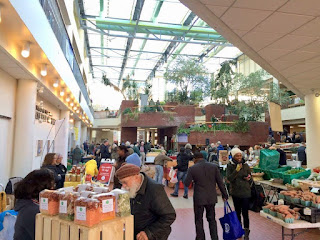
Wintry Market Mix

From the Food Vault Dept.: What’s encouraging is that, thirteen years later, almost all of the winter farmers’ markets detailed below are still in operation.


IT’S MORE THAN GOURDS AND COLLARD GREENS. Winter produce is tough-skinned stuff, those spaceship-like spears of Brussels sprouts perhaps the most emblematic. And while it’s true that these are good things to eat and you celebrate the season by eating them, you’ll find much more than cold-weather comestibles at those farmers markets that choose to run through the winter.

The phenomenon of these markets has been considerable and impressive, not only offering consumers fresh, locally grown items but also presenting the growers themselves. And bakers. And cheesemakers. And craftspeople.

Nothing beats being able to admire a loaf of bread and while you’re learning its provenance. For some, an accurate ingredients list is vital. For some, there’s a wonderful sense of community in the act of eating locally grown and/or assembled stuff.

The number of local farmers markets has exploded, giving us an unprecedented warm-weather bounty. I’m sure you’ve seen it: booth after booth of vegetables, fruit, meat, cheese, honey and milk, along with artisan products like crafts, sauces, jam, clothing – anything made by hand.

Monday, September 27, 2021

Planting Your Future

NEW DEMANDS from a dynamic global economy, continued decline in the quality and availability of natural resources, and the unprecedented challenges of climate change are just beginning to take their toll on the U.S. food system. That’s the starting point of Laura Lengnick’s book Resilient Agriculture, Cultivating Food Systems for a Changing Climate (New Society Publishers, Gabriola Island, British Columbia, Canada, 2015), which she researched and wrote in what seem now like the halcyon days of 2013-14, when the Obama administration’s responses to the challenges of climate change had begun to build some momentum, however slow. Now, with the U.S. government taken over by the corporate interests who profit from All Things Unsustainable – to the point of completely denying the irrefutable man-made contributions to global warming – her book takes on more urgency than ever.

Ironically, it argues that we can change our farming ways without governmental assistance, an approach that seemed amusingly maverick until Jan. 20. Now it’s absolutely vital if we want to continue to eat well even as the waters rise.

Lengnick visited 25 farmers across the United States, choosing those who had been in that business for at least twenty years, noting that many of them were fourth- or fifth-generation families working the soil.

The Great Plains, for example, is a major source of feed grains and cattle, but higher temperatures and greater rainfall has challenged third-generation Kansas farmer Gail Fuller to move to a no-till approach in order to reduce erosion (and save on fuel costs). He also stopped raising livestock – it was thought that cows “were too destructive to soils and the damage they caused by trampling farm ground couldn’t be fixed without tillage,” as he explained. But his erosion continued. He blamed that on his focus on corn and soybean production, so he added cover crops, increased crop rotation, and brought back the cattle, with the goal, as Lengnick explains, of “keeping a living root in the ground at all times.”

Friday, September 24, 2021

Thoughts on Fuel Saving

Guest Blogger Dept.: Robert Benchley returns with, well, thoughts on fuel saving, which are most appropriate as we enter autumn. Mr. Benchley has been doing heroic service here imparting his wisdom about topics I’m too bashful to cover.


CONSIDERABLE SPACE HAS BEEN GIVEN in the magazines and newspapers this winter to official and expert directions on How to Run Your Furnace and Save Coal—as if the two things were compatible. Some had accompanying diagrams of a furnace in its normal state, showing the exact position of the arteries and vitals, with arrows pointing in interesting directions, indicating the theoretical course of the heat.

I have given some time to studying these charts, and have come to the conclusion that when the authors of such articles and I speak the word “furnace,” we mean entirely different things. They are referring to some idealized, sublimated creation; perhaps the “furnace” which existed originally in the mind of Horace W. Furnace, the inventor; while, on the other hand, I am referring to the thing that is in my cellar. No wonder that I can’t understand their diagrams.

For my own satisfaction, therefore, I have drawn up a few regulations which I can understand, and have thrown them together most informally for whatever they may be worth. Any one else who has checked up the official furnace instructions with Life as it really is and has found something wrong somewhere may go as far as he likes with the results of my researches. I give them to the world.

Monday, September 20, 2021

Jardin à la Française

From the Food Vault Dept.: I ran the review below on this blog a decade ago as the sidebar to another piece from the same Metroland issue. I noted that this review visit was in the company of a stranger, someone who had won the privilege of a review meal with me at some arts auction to which I foolishly agreed to donate the event, and we had absolutely nothing to talk about during the course of the meal. So I never mentioned her in the piece. Chef-owner René Facchetti sold the business a year after this review appeared, his successors didn’t seem to get more than a couple of years out of it, and it became Capitol House and the Patroon House before getting repurposed into a business office. It also emerged since then that this was one of the kitchens where celebrity chef Damon Baehrel trained, although Baehrel’s obsessive pursuit of the image of a complete autodidact keeps him from acknowledging that debt. Here, again, is my 1987 review of Chez René:


NERO WOLFE, the detective of literature who combined investigative genius with a passion for fine food, never permitted talk of business at table. It’s a splendid policy and one that, really, is so easy to follow when you sit down to dinner as a celebration.

It’s probably the most ritualized activity of the day and deserves whatever fanfare can be invited around it. You mad microwavers, you who are “too busy too cook”– you’re too busy to dine.

Chez René is a lovely home in Glenmont, little altered save for the large professional kitchen added onto the back. Seating is in one of many small rooms for a truly intimate feel; service is discreet and ever watchful.

On a rainy weekday evening I met a guest under the awning and entered this wonderful embassy of old-fashioned France; our hostess was costumed in the colorful garb of that country.

Chef René Facchetti has been running the restaurant for over 12 years. “I was born in Brittany,” he explains, “and I trained there and in Paris. I’ve worked on the Riviera and the Cote Basque, among other places.”

Friday, September 17, 2021

Double Your Pleasure

From the Record Shelf Dept.: The reason for this reissue is explained in the text. I’m just not certain if it truly ran in Metroland, the Albany-based alternative weekly for which I wrote for many years. I have copies of the 1999 issues in a box in my attic, but I’m not motivated at the moment to go searching. What if I don’t find the piece in any of the issues? Better to confidently speculate. If it ran, it would have been on or about the date I’ve credited below.


THERE’S NO GETTING AROUND the inferior sound of very old recordings, but legendary stories describe alternatives. The Heifetz and Toscanini recording of the Beethoven violin concerto is dry and muffled, but it’s said that a warm-sounding version exists. And then there’s the problem with the 1939 Heifetz-Feuermann recording of the Brahms Double Concerto.

Back in the days of 78s, longer works needed side breaks every four minutes or so, and these were agreed upon by the engineer and performers before recording began. Thanks to a misunderstanding at the Brahms session, the first movement’s side breaks weren’t correctly engineered. Rather than re-record the movement, RCA Victor’s engineers dubbed the 78 masters before pressing copies, with a resultant deterioration in sound. Every issue since then, including vinyl and CD, includes a surfeit of noise and a lack of clarity.

But the session’s producer kept test pressings of the originals, and these were transfer engineer Mark Obert-Thorn’s source for the current release. The difference in sound is remarkable. Orchestral nuances suddenly appear, and the soloists themselves have a far nicer edge to their sound.

Monday, September 13, 2021

The Copland Legacy

From the Classical Vault Dept.: I’ve been covering the Bard Summerscape series for enough years that some of the earlier programs I’ve attended are starting to fade into the memory mists. Which is why it’s nice to discover a piece like the piece below, reminding me of a visit I made there sixteen years ago.


THE JOY OF BARD’S ANNUAL SUMMER MUSIC FESTIVAL is the concentration of music and people relating to the year’s chosen composer. This year, Aaron Copland got the much-deserved limelight, opening a window on the state of American music throughout the last century.

Aaron Copland
As in past years, the final summer concert last Sunday featured the American Symphony Orchestra in a rip-roaring program the like of which you’ll never find in a mainstream concert series. Copland’s brassy Symphony No. 3 was the centerpiece, but the rarely performed Third Symphony by Roger Sessions also was on the program, a work that practically insists that you dislike it upon first hearing.

Which may say more about we as listeners than about Sessions as a composer. True, his later music resisted the pursuit of populist approval, but it rewards the educated, open-minded listener with an experience of emotionally satisfying complexity. His four-movement Symphony No. 3, which dates from 1946, opens with a Molto agitato movement that explodes in your face with slashing gestures that soon coalesce into a remarkable soundscape, highlighted by solo violin over horn chords.

Friday, September 10, 2021

Theater of Pain

From the Theater Vault Dept.: Thirty-five years after the piece below appeared, Bread and Puppet Theater is still active, still based in Glover, Vermont. The Annual Domestic Resurrection Circus is no more, but you’ll find plenty of info about current activities on the group’s website. I’m aggrieved to note, however, that of the four contact venues listed at the end of the piece, only the first-named remains.


YOU HAVEN’T HEARD OF PETER SCHUMANN? You’re not alone. He doesn’t have much truck with the news media, and has rusticated himself in a tiny Vermont town away from the attention of the various cities.

But his Bread and Puppet Theater, when it’s at home in August, fills the town with spectators every August for the Nineteenth Annual Domestic Resurrection Circus (like Jack Benny’s age, the anniversary number never changes), weekend circus of celebration. Otherwise, Schumann is touring throughout this country and Europe, an itinerary that brings him to Page Hall at the downtown SIJNYA campus Tuesday, Sept. 9 at 8 PM for a special benefit performance.

“The Hunger of the Hungry and the Hunger of the Overfed” is being presented in support of the Interfaith Partnership for the Homeless, a group that provides shelter and services for the homeless in Albany.

They couldn’t have found a better enthusiast than Schumann, who has been using his theatrical sensibility to kick up political fusses for many years. He was one of Manhattan’s first guerilla theater performers, working solo on the streets of the Lower East Side in the early 1960s, even as he was trying to place his avant-garde sculpture into museums. Many of his street shows were done with “crankies,” a mural wrapped like a toilet roll and unwound to a narration. He took on subjects like rent strikes and rat control.

Monday, September 06, 2021

Sit Down!

With Labor Day upon us again, let's revisit a classic song performed by Mordecai Bauman and the Manhattan Chorus.

Friday, September 03, 2021

A Scrap of Curious History

Guest Blogger Dept.: Mark Twain published surprisingly little about the abolitionist cause, which had been a heated subject in his childhood home. However, a possibly unfinished manuscript he wrote in 1894 addressed the topic square on. It was published in Harper’s shortly after Twain’s death, edited, rather drastically, by Twain’s literary executor, Albert Bigelow Paine, and reprinted in the same form in the 1917 book What is Man? And Other Essays. Here’s the piece in something closer to its original form.


MARION CITY, on the Mississippi River, in the State of Missouri—a village; time, 1845. La Bourboule-les-Bains, France—a village; time, the end of June, 1894. I was in the one village in that early time; I am in the other now. These times and places are sufficiently wide apart, yet today I have the strange sense of being thrust back into that Missourian village and of reliving certain stirring days that I lived there so long ago.

Last Saturday night the life of the President of the French Republic was taken by an Italian assassin. Last night a mob surrounded our hotel, shouting, howling, singing the “Marseillaise,” and pelting our windows with sticks and stones; for we have Italian waiters, and the mob demanded that they be turned out of the house instantly—to be drubbed, and then driven out of the village. Everybody in the hotel remained up until far into the night, and experienced the several kinds of terror which one reads about in books which tell of night attacks by Italians and by French mobs: the growing roar of the oncoming crowd; the arrival, with rain of stones and a crash of glass; the withdrawal to rearrange plans—followed by a silence ominous, threatening, and harder to bear than even the active siege and the noise. The landlord and the two village policemen stood their ground, and at last the mob was persuaded to go away and leave our Italians in peace. Today four of the ringleaders have been sentenced to heavy punishment of a public sort—and are become local heroes, by consequence.

Monday, August 30, 2021

Beethoven’s Five

From the Classical Vault Dept.: I remember this concert well. The aged audience at Memorial Chapel was usually given to odd coughs and eructations, but at some point during the first sonata, the geezer two rows back sneezed with enough velocity that I felt it on the back of my neck. Followed by more sneezes. Too self-conscious to change seats mid-piece, I waited it out but – too late! – came down with the flu a few days later. Is it any wonder I trust no-one in the age of Covid?


AS PIANIST WU HAN pointed out during last Sunday’s Union College concert, we’re fortunate to have a wide chronological spread of Beethoven’s five cello sonatas. The first two, written when the composer was 25, show the first stirrings of rebellion in the context of fairly well-behaved classical pieces.

David Finckel and Wu Han
The third, which is the most famous of the three, dates from the time of the fifth symphony, fourth piano concerto and the “Ghost” Trio. The last two are the work of a 45-year-old who had lost his hearing and was about to begin work on his ninth symphony.

Which meant that we were able to enjoy a program that was at once a panorama of Beethoven’s styles and an intimate exploration of the sound of cello and piano, in the able hands of David Finckel and Wu Han, whose many visits to the Union College Concert Series have made them audience favorites.

They have long ago demonstrated the degree of technical mastery that makes all effort transparent. Add to this that Finckel played the cello parts from memory, and you can understand that the music itself would not be an issue. What we were there to witness was their unique interpretive stamp.

Friday, August 27, 2021

Boot Camp Blues

From the Theater Vault Dept.: Here’s a memory-lane piece that reminds me of folks in the area theater community who became friends, and one – the immensely talented Doug de Lisle – who died far too young. As productions reawaken, here’s a reminder of who was doing what 34 years ago.


COMMUNITY THEATER is often more of a collaboration between audience and actors than professional productions: you find yourself rooting for your neighbors to pull off the difficult masquerade onstage without too many flubs or departures from character. In Doug de Lisle's production of “Biloxi Blues,” which opened Friday evening at the Albany Civic Theatre, there are uncommonly long stretches where no such silent cheering is needed: the worthy cast acts with bravura assurance, and the only intrusions upon your suspended disbelief come from the author.

Doug de Lisle   
Neil Simon wrote the play as the middle of an autobiographical trilogy; following its successful Broadway run it has burst upon the local scene. ACT’s is but one of many that have played or play in the area; if you plan to see just one, see this one.

We have a collection of characters in boot camp, including our simple Simon hero, Eugene Jerome, played by Robert Weidert with a very authentic Brighton Beach dialect and just the right kind of Harold Lloyd-ish innocence.

The cheerful problems of Sergeant Bilko’s day, when TV-writer Simon trained for this kind of sit-com, have been replaced with the more explicit stuff we now expect from the barracks. And it’s funnier.

Gregory Bradley, as the pushups-happy drill sergeant, is rather more youthful than we’d expect this career man to be, but he otherwise gives a splendid performance as he goes up against the half-dozen recruits bunking with Eugene.

Monday, August 23, 2021

By Any Other Name

From the Food Vault Dept.: I’m delighted to see that the Rose and Kettle is still holding strong, having weathered the pandemic (so far) in its off-the-beaten path location. Ownership has long since changed since I wrote the below review: it’s now under the aegis of chef-owner Matt Begley, who has cooked there since 2010 and bought the place two years later. Dana Spiotta and Clement Coleman now inhabit the Syracuse, NY, area; Spiotta’s novel Wayward was just published to the usual great acclaim, and Coleman, when he isn’t working as chef at that city’s Otro Cinco, creates thoughtful, original music.


EVEN THE TOWN’S NAME strains credulity. Cherry Valley sounds absurdly nice or ironically Bates Motel-ish – but it’s a charming village with a Revolutionary War-era history that has welcomed the likes of Willa Cather and Allen Ginsburg. “The rumor is that there’s lithium in the water,” says Dana Spiotta, so maybe the name is appropriate.

Photo by B.A. Nilsson
Spiotta and her husband, Clement Coleman, own and operate The Rose & Kettle, maintaining a moniker used by a former owner but adding a fine-dining philosophy that centers around fresh, locally obtained ingredients.

Which is a recurring theme in these reviews of late. As it should be. As the mighty maw of Monsanto threatens to envelop all mega-farm fields, replacing heritage produce with frankenfood (even as it populated groups like the FDA with its own former employees), we have to depend on small-farm foodstuffs for purity.