Search This Blog

Friday, September 28, 2018

Bavarian Brass

From the Vault Dept.: The piece below ran in the Schenectady Gazette thirty years ago, and the group profiled is still active, with internet evidence of their travels very evident this time of year. Because it’s Oktoberfest time, of course, and you can’t enjoy German beer without German music.


LIKE SO MANY WORTHY CELEBRATION TRADITIONS, the Oktoberfest began as a wedding feast.  “The first one was back in, oh, 1810 or so,” says Harry R. Vincent, “when King Ludwig was marrying off one of his daughters. It was in a meadow in Munich, but as I understand it the event became more like a county fair.”

The Bavarian Barons - A more recent view
Vincent, founding director of the Bavarian Barons, presents the music of that era in a styling so authentic that his group recently received an award from the Federal Government of West Germany acknowledging the Barons as “America's Number One Bavarian Brass Band.” And the Barons will be an attraction at Schenectady's seventh annual Oktoberfest, noon to 5 p.m. Saturday, Oct. 1, at State and Jay Streets.

This preserves the German custom of hiring the local musicians for such a performance; as Vincent explains, “Every town in Germany has a band, or ‘kapelle,’ and that’s the group which plays for village functions. They’re very aware of what they have musically there, much the same as it used to be in this country back around the turn of the century.” Although the reputation of the Bavarian Barons is international, the group is based in nearby Nassau.

Monday, September 24, 2018

Delhi Meet

From the Food Vault Dept.: Albany’s restaurant scene has evolved slowly. Forty years ago, only a single Indian restaurant could be found; soon after, a number of its employees quit and opened another. Neither is still in business, but I couldn’t begin to count the number you’ll find in the Capital Region now. Unfortunately, the one reviewed below also has left us – a Greek restaurant and a Thai restaurant are among those that took its place in the now-shuttered building. This is not to be confused with the Taj Mahal in Schenectady or the Taj in Glenmont, both of which I’ve visited recently and very much enjoyed. And I can’t recall who my dining companion was during this excursion twenty years ago, but he obviously wished to remain anonymous, and that condition shall endure.


THE FLAVORS REVEAL THEMSELVES in a cascade of contrasts. First there’s just a general pungency, followed by a vinegary pucker. Then the salt hits, conditioned by bay leaf and other herbs. This is the essence of achari, a type of Indian dish that includes some manner of pickle.

And not the pickled cucumbers we associate with that term. Pickles and chutneys can include a wide range of components, typically invoking dramatic contrasts of sweet and/or salt and sour. Chutneys are cooked, pickles are marinated, typically, in sunlight.

Lamb achari, which I ordered, has flavors that are intense without being devastatingly pepper-hot. The salt of the pickle dominates, so be prepared to pucker. You need the rice pilaf, which accompanies the dish, and a hunk of nan, the flat tandoori bread, to make the dish complete.

At Taj Mahal, four achari selections are offered (chicken, lamb, shrimp, beef) on a menu that includes other diverse specialties you won’t find elsewhere in the area: karahi dishes, cooked quickly in a type of wok; patia, from the cuisine of the Parsis, a Persian tribe that resettled north of Bombay who developed their own sweet-and-sour style; the aromatic stews known as nehari dishes, and a few jaipuri preparations, celebrating the desert cusine of Rajasthan with another type of stew.

Friday, September 21, 2018

Steal the Words

Guest Blogger Dept.: Ellen Terry owned the stage, as far as Shakespeare was concerned, during the last two decades of the 19th Century; she was also accomplished in comedy and loved the work of Ibsen and Shaw. Her advice on acting -- found inscribed in her copy of "Romeo and Juliet" -- remains ever pertinent. 


Ellen Terry ("Choosing")
Painted by George Frederic Watts
GET THE WORDS into your remembrance first of all. Then, (as you have to convey the meaning of the words to some who have ears, but don’t hear, and eyes, but don’t see) put the words into the simplest vernacular. Then exercise your judgment about their sound.

So many different ways of speaking words! Beware of sound and fury signifying nothing. Voice unaccompanied by imagination, dreadful. Pomposity, rotundity.

Imagination and intelligence absolutely necessary to realize and portray high and low imaginings. Voice, yes, but not mere voice production. You must have a sensitive ear, and a sensitive judgment of the effect on your audience. But all the time you must be trying to please yourself.

Get yourself into tune. Then you can let fly your imagination, and the words will seem to be supplied by yourself. Shakespeare supplied by oneself! Oh!

Realism? Yes, if we mean by that real feeling, real sympathy. But people seem to mean by it only the realism of low-down things.

To act, you must make the thing written your own. You must steal the words, steal the thought, and convey the stolen treasure to others with great art.

-- Ellen Terry

Monday, September 17, 2018

What Makes a Legend

MARLENE DIETRICH BECAME A LEGEND long before she died (at 90, in 1992), a legend invented by director Josef von Sternberg, with whom she made seven notable films, and preserved by Dietrich herself during her long career before the public. There was a sure knowledge of craft behind the art: when she filmed “Stage Fright” with Alfred Hitchcock in 1950, he let her light and compose her scenes, which was quite a tribute from the micromanaging director.

Justyna Kostek as Marlene Dietrich
The legend of Dietrich refuses to die, and it is in a post-mortem state that we meet her in the person of Justyna Kostek, who carries us in a matter of minutes from a wheelchair to a lively rendition of “Puttin’ on the Ritz,” with the formidable Nevada Lozano at the keyboard.

Kostek wrote the show in collaboration with director Oliver Conant, highlighting Dietrich’s career with a succession of signature songs and just enough narrative to plausibly move us from one to the next. An extended sequence recreates her “screen test” for “The Blue Angel,” the Sternberg film that put her on the map. We have the young Dietrich, nicely impersonated, shrilling her way through “You’re the Cream in My Coffee” as her accompanist veers from what she expects – so she berates him and tries it again. You can find the recently found footage on YouTube, but this version is more fun by virtue of seeming less staged.

And that leads us into her signature song, “Falling in Love Again,” and the years with Sternberg that followed after they both moved to Hollywood. This was when Dietrich became Dietrich, encapsulated in a well-written movie-making sequence that races the actress from one side of the playing space to another, barking orders through a small megaphone. But, as we know, she learned a tremendous amount from the autocratic director.

Friday, September 14, 2018

More Than a Matter of Taste

YOU’D THINK IT HAS MUCH TO DO WITH FLAVOR, this diet of ours. It turns out we’re making choices based on an amazing range of factors, including the color and size of the plate on which our food is served and the volume and tempo of the music that might be coming at us.

Rachel Herz’s book Why You Eat What You Eat examines not only the actions and reactions that go on within us but also how we’re influenced by a huge variety of signals from around us. People will eat more Hershey’s Kisses – 46 percent more, in one study – when they’re presented in clear jars, as opposed to opaque containers. “The moral: put your candy in ceramic jars and wrap your sandwiches in aluminum foil,” she writes.

And the color preferences we associate with food extend to how the food is presented or plated, which “is due to the associations that we have learned between color and temperature. Red, yellow, and orange are ‘warm’ colors. Blue and white are ‘cold’ colors.” Red makes food taste sweeter, yet it’s also understood as a color of warning. In a fascinating study, people were seen to eat half as many pretzels served on a red plate as when they were served on blue or white. And even color distribution plays a part: we’ll scarf up fewer M&Ms when they’re presented in a color-segregated array. 

Size matters, too. We eat fewer hors d’oeuvres when they’re smaller, and we feel more satisfied finishing a portion presented on a small plate than when the same portion appears on one that’s larger.

Monday, September 10, 2018

Pursuit of Happiness

WILLIAM BLAKE PUBLISHED HIS “Songs of Innocence and of Experience,” a collection of metaphysical poems with mystical illustrations, at the end of the 18th century. It has baffled and inspired ever since, and some of its fans have been inspired enough to interpret the work in a variety of media. Thus we have settings of some or all of the poems by Britten, Vaughan Williams, Tangerine Dream, Greg Brown, William Bolcom, and Allen Ginsberg, while Joyce Cary’s fictional painter Gulley Jimson was inspired to paint his own versions in “The Horse’s Mouth” (and which were created by John Bratby for the film version).

Molly Parker Myers and Brian Petti
Photo by John Sowle
Playwright Mickle Maher has followed his own inspiration even further, turning Blake’s poetry into a ninety-minute exaltation of sensuality. “There Is a Happiness That Morning Is,” in a superb production at Catskill’s Bridge Street Theatre, celebrates the language and ideas of Blake, personifying three aspects of the poet’s worldview in the form of three compelling characters.

The premise is outrageous and simple. Bernard Barrow and Ellen Parker teach at a small liberal arts college in the northeast. Bernard is a Blake specialist; Ellen also teaches the work of the poet, and each focuses on a different part of the “Songs.” Bernard has the Innocence, Ellen the Experience. And Bernard, whom we hear from first, is aburst with joy, despite the fact that he and Ellen were so carried away during a joint lesson they offered outdoors the day before that they fell into each other’s embrace. And pursued it to a carnal-enough demonstration to bring the wrath of the college’s president upon their heads.

Friday, September 07, 2018

Bernstein Conducts Bernstein

From the Record Vault Dept.: As noted in the lede, there had been plenty of versions of this set in the past and the years since have seen many more. So, although this out-of-print set is fetching upwards of a hundred bucks today, there’s a more recent (but drab-looking) seven-disc version and a more-recent-still 25-disc version, and that’s not even mentioning the stuff he later recorded for Deutsche Grammophon.


RECENT HISTORY IS LITTERED with Bernstein Conducts Bernstein boxes and singles, but this new issue, a joint production of Carnegie Hall and Sony Classical, puts together all of the composer/conductor’s Columbia Records recordings, most of them with the New York Philharmonic.

Although it’s part of Sony’s Original Jacket Collection series, which packs the ten CDs in cardboard miniatures of LP albums, these discs have been filled out beyond LP length, so there’s some creative fiddling with that original artwork.

Speaking of fiddling: Bernstein’s Serenade for Violin, Strings, Harp and Percussion after Plato’s “Symposium” has withstood its pretentious title and become a something of a repertory item, but here’s a chance to enjoy two Bernstein-helmed performances. First, and the first-ever recording, features Isaac Stern as soloist. He concert-premiered the piece in 1954; this mono recording was made two years later with the Symphony of the Air (the former NBC Symphony).

With the smash popularity of stereo a few years later, this work became one of many re-recorded in the new format. This time (1965), Zino Francescatti was soloist; along with the expanded aural spread and Columbia’s strange, thin audio quality during that era comes a more consistently focused violin performance.

Tuesday, September 04, 2018

West Side Story Reimagined

LEONARD BERNSTEIN’S “WEST SIDE STORY” wasn’t by any means the first time Latin-influenced music came to Broadway. Irving Berlin’s “Watch Your Step” featured Vernon and Irene Castle dancing the scandalous tango; the “George White Scandals of 1922” included Gershwin’s “Argentina” (a bolero), and Cole Porter’s “Begin the Beguine” was part of his 1935 “Jubilee.” But those – and many, many subsequent offerings – either had no Latin context or, as with Porter’s “The Gypsy in Me” and Harold Rome’s “Don José of Far Rockaway,” were what we’d now understand as condescending.

But “West Side Story” had the temerity to put full-fledged Latin characters in leading roles. Its portrait of race hatred remains as poignant (and true) now as it did in 1957, as the many productions staged this year, the centenary of Bernstein’s birth, have proven.

Two years after the show’s debut, André Previn’s trio put out a jazz recording, inspiring other jazz greats to tackle the score in the early 1960s, among them Cal Tjader, Stan Kenton, Dave Brubeck, and Oscar Peterson. Songs and arrangements from the show have since been recorded by the likes of Earl Hines, Richie Cole, the Labeque sisters, and Joshua Bell; and there are the compilations, like “The Songs of West Side Story” (1996), which offered an array of terrific covers, including Aretha Franklin singing “Somewhere” and Little Richard’s “I Feel Pretty” (which will never be topped).

Friday, August 31, 2018

The Tom-Cat

Guest Blogger Dept.: Let’s welcome Don Marquis to these pages. Best known for the free-verse, lower-case writings of the reincarnated cockroach Archy and his alley-cat friend Mehitabel. Marquis was a newspaperman at heart, and worked for New York’s Evening Sun and Herald-Tribune during the ‘teens and ‘twenties of the last century. His writing also appeared in all of the popular magazines of the era, and were collected into many of the 35 books that bear his name. Here’s a sample of Marquis’s not-so-free verse.


Don Marquis
AT MIDNIGHT IN THE ALLEY
A Tom-cat comes to wail,
And he chants the hate of a million years
As he swings his snaky tail.

Malevolent, bony, brindled
Tiger and devil and bard,
His eyes are coals from the middle of Hell
And his heart is black and hard.

He twists and crouches and capers
And bares his curved sharp claws,
And he sings to the stars of the jungle nights
Ere cities were, or laws.

Beast from world primeval,
He and his leaping clan,
When the blotched red moon leers over the roofs,
Give voice to their scorn of man.

Monday, August 27, 2018

Lash Resort

From the Food Vault Dept.: Ten years ago, my wife and daughter and I treated ourselves to a post-Labor Day getaway to the mountains of Vermont. As was usual when we traveled back then, I turned one of our mealtime stops into a Metroland review. Menus and prices have changed, of course, so check out the restaurant’s web page before you visit.


DRIVE UP STOWE’S MOUNT MANSFIELD (or, if you have a constitution more rugged than mine, bicycle or walk) and, when you near the peak, clamber in and around the paths and boulders that constitute Smuggler’s Notch. Imagine forbidden cattle being herded over that mountaintop, cattle from Canada, forbidden because conflict with Canada-friendly Britain was a defining feature of early 19th-century politics.

Photo by B. A. Nilsson
And agriculture was a defining Stowe industry, and politics be damned: cranky Vermonters needed their animal trade.

Mt. Mansfield continues to dominate the town: it’s the highest peak in the state, and has given rise to the tourism upon which the area now thrives. Hikers, campers and, especially, skiers show up when it’s warm or cold; foliage draws tourists in fall.

Lodges humble and swanky flank the road to the mountain, but in the center of the charming village of Stowe sits the Green Mountain Inn, one of the first structures listed on the National Register of Historic Places, with an 1833-vintage building at its heart. Other buildings have been added over the years, and the complex now offers tasteful accommodations ranging from a single queen bed to a two-bedroom, multi-story townhouse – over 100 rooms in all.

Tuesday, August 21, 2018

Rimsky-Korsakoff and His World

WHY DID MARFA SOBAKINA SICKEN AND DIE immediately after her wedding to Ivan the Terrible?  Scholars speculate that it was the result of a fertility potion gone awry, which sparked the 19th-century Russian dramatist Lev Mey to concoct a version where in a jealous rival substitutes poison for the love potion her beloved intends to slip the woman. Nikolai Rimsky-Korsakoff had already set some of Mey’s other plays, so it was a natural progression to turn “The Tsar’s Bride” into an opera.

Andrey Valentiy, Efim Zavalny, Gerard Schneider,
and Lyubov Petrova. Photo courtesy Bard Summerscape
What was different was Rimsky-Korsakoff’s break from a style he and his fellow-composers had evolved that turned from the traditional compote of arias and ensembles into a more integrated presentation. With “The Tsar’s Bride,” the composer embraced everything he’d cast aside, probably because he was lovesick for the soprano who would sing the title role.

Soprano Lyubov Petrova sang the title role in the semi-staged production that climaxed the Bard Summerscape festival “Rimsky-Korsakoff and His World,” and I suspect that she, too, would have captivated the composer. Marfa is a character of exquisite goodness, two-dimensionally so, leaving it up to the singer to inform her with anything more interesting. This Petrova did with gusto, informing Marfa with appealing eagerness as she anticipates her marriage to Ivan Lykov (the excellent tenor Gerard Schneider) and texturing her descent into madness at the end with great vulnerability. And we got Petrova fresh from acclaimed appearances at the Met!

Friday, August 17, 2018

East Side Story

SASHA MARGOLIS IS A VERSATILE VIOLINIST, an accomplished actor, a witty novelist – but at heart he’s a tummler. He wants you to enjoy yourself, and he’s going to make you laugh along the way. His summer gig is playing violin in the Glimmerglass Festival Orchestra. As he has done in previous summers, he gave the audience a single performance of a different kind of show. Margolis leads a klezmer band called Big Galute, a five-piece ensemble that spreads this unique style of music into the classical world and beyond.

Sasha Margolis, Mary Hangley,
Richard Sosinsky, and Robin Seletsky.
Photo by Connor Lange/The Glimmerglass Festival
Their performance at the Glimmerglass Festival on Tuesday, August 14, followed a matinee of “West Side Story” and so, as is their tradition, they saluted the piece in their finale. But it wasn’t only Bernstein whose music was tweaked. Brahms entered the Gypsy realm with his set of Hungarian Dances, inspired, Margolis explained, by the composer’s evenings in a coffeehouse where such music was played – and at a time when the terms Hungarian and Gypsy were used interchangeably to describe music heavily influenced by Jewish tradition.

Thus we were treated to Brahms’s Dances Nos. 17, 11, and the superstar 5. It’s amazing how much a work’s character changes when you add an accordion oomph on the off-beats. With mandolin adding atmosphere to the slow intro, the piece soon took off with a clarinet lead and accompanying figures from the fiddle. The next dance had a theorbo in its rhythm section, the outsized instruments twangy sound giving a bluegrass feel. Brahms didn’t write clarinet glissando into the piece, but I’m sure he would have approved, especially when he had enough caffeine in his system. And 5 is 5, which means you have to equal or better every version of it that’s ever been featured in cartoon or commercial, and this they did.

Monday, August 13, 2018

Savory is Sweet

DUTCH SCHULTZ IS SUPPOSED TO HAVE buried his $5 million fortune in the Catskill woods; his delirious deathbed confession has sent countless treasure-hunters searching for the stuff and, as far as we know, to no avail. The rumor of a treasure-lode of historic jazz recordings was more credible: Bill Savory had played some of the many airchecks he accumulated to friends, and Benny Goodman even made a successful commercial release of some of the sessions in which he was featured. But Savory remained circumspect about the rest of the stuff. When he died, in 2004, the status – and extent – of his collection was unknown. Six years later, thanks to a campaign among jazz collectors, Savory’s son authorized the sale of the collection to the National Jazz Museum in Harlem.

The serpentine tale is recounted by several of its principals in the booklet accompanying the Mosaic Records release of The Savory Collection 1935-1940, but the recordings themselves tell an even more exciting story, The six-CD set begins with an astonishing Coleman Hawkins “Body and Soul” and finish with Lester Young, at his peak with Count Basie. In-between is a hodgepodge of treasures, recorded off-the-air by Savory at a time when you needed uncommon equipment – and very special know-how – to do so. Airchecks differ from studio recordings in significant ways. They’re one-time-only performances, not necessarily mistake-free. They’ve usually got an audience, which often adds a discernible level of excitement to the playing. Records were keepsakes; broadcasts let fans get familiar with their favorites.

Friday, August 10, 2018

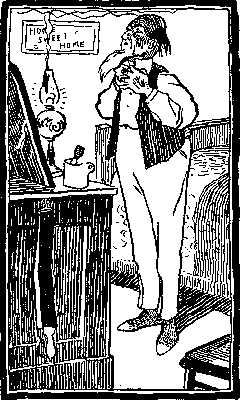
The Fable of How Uncle Brewster Was Too Shifty for the Tempter

Guest Blogger Dept.: George Ade was a best-selling author in his day, and his legacy persists among those who honor the encomia paid the Chicago-based writer by the likes of S.J. Perelman and Jean Shepherd – and Shepherd wrote a book about him! Any idea what a “Joe Miller” is? (It also shows up in a Cole Porter lyric, which inspired me to go to a damn library in those pre-internet days and look it up.)


WHEN UNCLE BREWSTER had put on his Annual Collar and combed his Beard and was about to start to the Depot, his Wife, Aunt Mehely, looked at him through her Specs and shook her Head doubtfully.

Drawing by Clyde J. Newman
Then she spoke as follows: “You go slow there in the City. You know your Failin’s. You’re just full of the Old Harry, and when you’re Het Up you’re just like as not to Raise Ned.”

“I guess I can take keer of myse’f about as well as the Next One,” retorted Uncle Brewster. “I’ve been to the Mill an’ got my Grist, if any one should ask. I ain’t no Greeny.”

With that he started for the Train, which was due in one Hour.

As he rode toward the Great City he smoked a Baby Mine Cigar, purchased of the Butcher, and told the Brakeman a few Joe Millers just to throw out the Impression that he was Fine and Fancy.

After he had Registered at the Hotel and Swelled Up properly when addressed as “Mister” by the Clerk, he wanted to know if there was a Lively Show in Town. The Clerk told him to follow the Street until he came to all the Electric Lights, and there he would find a Ballet. Uncle Brewster found the Place, and looked in through the Hole at an Assistant Treasurer, who was Pale and wore a Red Vest.

“I want a Chair near the Band,” said Uncle Brewster. “How much does one of ‘em Fetch?”

Monday, August 06, 2018

Pointing the Way

From the Computer Vault Dept.: Again, from the pile of magazines that recently turned up, a piece I wrote in 1994 about the variety of portable pointing devices then available. (I reviewed some of these devices in a similar piece that’s here.) Some of the info here actually isn’t outmoded, but it’s amusing to look that far back in time. I also found the unedited version of the piece, which tends to have cleverer wordplay than the magazine’s editors could tolerate. So that’s what’s below.


THE GRAPHICAL USER INTERFACE was a relative latecomer to portable computers, but it’s here, it’s pretty, and it requires a pointing device. The portable alternatives to the desktop mouse are varied and creative, and sometimes even successful. But that depends upon how success is judged--there are plenty of competing criteria. As portables get smaller, real estate is more and more of a problem. And many hours of usability research have yet to come up with one perfect and perfectly comfortable solution.

With the exception of some truly oddball devices like the IsoPoint roller, which was the size of a chunk of soda straw positioned near the space bar, built-in pointing devices are either some form of trackball or an isometric device like IBM’s TrackPoint II and Zenith’s J-Mouse.

From the pea-sized model on Panasonic’s notebook series to the large, centered unit on the old Apple PowerBook, portable trackballs show the greatest variety in placement and design. Although pointing accuracy is enhanced by software interpretation of your physical manipulation, you still need something physical to manipulate. Which is why the size of the ball itself is so important. A rash of tiny trackballs infected a recent wave of notebook computers, causing a backlash of user complaints. Not only was the rolling surface too small, but it also picked up oil and grime from the fingers, attracting dust and clogging the internal mechanisms. All trackballs need regular cleaning, but these needed to be cleaned only after a couple of hours of comprehensive use.

Friday, August 03, 2018

Put Yourself Online

From the Computer Vault: Back before the Flood, computerists had to call one another to share files and such, and an enterprising techie with a good computer and plenty of disk space could run a what was called a bulletin board system (BBS). Some were free; some (especially the ones purveying porn) charged subscription fees. Needless to say, the World Wide Web wiped them all out, but not before I wrote this how-to piece for Computer Life magazine. Let’s go back to 1995.


MY PHONE BILLS were getting way too high. “What are these calls to Florida and Oregon and Virginia all about?” my wife would ask. Because there is no alternative, I’d tell her. “Why do you have to call these BBSes all over the country?” she asked, adding reasonably, “Why can’t they call you?”

Thanks to a recent upgrade ripple in the house, I had enough pieces left over to put together a 386-based PC clone. Once a screamer, with an 80MB hard drive and 4MB of memory, it is now the last and least of my machines.

Perfect for a dedicated bulletin board system.

In my case, it’s intended to provoke lively conversation, with an emphasis on the writer’s craft. I’ve hosted writers’ conferences on other systems; this would be a chance to bring it home. And to save on those long-distance expenses.

Your reasons for setting up a BBS can be as varied as they are creative. If you’ve sampled any of the many to be found in every city all across the country (throughout the world, in fact, if your phone bill knows no fear), you’ve seen hobbies and interests of all sorts represented. Computer-based companies offer software and utilities on their BBSes; other businesses are now joining in, offering troubleshooting tips, product ordering facilities, and even a way for employees to stay in touch with each other and the central office.

Monday, July 30, 2018

Born of Disappointment

From the Food Vault: The expected life of a restaurant is, sadly, brief. Unless it’s a chain with endless advertising money behind it, able to drum its culinary marching orders into the skulls of the frightened masses, a restaurant has to succeed on merits that too much of the dining public fails to appreciate. Thus it is that both of the places mentioned below – MOD Gourmet Café and Retriever Rasters – have departed from Catskill. As my review suggests, it wasn’t my fault.


WE PERFORM AN ACT OF GREAT TRUST when we order from an unfamiliar restaurant. Much anticipation may lie behind it: a long stretch on the highway, a diversion for the family, a gathering of colleagues. Our palates are whetted by remembrances of meals past, our hopes sharpened by the menu’s promises.

Photo by B. A. Nilsson
And then we’re served the driest, most flavorless omelette imaginable.

“It’s fair to say that our restaurant was born out of disappointment,” says Mary DiStefano, co-owner of MOD Gourmet Café on Catskill’s Main Street. “So often you sit down for food that you hope will be good – and it never is.”

She and partner Dana Wegener worked in a number of restaurants before opening their own place nearly three years ago, and MOD Gourmet Café excellently satisfies any reasonable breakfast and lunch expectations.

We’re not talking about old-school diner fare, however. Three-egg omelettes ($7) are crafted around spinach, feta and sun-dried tomatoes, or home fries, cheddar and hot sauce, or home-grown herbs and goat cheese, among other cheese-rich combos.

Friday, July 27, 2018

Brooklyn Rides Again

From the Classical Vault Dept.: Eight years ago, the avant-garde quartet Brooklyn Rider snuck into Schenectady to inflict its adventurous programming upon the unsuspecting not-quite crowd (as happened when a sibling ensemble, The Knights, played in Troy in 2012). Here’s my Brooklyn Rider review.


FOUR STRING PLAYERS with impressively diverse performance credentials founded Brooklyn Rider, a string quartet that brought a brilliant program to Union College’s Memorial Chapel last Sunday and justified the adventurous bill of fare with playing that was more than equal to the music’s demands.

Brooklyn Rider
There’s been a tendency in the classical music world to sacrifice integrity to the supposed audience appeal of brainless pop-music stylings. There’s also a way to do it that enhances of the worlds thus straddled, and that’s where Brooklyn Rider lives. They’re a traditional string quartet. That said, they’re exploring sounds of that combination that go well beyond the Haydn-to-Bartok tradition.

Sunday’s program was anchored in Debussy’s appealing string quartet, written in 1893 but eagerly breaking from the sounds of Brahms and his Debussy’s own compatriot, Cesar Franck. Although it’s in the traditional four movements, the piece favors melodic invention over development, and has Franck-ian cyclical tendencies. It offers enough unique rhythmic and melodic nuggets to inspire a slew of tributes; thus the opening work, Colin Jacobsen’s “Achille’s Heel.”

Monday, July 23, 2018

Careless Philosopher’s Soliloquy

Guest Blogger Dept.: There’s no question in my mind that Henry Livingston wrote “A Visit from St. Nicholas,” the poem we incorrectly title “The Night before Christmas” and incorrectly attribute to Clement Moore – and Moore, the old bastard, wasn’t averse to taking false credit for it. Here’s more verse by Livingston, a sonnet whose message never will stale.


Henry Livingston, Jr.
I rise when I please, when I please I lie down
Nor seek, what I care not a rush for, renown:
The rattle call’d wealth I have learnt to despise
Nor aim to be either important or wise.

Let women & children & children-like men
Pursue the false trollop the world has called fame.
Who just as enjoyed, is instantly flown
And leaves disappointment the hag in her room.

If the world is content not to stand in my way
The world may jog on both by night & by day
Unimpeded by me - not a straw will I put
Where a dear fellow-creature uplifteth its foot.

While my conscience upbraids not, I’ll rise and lye down
Nor envy a monarch his cares and his crown.

– Henry Livingston, Jr., 1787