Search This Blog

Friday, August 10, 2018

The Fable of How Uncle Brewster Was Too Shifty for the Tempter

Guest Blogger Dept.: George Ade was a best-selling author in his day, and his legacy persists among those who honor the encomia paid the Chicago-based writer by the likes of S.J. Perelman and Jean Shepherd – and Shepherd wrote a book about him! Any idea what a “Joe Miller” is? (It also shows up in a Cole Porter lyric, which inspired me to go to a damn library in those pre-internet days and look it up.)


WHEN UNCLE BREWSTER had put on his Annual Collar and combed his Beard and was about to start to the Depot, his Wife, Aunt Mehely, looked at him through her Specs and shook her Head doubtfully.
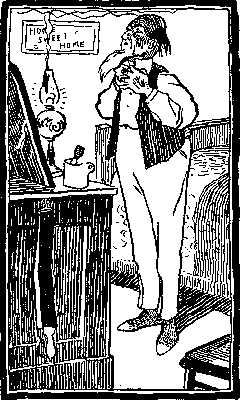
Drawing by Clyde J. Newman
Then she spoke as follows: “You go slow there in the City. You know your Failin’s. You’re just full of the Old Harry, and when you’re Het Up you’re just like as not to Raise Ned.”

“I guess I can take keer of myse’f about as well as the Next One,” retorted Uncle Brewster. “I’ve been to the Mill an’ got my Grist, if any one should ask. I ain’t no Greeny.”

With that he started for the Train, which was due in one Hour.

As he rode toward the Great City he smoked a Baby Mine Cigar, purchased of the Butcher, and told the Brakeman a few Joe Millers just to throw out the Impression that he was Fine and Fancy.

After he had Registered at the Hotel and Swelled Up properly when addressed as “Mister” by the Clerk, he wanted to know if there was a Lively Show in Town. The Clerk told him to follow the Street until he came to all the Electric Lights, and there he would find a Ballet. Uncle Brewster found the Place, and looked in through the Hole at an Assistant Treasurer, who was Pale and wore a Red Vest.

“I want a Chair near the Band,” said Uncle Brewster. “How much does one of ‘em Fetch?”

Monday, August 06, 2018

Pointing the Way

From the Computer Vault Dept.: Again, from the pile of magazines that recently turned up, a piece I wrote in 1994 about the variety of portable pointing devices then available. (I reviewed some of these devices in a similar piece that’s here.) Some of the info here actually isn’t outmoded, but it’s amusing to look that far back in time. I also found the unedited version of the piece, which tends to have cleverer wordplay than the magazine’s editors could tolerate. So that’s what’s below.


THE GRAPHICAL USER INTERFACE was a relative latecomer to portable computers, but it’s here, it’s pretty, and it requires a pointing device. The portable alternatives to the desktop mouse are varied and creative, and sometimes even successful. But that depends upon how success is judged--there are plenty of competing criteria. As portables get smaller, real estate is more and more of a problem. And many hours of usability research have yet to come up with one perfect and perfectly comfortable solution.

With the exception of some truly oddball devices like the IsoPoint roller, which was the size of a chunk of soda straw positioned near the space bar, built-in pointing devices are either some form of trackball or an isometric device like IBM’s TrackPoint II and Zenith’s J-Mouse.

From the pea-sized model on Panasonic’s notebook series to the large, centered unit on the old Apple PowerBook, portable trackballs show the greatest variety in placement and design. Although pointing accuracy is enhanced by software interpretation of your physical manipulation, you still need something physical to manipulate. Which is why the size of the ball itself is so important. A rash of tiny trackballs infected a recent wave of notebook computers, causing a backlash of user complaints. Not only was the rolling surface too small, but it also picked up oil and grime from the fingers, attracting dust and clogging the internal mechanisms. All trackballs need regular cleaning, but these needed to be cleaned only after a couple of hours of comprehensive use.

Friday, August 03, 2018

Put Yourself Online

From the Computer Vault: Back before the Flood, computerists had to call one another to share files and such, and an enterprising techie with a good computer and plenty of disk space could run a what was called a bulletin board system (BBS). Some were free; some (especially the ones purveying porn) charged subscription fees. Needless to say, the World Wide Web wiped them all out, but not before I wrote this how-to piece for Computer Life magazine. Let’s go back to 1995.


MY PHONE BILLS were getting way too high. “What are these calls to Florida and Oregon and Virginia all about?” my wife would ask. Because there is no alternative, I’d tell her. “Why do you have to call these BBSes all over the country?” she asked, adding reasonably, “Why can’t they call you?”

Thanks to a recent upgrade ripple in the house, I had enough pieces left over to put together a 386-based PC clone. Once a screamer, with an 80MB hard drive and 4MB of memory, it is now the last and least of my machines.

Perfect for a dedicated bulletin board system.

In my case, it’s intended to provoke lively conversation, with an emphasis on the writer’s craft. I’ve hosted writers’ conferences on other systems; this would be a chance to bring it home. And to save on those long-distance expenses.

Your reasons for setting up a BBS can be as varied as they are creative. If you’ve sampled any of the many to be found in every city all across the country (throughout the world, in fact, if your phone bill knows no fear), you’ve seen hobbies and interests of all sorts represented. Computer-based companies offer software and utilities on their BBSes; other businesses are now joining in, offering troubleshooting tips, product ordering facilities, and even a way for employees to stay in touch with each other and the central office.

Monday, July 30, 2018

Born of Disappointment

From the Food Vault: The expected life of a restaurant is, sadly, brief. Unless it’s a chain with endless advertising money behind it, able to drum its culinary marching orders into the skulls of the frightened masses, a restaurant has to succeed on merits that too much of the dining public fails to appreciate. Thus it is that both of the places mentioned below – MOD Gourmet Café and Retriever Rasters – have departed from Catskill. As my review suggests, it wasn’t my fault.


WE PERFORM AN ACT OF GREAT TRUST when we order from an unfamiliar restaurant. Much anticipation may lie behind it: a long stretch on the highway, a diversion for the family, a gathering of colleagues. Our palates are whetted by remembrances of meals past, our hopes sharpened by the menu’s promises.

Photo by B. A. Nilsson
And then we’re served the driest, most flavorless omelette imaginable.

“It’s fair to say that our restaurant was born out of disappointment,” says Mary DiStefano, co-owner of MOD Gourmet Café on Catskill’s Main Street. “So often you sit down for food that you hope will be good – and it never is.”

She and partner Dana Wegener worked in a number of restaurants before opening their own place nearly three years ago, and MOD Gourmet Café excellently satisfies any reasonable breakfast and lunch expectations.

We’re not talking about old-school diner fare, however. Three-egg omelettes ($7) are crafted around spinach, feta and sun-dried tomatoes, or home fries, cheddar and hot sauce, or home-grown herbs and goat cheese, among other cheese-rich combos.

Friday, July 27, 2018

Brooklyn Rides Again

From the Classical Vault Dept.: Eight years ago, the avant-garde quartet Brooklyn Rider snuck into Schenectady to inflict its adventurous programming upon the unsuspecting not-quite crowd (as happened when a sibling ensemble, The Knights, played in Troy in 2012). Here’s my Brooklyn Rider review.


FOUR STRING PLAYERS with impressively diverse performance credentials founded Brooklyn Rider, a string quartet that brought a brilliant program to Union College’s Memorial Chapel last Sunday and justified the adventurous bill of fare with playing that was more than equal to the music’s demands.

Brooklyn Rider
There’s been a tendency in the classical music world to sacrifice integrity to the supposed audience appeal of brainless pop-music stylings. There’s also a way to do it that enhances of the worlds thus straddled, and that’s where Brooklyn Rider lives. They’re a traditional string quartet. That said, they’re exploring sounds of that combination that go well beyond the Haydn-to-Bartok tradition.

Sunday’s program was anchored in Debussy’s appealing string quartet, written in 1893 but eagerly breaking from the sounds of Brahms and his Debussy’s own compatriot, Cesar Franck. Although it’s in the traditional four movements, the piece favors melodic invention over development, and has Franck-ian cyclical tendencies. It offers enough unique rhythmic and melodic nuggets to inspire a slew of tributes; thus the opening work, Colin Jacobsen’s “Achille’s Heel.”

Monday, July 23, 2018

Careless Philosopher’s Soliloquy

Guest Blogger Dept.: There’s no question in my mind that Henry Livingston wrote “A Visit from St. Nicholas,” the poem we incorrectly title “The Night before Christmas” and incorrectly attribute to Clement Moore – and Moore, the old bastard, wasn’t averse to taking false credit for it. Here’s more verse by Livingston, a sonnet whose message never will stale.


Henry Livingston, Jr.
I rise when I please, when I please I lie down
Nor seek, what I care not a rush for, renown:
The rattle call’d wealth I have learnt to despise
Nor aim to be either important or wise.

Let women & children & children-like men
Pursue the false trollop the world has called fame.
Who just as enjoyed, is instantly flown
And leaves disappointment the hag in her room.

If the world is content not to stand in my way
The world may jog on both by night & by day
Unimpeded by me - not a straw will I put
Where a dear fellow-creature uplifteth its foot.

While my conscience upbraids not, I’ll rise and lye down
Nor envy a monarch his cares and his crown.

– Henry Livingston, Jr., 1787

Friday, July 20, 2018

Look at the Record

I FINALLY GOT AROUND to digitizing those remaining records that seemed worth having and which lacked affordable (or any) CD replacement. Not surprisingly, it was a painstaking process, often calling for cleaning, the static electricity from which then invites more crud and more cleaning. Then there was the jacket to contend with. I’m sentimental about those jackets: they provided my earliest music education, but they’re too large for a single pass through my scanner. Each face needed four, and subsequent stitching. The box sets with booklets were especially challenging, as I’m fussy enough to want a nice PDF file alongside the MP3s.

At its peak, my record collection topped out at about 1,000. I was quick to replace favorites as they appeared on CD, which often was a mistake – those early CDs didn’t always do justice to the recordings, and were re-mastered and issued again. Between that and a heartbreaking day during which I culled records I knew I’d never want to hear again, I whittled it down to about 600. Reissues grew cheaper and more expansive. CD box sets of the Heifetz, Toscanini, Munch, Horowitz, Reiner, Gould, and others made significant dents in my record holdings. I had to forego a complete Arthur Rubinstein when the set first appeared in all its costly glory, but it returned in a pared-down, cardboard-jacketed set that killed another two dozen records.

Wednesday, July 18, 2018

Manhattan Melodrama

“WEST SIDE STORY” SHOWS ITS AGE in many ways. Language that seemed hip 60 years ago has been replaced by terms even more evanescent. What seemed like credibly horrible behavior back then also has been eclipsed. And the music, steeped in jazz and Latin rhythms, is now as quaint as an old Paul Whiteman recording. Yet each of those elements endures – thrives, even – in the context of this show. It hit the boards in 1957, garnering excellent reviews, reviews that particularly praised Jerome Robbins’s direction and choreography.

Vanessa Becerra and Joseph Leppek
Photo: Karli Cadel/The Glimmerglass Festival
It’s difficult to think of the piece apart from his work, especially with the 1960 film version accessible. Julio Monge choreographed the current Glimmerglass Festival production, hewing as closely as possible to Robbins’s original movement, and doing so as one of the few authorized by the Robbins Rights Trust to do so.

Although the set (by Peter J. Davison, and more about it below) and the costumes (by Jessica Jahn) suggest a more recent time, you can’t pull the 1950s out of this show. It’s as specific to its time as a Gershwin show was to the ’30s, but “West Side Story”’s two Tonys and ten Oscars suggest how firmly it lodged in the public consciousness. Thus, while it ought to seem as antique as that Gershwin show, its central conflict has never been more up-to-date. Composer Leonard Bernstein was very vocal about his wish to effect change; perhaps it’s just as well that he’s not here to see how far we’ve backslid.

Monday, July 16, 2018

The Missing Peace

AS THE POLITICAL FUTURE of the United States grows bleaker – with its corresponding drag on the future of everyone everywhere – it’s more important than ever to turn to the arts for inspiration and even, dare I suggest it, optimism. The Pulitzer Prize-winning opera “Silent Night,” which details an exceptional incident that occurred on a World War One battlefield, packs a wallop.

Michael Miller, Michael Hewitt, and Jonathan Bryan
Photo: Karli Cadel/The Glimmerglass Festival
Mark Campbell’s libretto is based on Christian Carion’s screenplay for his 2005 film “Joyeux Noël,” itself inspired by a spontaneous truce that broke out on a Belgian battlefield on Christmas Eve, 1914. German, French, and Scottish soldiers shared food and wine and stories as hostility fell away into friendship – but it was a temporary truce that led to recrimination from the higher-ups.

Thanks to the propaganda activities of the U.S. Office of War Information during World War Two, the depiction of combat and the American way of life was sugarcoated to a risible degree. Some of the conventions of those motion pictures  (that service platoons were racially mixed, for example) grew into accepted archetypes and infected our understanding of the look at war for decades to follow, despite the efforts of films like “Paths of Glory.”

Sunday, July 15, 2018

Getting Down with the Count

ROSSINI’S “THE BARBER OF SEVILLE” is so iconic that you can’t help but collect recordings of it, and I’m most interested in hearing how Figaro fares. Hermann Prey, Robert Merrill, and Sherrill Milnes rank among my favorites, and I’m adding Joshua Hopkins to the list in the hope that he’ll get around to recording it soon. He’s singing the role in the new Glimmerglass Festival production, and from the moment he launches into the famous “Largo al factotum,” we can easily believe that this charismatic fellow can control any situation he puts his hand in.

Joshua Hopkins and Rock Lasky
Karli Cadel/The Glimmerglass Festival
In this case, he’s asked by Count Almaviva (David Walton), his former employer, to help secure a meeting with the elusive Rosina (Emily D’Angelo), who is being kept a virtual prisoner as the ward of gruff old Dr. Bartolo (Dale Travis). Almaviva doesn’t want her to know his social position lest she should be too attracted by his wealth, so he’s styling himself as a penniless student. But she has a considerable dowry down the pike, which is why Bartolo wants to marry her, so why Almaviva should worry about . . . but there’s no point in letting plot get in the way. This piece is a romp for a sextet of versatile voices, the definition of comic opera at its best.

The opera opens with an overture that has become its own classic, and Festival music director Joseph Colaneri hits it with a Toscanini-like intensity, which is my definition of the best possible performance. There’s little time for breath when the orchestra kicks in, yet Colanari shapes the sound of this tight little group with impressive precision. And when the orchestra is pausing, Christopher Devlin is burning up the keyboard with smooth, witty continuo work.

Thursday, July 12, 2018

Your Name Is a Number

OPERA SARATOGA ISN’T AFRAID of making statements. In 2015, Jeremy Howard Beck’s “The Long Walk” told the true story of Iraq veteran Brian Castner’s battle with PTSD; last season’s “The Cradle Will Rock” presented Marc Blitzstein’s socially conscious opera in its fully orchestrated glory, giving us a piece that the U.S. government shut down just before its 1937 premiere as a gesture of political censorship. (That production was recorded, and the CD set is now available.)

Jennifer Panara and Meghan Kasanders
Photo by Gary David Gold
This year’s message opera is bleaker still, and all the more glorious for it. Gian Carlo Menotti wrote music and libretto for “The Consul,” which premiered in 1950 and enjoyed a long run on Broadway – back in the day before jukebox musicals and tripe like “The Lion King” took over the street. Back in the day before the audience had been TV-conditioned to avoid entertainment that’s too emotionally challenging.

Menotti wrote the piece in response to the plight of a Polish woman who tried to emigrate to the U.S. and was so frustrated while detained at Ellis Island that she hanged herself. Not that there was any lack of other political indignities to inspire him: late-40s America was blacklisting artists with a glee unmatched until very recent times. What made the opera timely back then was its portrait of a bureaucracy indifferent to suffering. Even as that endures as apposite, what now makes the opera all too up-to-date is its treatment of immigration. If you don’t shiver with horror at the treatment endured by Magda Sorel and her fellow consulate victims, you’re probably qualified to work for the White House.

Tuesday, July 10, 2018

Little Foxes

ALTHOUGH RUDOLF TESNOHLÍDEK’S NOVEL about a resourceful, willful fox was presented as a comedy when serialized (with drawings) in 1920, composer Leoš Janáček decided to inform it with a more somber feeling when he turned it into the opera known in English as “The Cunning Little Vixen.” He also informed it with breathtaking glory, a sensual trip through his portrait of the natural world. Where humans dwell, however, is a realm of jealousy and unhappiness. The two worlds coexist very uncomfortably.

Joanna Latini and Zachary Owen
Photo by Karli Cadel/The Glimmerglass Festival
At the start of the new Glimmerglass Festival production, the music shimmers as lights come up on an abstract glen in which native creatures rustle by. The music underpins the magic of the scene, and as dragonflies, cricket, and grasshopper gather, we’re swept into an anthropomorphic world that soon enough stops being singers in costume. Our belief in these apparitions turns them real, especially when the gun-wielding Forester enters and provides a too-human contrast.

Costume designer Erik Teague offers outrageous outfits for the animal world, but they stop well short of being too distracting. Likewise, Ryan McGettigan’s spare stage settings of forest, farm, and tavern provide enough to root us in a fantasyland, and set the two worlds apart with curves and curls in the natural expanse and, in the spaces where humans are found, an architecture of lines and angles.

Friday, July 06, 2018

The Damned Human Race

Guest Blogger Dept.: As the 20th century began, Mark Twain suffered the deaths of his daughter and his wife, and seemed to owe money to everybody. He penned a series of essays that reflect his darker side, essays eventually published posthumously. Here’s one of them.


I HAVE BEEN STUDYING the traits and dispositions of the lower animals (so-called), and contrasting them with the traits and dispositions of man. I find the result humiliating to me. For it obliges me to renounce my allegiance to the Darwinian theory of the Ascent of Man from the Lower Animals; since it now seems plain to me that the theory ought to be vacated in favor of a new and truer one, this new and truer one to be named the Descent of Man from the Higher Animals.

In proceeding toward this unpleasant conclusion I have not guessed or speculated or conjectured, but have used what is commonly called the scientific method. That is to say, I have subjected every postulate that presented itself to the crucial test of actual experiment, and have adopted it or rejected it according to the result. Thus I verified and established each step of my course in its turn before advancing to the next. These experiments were made in the London Zoological Gardens, and covered  many months of painstaking and fatiguing work.

Before particularizing any of the experiments, I wish to state one or two things which seem to more properly belong in this place than further along. This, in the interest of clearness. The massed experiments established to my satisfaction certain generalizations, to wit:

1. That the human race is of one distinct species. It exhibits slight variations (in color, stature, mental caliber, and so on) due to climate, environment, and so forth; but it is a species by itself, and not to be confounded with any other.

Monday, July 02, 2018

A Personal Space Odyssey

BY THE TIME Stanley Kubrick’s “2001: A Space Odyssey” was released, we were but one year shy of Neil Armstrong’s moon walk. Even as Cold War logistics hurried NASA’s space program, with its seemingly unlimited funding, Kubrick’s dream of a “proverbial ‘really good’ science fiction movie” took shape first in offices (and an abandoned bra factory) in Manhattan and then at MGM’s British Studios in Borehamwood, a few miles north of London from 1964 to 1968, going wildly over budget in the process.

In the wake of the movie’s disastrous premiere, its success skyrocketed and its innovations were rightly hailed as groundbreaking – and it’s been the subject of a slew of books. But none has explored the movie’s genesis as thoroughly as Michael Benson’s Space Odyssey, which has mined what’s already been written and added much, much more.

Kubrick already had the acclaimed movies “Paths of Glory,” “Spartacus,” and “Lolita” behind him, and “Dr. Strangelove,” his most recent, was a runaway success. So he was in a position to film whatever he wanted, and he wanted to tackle science fiction. He asked his friend Artie Shaw, who had by that time had abandoned music and was working in film distribution, to recommend a writer, and Shaw mentioned Arthur C. Clarke.

Introducing the Kubrick-Clarke working relationship, Benson sets up the scenes with the description and dialogue of a novel, which makes it the more compelling, and which is justified by his general research and interviews with Clarke himself. Other key moments in the saga get a similar treatment, but it’s largely a scholarly trip through the creation of the movie, written with gusto and always evoking a sense of excitement as the process builds and builds.

Saturday, June 30, 2018

A Fine Family Fortune

WHAT “THE MERRY WIDOW” DEMANDS, first and foremost, is a hushed, haunting “Vilia” at the top of Act Two, in which the titular widow evokes the spirit of a wood-nymph who enchants a hunter even as Franz Lehár’s gentle melody enchants the chorus, who join it at key moments, and the audience, who probably, with little encouragement, would sing along as well.

John Tibbetts, Quinn Bernegger,
and Cecilia Violetta López
Although probably not “as well” in the other sense of the phrase, because Opera Saratoga’s performers, chorus and principals alike, brought a stellar array of voices to bear upon this production, the company’s first for 30 years. Cecilia Violetta López easily met the challenge of portraying Hanna Glawari, Pontevedro’s wealthy widow, who charms all of the men in her wake with her beauty and, of course, a shot at her fortune.

We’re in Paris, where Baron Zeta, the cash-poor country’s ambassador, has been charged with making sure that she only marries a fellow Pontevedrian, and baritone Andy Papas runs wild with the role, indulging in a frenzy of eye-rolling and fits of exasperation worthy of ’30s actor Walter Connolly. His hope is to marry the widow to the rakish Count Danilo, but Danilo, when finally located at Maxim’s, evinces no interest. Alex Lawrence has a wonderful voice that he uses to thrilling effect. His characterization, however, is hampered by a common acting trap, in which the diffidence he’s supposed to play comes across as unpleasant petulance.

Monday, June 25, 2018

Friday, June 22, 2018

The Gourmet’s Love Song

Guest Blogger Dept.: Another poem by Wodehouse, you cry? My pleasure. The English writer P.G. Wodehouse not only was a master of light verse – he also showed himself to be an acclaimed lyricist, working with Jerome Kern on the famouse Princess Theater shows of 1915-1917, and inspiring many a fledgling lyricist, like Ira Gershwin, Howard Dietz, and E.Y. Harburg, along the way.


HOW STRANGE IS LOVE; I am not one
Who Cupid’s power belittles,
For Cupid ‘tis who makes me shun
My customary victuals.

Oh, EFFIE, since that painful scene
That left me broken-hearted,
My appetite, erstwhile so keen,
Has utterly departed.

My form, my friends observe with pain,
Is growing daily thinner.
Love only occupies the brain
That once could think of dinner.

Around me myriad waiters flit,
With meat and drink to ply men;
Alone, disconsolate, I sit,
And feed on thoughts of Hymen.

Monday, June 18, 2018

The Central Issue

From the Food Vault Dept.: How much do restaurant review matter? At one time, they were on the order of sacred pronouncements issuing from a privileged few; now, the voices that clog online review sites have created a cranky clamor that obscures the opinions of those actually qualified to make such judgments. But I found out where I stood back in 2011, when my review of the short-lived Central Steak ran in Metroland at the same time that Cheryl Clark’s review of the place ran in the Albany Times-Union. As it happened, we sat together at the restaurant, and below you’ll read why. As it also happened, there were considerable problems with the meal. Cheryl’s review was fair but unkind, and the White Management Group, which owned the restaurant, swooped down on the Times-Union and gave Cheryl’s bosses hell, which, naturally, redounded to the experienced, professional reporter who was doing her job and doing it well. Over at Metroland? We never heard a peep.


JOURNALISTS DISLIKE COINCIDENCES. They are the stuff of the fictionist, desperate to tie together divergent threads of plot. Yet they do occur, and they must be dealt with.

Photo by B. A. Nilsson
It is a coincidence that my review of Dinosaur Bar-B-Que ran the same week as Cheryl Clark’s piece in the Albany Times-Union. It is also a coincidence, and, given my travels last Saturday, a very unlikely one, that we should encounter Clark and her husband, Paul, at Central Steak.

My family and I were waiting to be seated. Saturday night can be a trying time for restaurants, but we hoped that Central Steak was designed to move food and customers along with some efficiency. As soon as you enter, you can the grill – a long, open line banging out entrées like something out of “Modern Times.”

Friday, June 15, 2018

A Revolution Underfoot

SPRING – PLANTING SEASON – isn’t a good time to read David R. Montgomery’s Growing a Revolution. Not when you live, as I do, in farming country. The plows are at work everywhere, from large green motorized behemoths to the horse-drawn antiques of the Amish. And, according to Montgomery, this is what not only has been destroying farmland around the world, it also probably was responsible for destroying past civilizations.

Montgomery sounded a death-knell over a decade ago in his book Dirt, which took a pessimistic trip through a history of soil erosion and nutrient eradication, the long-range after-effects of what we thought was progressive agriculture. It stands alongside Bill McKibben’s The End of Nature as a call for action falling largely on deaf ears, so Montgomery has revisited the topic in an encouraging, inspiring way. The needed changes can be made, he argues, and are being made – and in the unlikeliest places.

Growing a Revolution follows the author from country to country, climate to climate, to look at successful examples of no-till farming. As Montgomery is quick to observe, farmers generally aren’t given to change anything unless confronted with evidence of success, and that success needs to be seen in the harvests.

The key to Montgomery’s argument is conservation agriculture, the three components of which are “(1) minimum disturbance of the soil; (2) growing cover crops and retaining crop residue so that soil is always covered; and (3) use of diverse crop rotations. These principles can be applied anywhere, on organic or conventional farms, with or without genetically modified crops.”

Monday, June 11, 2018

Venezia Millenaria

JUST WHEN YOU THINK you’ve heard everything, the slow movement of Beethoven’s Seventh starts to sound in a chamber-ensemble arrangement, and then soft voices creep in, singing, in French, “The night is dark ... let us go forth (to) wage war against the godless.” It’s a 19th-century cantata penned by the exiled Neapolitan Luigi Bordese, set to music by the composer who famously reversed his high opinion about Napoleon upon learning that the latter had declared himself emperor of France.

This oddball piece closes the new two-CD portrait of the musical beginnings of Venice, a place that long stood apart from other Italian cities. While this is unmistakably a Jordi Savall collection, it may have the most variety of material he’s ever presented. Which is very much the point, as “Venezia Millenaria” presents over a thousand years of material, from around 700, when the Byzantines began to inhabit it, to 1797, when Napoleon invaded, soon to cede Venice to Austria.

Savall recorded this material in 2016, and the musical portrait sparked a Carnegie Hall-based festival in February 2017 (coincident with Venice’s own Carnevale) at which Savall and his musicians performed, and which included lectures, museum shows, and other concert events  throughout Manhattan.

But this recording remains a most compelling souvenir. To make these musical points, Savall enlisted his usual ensembles: the instrumental groups Le Concert des Nations and Hespèrion XXI, and vocal ensemble La Capella Reial de Catalunya. Added to them are Salonica’s Orthodox Byzantine Vocal Ensemble and a quartet of specialist players comprising Driss El Maloumi (a previous Savall collaborator) adding wicked percussion lines on the oud; Dimitri Psonis, santur (hammered dulcimer) and morisca (a small guitar); Hakan Güngör, qanun (a zither cousin); and Haïg Sarikouyoumdjian on the oboe-like duduk and the lute-like belul.