Search This Blog

Saturday, June 30, 2018

A Fine Family Fortune

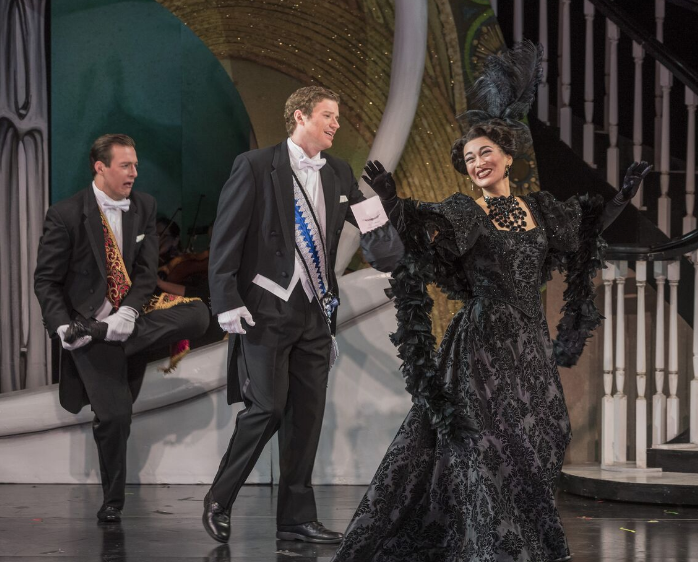
WHAT “THE MERRY WIDOW” DEMANDS, first and foremost, is a hushed, haunting “Vilia” at the top of Act Two, in which the titular widow evokes the spirit of a wood-nymph who enchants a hunter even as Franz Lehár’s gentle melody enchants the chorus, who join it at key moments, and the audience, who probably, with little encouragement, would sing along as well.

John Tibbetts, Quinn Bernegger,
and Cecilia Violetta López
Although probably not “as well” in the other sense of the phrase, because Opera Saratoga’s performers, chorus and principals alike, brought a stellar array of voices to bear upon this production, the company’s first for 30 years. Cecilia Violetta López easily met the challenge of portraying Hanna Glawari, Pontevedro’s wealthy widow, who charms all of the men in her wake with her beauty and, of course, a shot at her fortune.

We’re in Paris, where Baron Zeta, the cash-poor country’s ambassador, has been charged with making sure that she only marries a fellow Pontevedrian, and baritone Andy Papas runs wild with the role, indulging in a frenzy of eye-rolling and fits of exasperation worthy of ’30s actor Walter Connolly. His hope is to marry the widow to the rakish Count Danilo, but Danilo, when finally located at Maxim’s, evinces no interest. Alex Lawrence has a wonderful voice that he uses to thrilling effect. His characterization, however, is hampered by a common acting trap, in which the diffidence he’s supposed to play comes across as unpleasant petulance.

Monday, June 25, 2018

Friday, June 22, 2018

The Gourmet’s Love Song

Guest Blogger Dept.: Another poem by Wodehouse, you cry? My pleasure. The English writer P.G. Wodehouse not only was a master of light verse – he also showed himself to be an acclaimed lyricist, working with Jerome Kern on the famouse Princess Theater shows of 1915-1917, and inspiring many a fledgling lyricist, like Ira Gershwin, Howard Dietz, and E.Y. Harburg, along the way.


HOW STRANGE IS LOVE; I am not one
Who Cupid’s power belittles,
For Cupid ‘tis who makes me shun
My customary victuals.

Oh, EFFIE, since that painful scene
That left me broken-hearted,
My appetite, erstwhile so keen,
Has utterly departed.

My form, my friends observe with pain,
Is growing daily thinner.
Love only occupies the brain
That once could think of dinner.

Around me myriad waiters flit,
With meat and drink to ply men;
Alone, disconsolate, I sit,
And feed on thoughts of Hymen.

Monday, June 18, 2018

The Central Issue

From the Food Vault Dept.: How much do restaurant review matter? At one time, they were on the order of sacred pronouncements issuing from a privileged few; now, the voices that clog online review sites have created a cranky clamor that obscures the opinions of those actually qualified to make such judgments. But I found out where I stood back in 2011, when my review of the short-lived Central Steak ran in Metroland at the same time that Cheryl Clark’s review of the place ran in the Albany Times-Union. As it happened, we sat together at the restaurant, and below you’ll read why. As it also happened, there were considerable problems with the meal. Cheryl’s review was fair but unkind, and the White Management Group, which owned the restaurant, swooped down on the Times-Union and gave Cheryl’s bosses hell, which, naturally, redounded to the experienced, professional reporter who was doing her job and doing it well. Over at Metroland? We never heard a peep.


JOURNALISTS DISLIKE COINCIDENCES. They are the stuff of the fictionist, desperate to tie together divergent threads of plot. Yet they do occur, and they must be dealt with.

Photo by B. A. Nilsson
It is a coincidence that my review of Dinosaur Bar-B-Que ran the same week as Cheryl Clark’s piece in the Albany Times-Union. It is also a coincidence, and, given my travels last Saturday, a very unlikely one, that we should encounter Clark and her husband, Paul, at Central Steak.

My family and I were waiting to be seated. Saturday night can be a trying time for restaurants, but we hoped that Central Steak was designed to move food and customers along with some efficiency. As soon as you enter, you can the grill – a long, open line banging out entrées like something out of “Modern Times.”

Friday, June 15, 2018

A Revolution Underfoot

SPRING – PLANTING SEASON – isn’t a good time to read David R. Montgomery’s Growing a Revolution. Not when you live, as I do, in farming country. The plows are at work everywhere, from large green motorized behemoths to the horse-drawn antiques of the Amish. And, according to Montgomery, this is what not only has been destroying farmland around the world, it also probably was responsible for destroying past civilizations.

Montgomery sounded a death-knell over a decade ago in his book Dirt, which took a pessimistic trip through a history of soil erosion and nutrient eradication, the long-range after-effects of what we thought was progressive agriculture. It stands alongside Bill McKibben’s The End of Nature as a call for action falling largely on deaf ears, so Montgomery has revisited the topic in an encouraging, inspiring way. The needed changes can be made, he argues, and are being made – and in the unlikeliest places.

Growing a Revolution follows the author from country to country, climate to climate, to look at successful examples of no-till farming. As Montgomery is quick to observe, farmers generally aren’t given to change anything unless confronted with evidence of success, and that success needs to be seen in the harvests.

The key to Montgomery’s argument is conservation agriculture, the three components of which are “(1) minimum disturbance of the soil; (2) growing cover crops and retaining crop residue so that soil is always covered; and (3) use of diverse crop rotations. These principles can be applied anywhere, on organic or conventional farms, with or without genetically modified crops.”
Monday, June 11, 2018

Venezia Millenaria

JUST WHEN YOU THINK you’ve heard everything, the slow movement of Beethoven’s Seventh starts to sound in a chamber-ensemble arrangement, and then soft voices creep in, singing, in French, “The night is dark ... let us go forth (to) wage war against the godless.” It’s a 19th-century cantata penned by the exiled Neapolitan Luigi Bordese, set to music by the composer who famously reversed his high opinion about Napoleon upon learning that the latter had declared himself emperor of France.

This oddball piece closes the new two-CD portrait of the musical beginnings of Venice, a place that long stood apart from other Italian cities. While this is unmistakably a Jordi Savall collection, it may have the most variety of material he’s ever presented. Which is very much the point, as “Venezia Millenaria” presents over a thousand years of material, from around 700, when the Byzantines began to inhabit it, to 1797, when Napoleon invaded, soon to cede Venice to Austria.

Savall recorded this material in 2016, and the musical portrait sparked a Carnegie Hall-based festival in February 2017 (coincident with Venice’s own Carnevale) at which Savall and his musicians performed, and which included lectures, museum shows, and other concert events  throughout Manhattan.

But this recording remains a most compelling souvenir. To make these musical points, Savall enlisted his usual ensembles: the instrumental groups Le Concert des Nations and Hespèrion XXI, and vocal ensemble La Capella Reial de Catalunya. Added to them are Salonica’s Orthodox Byzantine Vocal Ensemble and a quartet of specialist players comprising Driss El Maloumi (a previous Savall collaborator) adding wicked percussion lines on the oud; Dimitri Psonis, santur (hammered dulcimer) and morisca (a small guitar); Hakan Güngör, qanun (a zither cousin); and Haïg Sarikouyoumdjian on the oboe-like duduk and the lute-like belul.

Friday, June 08, 2018

A Cure for Insomnia

Guest Blogger Dept.: We’re revisiting To Think of Tea! by Agnes Repplier, one of America’s finest essayists. As I wrote earlier, her keen mind and colorful, precise prose style ensured a successful career. As a child, she quickly memorized and recited the poems her mother read to her, but resisted her mother’s efforts to teach her to read, which she did on her own at the age of ten. Apparently an unruly child, at 14 she was kicked out of Eden Hall, the Convent of the Sacred Heart, and then asked to leave Agnes Irwin’s West Penn Square Seminary for Young Ladies three times because of her rebelliousness. By the time she was 20, her writing began bringing in enough money to help support her family. She died in 1950 at the age of 95 in her native Philadelphia.


THERE WAS NO AILMENT – none at least known to the uninstructed seventeenth century – of which the new drink was not discovered to be the cause or cure. “Every remedy,” it has been pleasantly said, “has its appropriate disease”; but tea had so many appropriate diseases that, if we may believe Dr. Cornelius Bontekoë, of the University of Leyden, the moral as well as the physical world stood waiting for this great regenerator.

Dr. Bontekoë had the good or the ill fortune to cherish opinions which were well in advance of his day. It was his wont to express these opinions in terms which insured him opponents, so that he never lacked the cheerful stimulus of a quarrel. His treatise on “The Most Excellent Herb, Tea,” claimed for this “wondrous distillation” qualities more potent and more salutary than ever lay hidden in the Fountain of Youth. The author was no mean-spirited advocate of abstinence. He did not cherish tea because it cheered without inebriating. On the contrary, he denounced water in unsparing terms as being the most dangerous, as well as the least comforting, of drinks. Wine and rum were admirable in their way, but demanded temperance. They were ill-suited for continuous or excessive drinking. Tea and tea alone was innocent of offence. It warmed the stomach, cleared the mind, strengthened the memory, befriended learning, and lent substantial aid to the acquirement of wisdom and piety. It was, moreover, a supreme remedy for heaviness of spirit and for all melancholy humours. It promoted the sober and moderate cheerfulness which the Dutch rightly valued, and the stubborn courage which had won for them the apprehensive respect of Europe.

Monday, June 04, 2018

Running a Round: La Ronde

IMMERSIVE THEATER has become the rage, which angers a theater-going friend. “I go to plays to be entertained,” he grouses. “Why can’t they do O’Neill? Or ‘Macbeth’?”

Fisch and Botwick in "La Ronde"
Troy Foundry Theatre closes its inaugural season with an immersive “La Ronde,” the Arthur Schnitzler play so controversial when it was published in Germany at the turn of the last century that it was banned by censors and not performed until 1920. The play’s no-holds-barred depictions of freewheeling sexual affairs invited equal measures of scandal and acclaim, but it’s at heart a look at the contrasting, though often similar, mores of a rigidly class-structured society. (Schnitzler probably is better known these days as the author of “Traumnovelle,” which inspired Stanley Kubrick’s final film, “Eyes Wide Shut.”)

So what if, instead of watching the ten short encounters of “La Ronde” in sequence on a single stage, they were take place simultaneously in a number of rooms (and a staircase)? This is the conceit of director Brenna Geffers’s production for Troy Foundry Theatre, and it’s set in the lovely old Frear House, part of the Russell Sage College campus.

Friday, June 01, 2018

Sydney Greenstreet: The Story Now Told

MY INTEREST IN MOVIES as an art form was sparked by a TV viewing of “The Maltese Falcon” one afternoon. Although the film was cut to fit a ninety-minute ads-filled slot, its unique style, unforgettable cast, and surprising finish were enough to set me searching for more information about this movie. One of the first books I consulted (and I can’t remember its author or title) identified Sydney Greenstreet as a stage actor who specialized in playing butlers. How insufficient a description that turns out to be!

Greenstreet made his motion-picture debut in that film at the age of 61 in the unforgettable role of the chuckling, booming villain Kaspar Gutman. He was nominated for an Academy Award and worked steadily in Hollywood for the next eight years, appearing in 24 movies – although, as his fame skyrocketed, some of those appearances were mere cameos trading on his notoriety.

Yet there’s been a dearth of biographical material. Greenstreet has been included in several “Character Actors of the 1940s”-type anthologizes, and merited mention in books by or about Humphrey Bogart, Mary Astor, Joan Crawford, Alfred Lunt and Lynn Fontanne, and others. Why the lack? Peter Lorre, with whom Greenstreet appeared in several films, has merited book-length studies, and a joint study of the two by Ted Sennett offered a tantalizing amount of biography before spending most of its length on a film-by-film analysis.

Monday, May 28, 2018

The Worthiest War

Guest Blogger Dept.: Who better to celebrate Decoration Day with than Mark Twain? Here’s a selection from Albert Bigelow Paine’s massive four-volume biography of Twain, published in 1912, to be followed by The Boy's Life of Mark Twain (1916), Mark Twain's Letters, (two volumes, 1917), A Short Life of Mark Twain (1920), and Mark Twain's Speeches (1923). This excerpt finds Twain in Vienna in the winter of 1989.


CLEMENS AND HIS FAMILY, as Americans, did not always have a happy time of it. It was the eve of the Spanish-American War and most of continental Europe sided with Spain. Austria, in particular, was friendly to its related nation; and from every side the Clemenses heard how America was about to take a brutal and unfair advantage of a weaker nation for the sole purpose of annexing Cuba.

Charles Langdon and his son Jervis happened to arrive in Vienna about this time, bringing straight from America the comforting assurance that the war was not one of conquest or annexation, but a righteous defense of the weak. Mrs. Clemens gave a dinner for them, at which, besides some American students, were Mark Hambourg, Gabrilowitsch, and the great Leschetizky himself. Leschetizky, an impetuous and eloquent talker, took this occasion to inform the American visitors that their country was only shamming, that Cuba would soon be an American dependency. No one not born to the language could argue with Leschetizky. Clemens once wrote of him:

Friday, May 25, 2018

Weekend Update

BACK IN 1968, when I was a slip of a boy, Congress passed the Uniform Monday Holiday Act, which affixed Memorial Day to the last Monday in May, removing the flotation quality it (and three other secular holidays – there’s a contradiction in terms!) had sported when it was affixed to the 30th of that month. The Veterans of Foreign Wars decried this over a decade ago, noting that the three-day weekend thus presented “has contributed a lot to the general public's nonchalant observance of Memorial Day.”

It was known as Decoration Day up until around World War II, when the current moniker was affixed. It draws on a long tradition of decorating gravesites once the weather has warmed, and became particularly meaningful after the horrors of the Civil War, which was when the late-May practice began to become ritualized enough to warrant an official observance. Naturally, there’s some jockeying among those towns claiming to have been first, with the Finger Lakes-region town of Waterloo, NY, claiming a precedent that was officially endorsed by President Johnson in 1966, which would have been the centenary of that first celebration except for a newspaper error that set that event two years earlier than it actually occurred.

Monday, May 21, 2018

The Teddy Wilson Touch

WE’RE TALKING ABOUT the most poised, the most elegant of jazz pianists. It’s no surprise that Teddy Wilson trained in classical music at first – the mighty influence of Bach alone has been acknowledged by keyboard wizards ranging from Fats Waller to Keith Jarrett, with a significant stop at Bill Evans. The influence shows in Wilson’s technical facility, of course, but there also is evidence in his harmonic language and in the construction of his solos, which build with a rare combination of logic, inevitability, and surprise.

You know him as part of Benny Goodman’s breakout trio and quartet configurations in the 1930s, when jazz was given its most visible portrait of racial integration; you also know him as the leader of Billie Holiday’s favorite recording ensemble. The Wilson recordings you’re missing are massed in a lavish seven-CD box set from Mosaic Records (which makes the term “lavish” redundant) that collects his work from 1934 to 1942.

The 21-year-old Wilson hit the recording studio for the first time in October 1933 for a couple of sessions with Benny Carter; the following May he cut four sides with a Goodman ensemble, and a week later recorded his first solo sides, which is where the Mosaic collection begins. Although new to recordings, he’d been performing long enough to have the beginnings of a distinctive style in place.

Friday, May 18, 2018

The Fable of the Brash Drummer and the Peach Who Learned That There Were Others

Guest Blogger Dept.: Oh, my stars and garters! We haven’t heard from George Ade in a while. S.J. Perelman regarded Ade as the greatest American humorist, and who am I to argue? Here’s one of Ade’s wonderful Fables in Slang.


Drawing by Clyde J. Newman
A WELL-FIXED MORTGAGE SHARK, residing at a Way Station, had a Daughter whose Experience was not as large as her prospective Bank Roll. She had all the component Parts of a Peach, but she didn't know how to make a Showing, and there was nobody in Town qualified to give her a quiet Hunch.

She got her Fashion Hints from a Trade Catalogue, and took her Tips on Etiquette and Behavior from the Questions and Answers Department of an Agricultural Monthly.

The Girl and her Father lived in a big White House, with Evergreen Trees and whitewashed Dornicks in front of it, and a Wind-Pump at the rear. Father was a good deal the same kind of a Man as David Harum, except that he didn't let go of any Christmas Presents, or work the Soft Pedal when he had a chance to apply a Crimp to some Widow who had seen Better Days. In fact, Daughter was the only one on Earth who could induce him to Loosen Up.

Now, it happened that there came to this Town every Thirty Days a brash Drummer, who represented a Tobacco House. He was a Gabby Young Man, and he could Articulate at all Times, whether he had anything to Say or not.

Friday, May 11, 2018

You’re the Pops

From the Vault Dept.: There was a time when major orchestras visited the Capital Region with alarming frequency. True, they didn’t draw much of an audience – this is a stubbornly middlebrow crowd – but some ensembles, like the Boston Pops, have enough of a non-threatening reputation to fill lots of seats. Here’s my report of their visit in 2000, followed by an interview with conductor Keith Lockhart (now in his 23rd year helming the group).


“DOESN’T THE GYM LOOK GREAT TONIGHT?” So exclaimed Dom DeLuise before he launched into a reading of Clement Moore’s Visit from St. Nicholas with the Boston Pops last week, and he certainly captured the essence of the ambiance.

Keith Lockhart and the Boston Pops
Because the Boston Pops gave a sell-out performance at Proctor’s Theatre two years ago, this year’s appearance was booked into the much larger arena. The orchestra was placed on risers at one end of the rink, the bulk of the floor space given to tables at which the best-heeled guests were seated, sipping wine. The rest of us took to the plastic chairs in the risers.

Two very contrasting characteristics were at work during this concert. First, of course, is the excellent orchestra and its dynamic conductor, Keith Lockhart, whose energy is so infectious that he could conduct a road repair crew and make it sound exciting. The orchestra is famous for its sound, but that quality was lost thanks to the second characteristic: the hall.

Monday, May 07, 2018

When My Movie Snarls at Me

From the Projection Booth Dept.: The Bobs have officially disbanded – they stopped by Caffe Lena, a longtime local performance venue for them, to sing goodbye to area fans – but we can still enjoy this unique a cappella quartet through their many recordings and this delightful documentary, which I reviewed a decade ago.


OVERWHELMING MAINSTREAM SUCCESS is given to but a handful these days, and typically results more from marketing than talent. The Bobs, an a-cappella foursome, never have had a hit record, they have grown a maniacally loyal, Internet-connected fan base that buys the recordings and supports the group’s cross-country – and international – tours. Not bad for a foursome sans instruments.

Lacking the pulsing drumbeat of most pop music, close-harmony singing appeals through texture and innovation. So right away your fan base is going to be that much hipper. In “Sign My Snarling Movie,” a new documentary celebrating the Bobs’ quarter century, we see those fans exult over this group, and learn that they pursue the Bobs’ concert appearances as avidly as any Deadheads.

Most of the performance footage is drawn from recent anniversary get-togethers at Berkeley’s Freight and Salvage, bringing together seven of the eight past and present Bobs. Founding members Gunnar Madsen and Matthew Stull reminisce about their start as members of San Francisco’s Western Onion Singing Telegram Company, which inspired them to go out on their own – adding bass Richard Greene and soprano Janie Scott along the way.

Friday, May 04, 2018

Force of Your Nature

From the Theater Vault Dept.: This was a show I missed during its development and eventual success in NYC, so I was glad to see it when the tour hit Schenectady last year. Following my review is an interview I did with Euan Morton.


HANSEL SCHMIDT, growing up in a walled-off East Berlin, is a divided person seeking a unity only, it seems, to be found in myth – an Aristophanean myth of a third gender. We meet him after he has transitioned into Hedwig Robinson, a wanna-be glam-rock queen whose self-deprecating wit and compelling way with song and story propels a heart-rending and ultimately uplifting saga of a search to which we’re all subject.

Euan Morton as Hedwig | Photo by Joan Marcus
The clash between self-determination and forces of nature drives “Hedwig and the Angry Inch” through a story too improbably not to believe, and Euan Morton, as Hedwig, is his own force of nature, tearing up the stage in high-heeled boots as he delivers high-energy, hard-rocking numbers like “Angry Inch” (describing the botched sex-change operation that leaves her in an even more indeterminate state), and, eventually, ballads like “Hedwig’s Lament.”

The theme of dismemberment runs through many of the numbers, explored in physical and psychological ways. Hedwig is pursuing an ex-boyfriend, the far-more-successful rock star Tommy Gnosis, who is performing in a nearby arena.

Monday, April 30, 2018

The Faux McCoys


Twenty-five years ago, I drew the above to celebrate Susan's and my recent acquisition of a Montgomery County, NY, farm. Our friend Lily Bartels appropriately dubbed it "The Faux McCoys." The silo was sold a few years thereafter; the cupola came off the barn during a re-roofing and, as it's not original to a Dutch design, remained off. Asta, our Australian Blue-Heeler puppy, aged into oblivion. The portrait remains a nostalgic reminder of what's now a generation ago.

Friday, April 27, 2018

Highland Fling

From the Food Vault: I wrote this review in 2011, but when you’re dealing with a place that has been successfully operating, with little change, since 1936, you’re liable to lose your chronological bearings, as I note below. Prices have increased a bit since this visit, but you can get updated info at the restaurant’s website.


YOU MAY THINK YOU WALKED INTO THE WRONG PLACE, as I thought. Not that the Highland doesn’t look sufficiently restaurantlike – but it looks like you’ve entered an Italian joint from your parents’ (or, you stripling, grandparents’) childhood. Which already probably projects the Highland into its own future. It opened in 1936.

Photo by B. A. Nilsson
Twenty years is an eternity in this business. Three-quarters of a century is freakish. But another anachronistic phenomenon kicks into play here once you’re seated and studying the menu. You feel like you’ve been here before – been here often enough that your server’s easy familiarity was earned by those repeated visits. Why else would anyone be so friendly?

Read the online reviews and you’ll learn it’s the nature of the place. Nothing in the experience of my recent visit proved otherwise. It was a Sunday evening, going on 7. Downtown Pittsfield was sepulchral, with open-for-business lights peeking only from an occasional convenience store. My GPS, grumpy for getting the wormy downtown streets wrong, tried to send me to Lenox, but I wrestled it to the destination.

Monday, April 23, 2018

According to Alice

From the Theater Vault Dept.: As the father of a theater major, I’m no longer easily persuaded to avail myself of child-centered entertainment. But this production of “Alice in Wonderland,” I was told by a very reliable friend, was exceptional. It was.


THANKS TO ITS ROBUST WORDPLAY and surrealist approach to the fears of childhood, this is a story that resists the transition from book to other media. Which only seems to encourage those adaptations. “Alice in Wonderland” is one of nearly a dozen children’s shows devised by the Prince Street Players beginning in the late 1960s, with book and lyrics by Jim Eiler, who co-wrote the music with Jeanne Bargy.

Charlie Barnett IV and Taylor Fuld
It’s the current offering of the Theatre Institute at Sage, and gets a superb production from an all-student cast who take over the stage with the aplomb of Broadway veterans. You won’t mistake it for a performance by polished pros, but this is as good as community theater gets, which is very good indeed.

The adaptation captures the best-remembered moments from “Alice in Wonderland” and even incorporates a bit of “Through the Looking Glass” in a music hall sequence that’s very entertaining even as it stops the momentum of the rest of the story.

Friday, April 20, 2018

Italian Without a Master

Guest Blogger Dept.: We call once more upon the redoubtable Mark Twain to enlighten us, this time with reflections upon his vacation residence in Florence. It first appeared in Harper’s Weekly in 1904, with the six illustrations by Albert Levering reproduced below, all of which were collected in The $30,000 Bequest and Other Stories, which Harper and Brothers issued in 1906.


IT IS ALMOST A FORTNIGHT now that I am domiciled in a medieval villa in the country, a mile or two from Florence. I cannot speak the language; I am too old now to learn how, also too busy when I am busy, and too indolent when I am not; wherefore some will imagine that I am having a dull time of it. But it is not so. The “help” are all natives; they talk Italian to me, I answer in English; I do not understand them, they do not understand me, consequently no harm is done, and everybody is satisfied.

In order to be just and fair, I throw in an Italian word when I have one, and this has a good influence. I get the word out of the morning paper. I have to use it while it is fresh, for I find that Italian words do not keep in this climate. They fade toward night, and next morning they are gone. But it is no matter; I get a new one out of the paper before breakfast, and thrill the domestics with it while it lasts. I have no dictionary, and I do not want one; I can select words by the sound, or by orthographic aspect. Many of them have French or German or English look, and these are the ones I enslave for the day's service. That is, as a rule. Not always. If I find a learnable phrase that has an imposing look and warbles musically along I do not care to know the meaning of it; I pay it out to the first applicant, knowing that if I pronounce it carefully he will understand it, and that's enough.