Search This Blog

Monday, March 28, 2016

Churrasco: At Your Service

YOU WILL HAVE SPENT THE DAY working hard – herding cattle, perhaps – and you’ll come to the table feeling ravenous. Even then, dinner will unfold like a dream, with an endless series of servers stopping at your table to slice a succession of succulent meats. More filet mignon? Here you go. Parmesan-crusted pork loin? Don’t mind if I do. Leg of lamb? Sausage? It keeps on arriving for as long as you signal your readiness to keep on eating.

Slicing the picanha.
Photo by B. A. Nilsson
This is a churrascaria, a type of restaurant that originated in Brazil, with tableside carving from skewers (rodizio) of a slow-cooked variety of meatstuffs (churrasco). Add to that an imaginative, well-tended salad bar that includes soup, plenty of vegetables, and Brazilian antipasti, and you’re in as good a buffet situation as you’re likely to find. Texas de Brazil is an international chain of more than 40 such eateries, with an Albany, NY, unit in Crossgates Mall not far from Lord & Taylor.

Evandro Caregnato, the chain’s culinary director, shares his personal history with the cuisine and over 70 recipes in his book Churrasco (Gibbs Smith), and he’s inviting you to cook these dishes at home, secure in the knowledge that you’ll still keep coming back to the restaurant.

That is, after all, where your expectations are set, and a recent visit to the Albany branch of Texas de Brazil set mine high. The restaurant sits on a corner space that offers the mall equivalent of patio dining. Inside is a bar area with a generous wine display; in the dining room’s center sprawls the rectangular salad bar, topped with a huge, colorful flower arrangement. It was an uncrowded Thursday evening, but the staff showed nothing but eagerness as were greeted and shown to our table, taking a route that allowed us to see the grilling area.

Saturday, March 26, 2016

Friday, March 25, 2016

Last Suppers

From the Communal Table Dept.: It’s time to celebrate betrayal, death, resurrection, rabbits, and eggs, while one considers carefully what foodstuffs one might be consuming. Suppose you had certain knowledge that your next meal would be your last? I pondered that in this piece from three and a half years ago, written to celebrate the End of the World, according to a misguided interpretation of the Mayan calendar.


“Just coffee and a slice of toast, thank you. Oh, and perhaps a few grapes. I hate to disappoint the newspaper-reading public, but it'll be too early for the conventional hearty breakfast. The appointment is at 8, is it not?” – Louis D’Ascoyne Mazzini, "Kind Hearts and Coronets."

MAZZINI IS ABOUT TO BE HANGED FOR MURDER, and therefore chooses the meal with the confidence that it will be his last. Not many of us enjoy that privilege, succumbing to unexpected endings or wasting away to a point where the food choice probably courses through a tube.

But with the confidence that tomorrow (Friday) spells the end, you’re no doubt looking over menus and ingredients. It’s difficult to find precedent. Most of the last meals we know of come from death row, and range from the artistic simplicity of murderer Victor Feguer’s request for a single unpitted olive to murderer-rapist John Wayne Gacy’s banquet of a dozen fried shrimp, a bucket of original recipe KFC, a side of french fries and a pound of strawberries.

Tuesday, March 22, 2016

Fie on Goodness!

The State of the Stage Dept.: Three years ago, I Metroland-reviewed the Glimmerglass Opera’s production of “Camelot,” but denied you, the vast blog-reading public, a look at the piece. This is rectified below.


THE LANCELOT PROBLEM keeps the Arthurian writers and scholars on their toes. According to Thomas (“Tom of Warwick”) Malory, he slavishly follows the Pentecostal Oath; by the time T.H. White gets hold of him, he’s initially ugly and undesirable. And Lancelot’s godlike goodness doesn’t keep him from pursuing an adulterous relationship that kills 100,000 knights as it brings down a kingdom.

Andriana Chuchman and David Pittsinger
Photo by Karli Cadel.
As librettist Alan Jay Lerner wrestled a chunk of White’s The Once and Future King into stage-musical shape, he made the dramatically satisfying choice to introduce Lancelot as a self-absorbed buffoon (“C’est moi!”), which unfortunately sets up a trail of inconsistencies to the big ballad (“If Ever I Would Leave You”) and the let’s-get-it-over-with finale.

What’s needed is a strong actor with a strong voice who can radiate charm, and Nathan Gunn gives us all that as well as a goofily appropriate French accent. “Camelot” well fits the Glimmerglass mission to revisit classic golden-age musicals that are strong on score and, if Lerner and Loewe didn’t hit another “My Fair Lady” home run with this one, they created a set of songs that became part of America’s musical consciousness during the Kennedy administration, with a cast album that pushed Bob Newhart out of the number-one slot.

Friday, March 18, 2016

In Memoriam: Jackie Baldwin

Beat the Drum Slowly Dept.: The news of the death of chef Jackie Baldwin is too recent as I write this to include much detail, but I at least can reflect upon her legacy by sharing two pieces I wrote about her, 17 years apart. Most recent was an overview of dining at RPI, which she helmed for a baker’s dozen years, and you’ll find that here. In 1991, my wife and I visited (the long-gone) L’Ecole Encore on Albany’s Fuller Road, where Jackie impressed us with her excellent interpretation of some classic French fare.


Jackie Baldwin
IF YOU’RE IN THE RIGHT MOOD, you can be pleased fairly easily. Bad burgers and watery beer seem great on a lovely mountainside with the right company. But when Susan insisted we go out to dinner one particular evening last week, I was in no mood to do so and knew that nothing would seem pleasant.

Besides, L’Ecole Encore would require me to sit in a dark, stuffy room and eat overly Frenchy stuff. With heavy sauces. And on a warm, summery night, I’m in the mood for cold soups and less-demanding entrees. “We’re going anyway,” said Susan.

I’m glad she insisted.

Did you know that L’Ecole has an outdoor dining deck? I didn’t, but was happy to take the host’s suggestion that we sit there. I’ve sneered at such accouterments in the past, having overlooked some pretty ratty parking lots in the name of al fresco dining, but L’Ecole Encore’s view of Stuyvesant Plaza is masked by trees and looks especially nice when the setting sun is ablaze.

No silly fruit drinks available – “We don’t have a blender at the bar,” said Mark, our superb waiter, but we ordered a half-bottle of Kendall Jackson Chardonnay from the generous selection of wines and regarded a menu (and specials) that included two of our favorite soups – pistou and gazpacho.

Wednesday, March 16, 2016

Here’s the Beef

From the Deli Dept.: Three years ago at around this time I wrote about Helmbold’s Market and Old World Provisions, and it’s been my source of corned beef and pastrami ever since. In fact, there’s a huge slab of corned beef brisket in the oven as I write this.


THEY’RE AT THE PEAK of corned-beef craziness right now, so busy churning out our favorite St. Patrick’s Day dinner that even the executives have donned cap and gown to work the processing line.

Photo by B. A. Nilsson
Thus it was that Ross Shuket, a company vice president, was wearing a sanitary overcoat, hairnet and gloves when he met me recently at Helmbold’s Market in Troy. “As you can see,” he said, “corned beefs are coming right off the line. This morning, full truckloads of meat came in, by the end of the day, full truckloads of the product will go out.” We were peering through a window onto the production floor, which seemed to be a blur of slabs of pink.

Corning beef is a process of curing the meat in brine, the production of which has been stepped up here for the past couple of months. “We take the briskets or the rounds from the packer,” says Shuket, “and trim it to our specs. Then it goes into a pumping room where we put it through a water-injection process. It cures overnight. It’s our proprietary flavors that make it special.”

The market is located around the back of a warehouse and processing plant located in a residential area off Campbell Ave. The store has been there for nearly 50 years, a neighborhood-style deli that has been serving generations of loyal patrons.

Monday, March 14, 2016

The Old Middle

From the Vault Dept.: Incorporating music into a non-musical play is a challenge that was well met by Susan Dworkin in “The Old Mezzo,” which had an excellent production in Pittsfield a few years ago. Let’s revisit my Metroland review.


AT THE FUNERAL of renowned conductor Pauletta Kripalova-Canti, the absence of her famous mezzo-soprano friend Alyssa was noted by several of Alyssa’s students, who summon the courage to query their instructor about it as a master class is about to begin. The answer is in a script the students were handed earlier, a script they enact as this framing device gives way to a story of indifference and betrayal.

Eileen Schuyler (foreground) and cast.
Photo by Joseph Schuyler
Susan Dworkin’s multi-layered play examines the too-common conflict between art and  regressive politics. It’s not a comfortable journey: the ugliness of the conflict is meted out slowly, setting up quick epiphany that climaxes the 85-minute, intermissionless piece. It’s also presented in a way that keeps us questioning, keeps us guessing. The students speak with contemporary tropes, yet the young men sport wing collars and black ties.

Alyssa speaks with an eastern European accent, which she maintains as her story unfolds, but the students – who play the roles of her parents and others – retain their today’s-America sounds, especially in the case of Kripalova-Canti, known as Pow (the radiant Elizabeth Donnelly), whose speech is almost jarringly filled with Valley Girl-ish sounds and phrases.

Sunday, March 13, 2016

Stone Beginnings

From Deep in the Vault Dept.: From my inaugural year as Metroland’s restaurant reviewer, here’s my first stop at The Stone Ends, a place that flourished for a while under a variety of owners and chefs before slipping into a succession of less-ambitious guises, and then going dark. Which is a shame: it’s a quirky, charming place, which I also visited in 1989, 1991 and 2000.


THANKS TO 30 YEARS in the same location, Ralph Junco’s Stone Ends restaurant has achieved something available to none of the culinary youngsters: it has the redolence of a place where a lot of good food has been prepared, that “grandmother’s kitchen” kind of aroma.

Chef Roger Herweth. Photo by Drew Kinum
Lousy photocopy by me.
Which instantly brings me back to my own cooking days at a Connecticut restaurant with an even longer history but much the same scent - a nice Proustian assciation. Plus, there was Coleman Hawkins on the PA, his classic “Body and Soul” recording. Nice.

A trip to the Stone Ends is a trip back in time, of sorts – to a restaurant era that featured a large, meaty menu and perhaps a cocktail pianist; a product of the 1950s. Like a vintage car, it has stood a test of time to come back in style. This is a restaurant with fins, and proud of it.

Yes, the walls at either end of the large dining room are of mortared stone; the floor is flagstone, too. The ranch-style interior features orange lanterns, a decorating touch from another era. The carts and copper chafing dishes aren’t just, antiques - they’re treasures.

But something that’s very new about the place is the man in the kitchen. Executive chef Roger Herwerth has been there about six months, a graduate of the food-service program of SUNY at Cobleskill. He has taken the classic ‘50s menu and brought it into the ‘80s without resorting to nachos and fried potato skins: he emphasizes freshness and quality products.

Tuesday, March 08, 2016

The Music of the Maid

From the Slush Pile Dept.: Some pieces get lost in the pipeline. Here’s one I wrote for Metroland towards the end of 2012 but which never ran, although I included the CD set described below in my year-end Best Classical CDs roundup that year, and it continues to be a delight to revisit.


HAVING HIT ON THE PROFITABLE MODEL of presenting a single-themed, multi-CD set in attractive book form, tireless musicologist and conductor Jordi Savall continues to top himself with the often-arcane subject he’s able to cover in each successive release. On the heels of Mare Nostrum (“Our Sea”), itself a richly varied musical exploration of disparate Mediterranean voices comes his eighth such set, a tribute to the music of the time and place of Joan of Arc.

Unlike its predecessors, this program, spread across two CDs, follows a single narrative: in this case, the story of Joan’s visions, political activity and martyrdom, drawing from contemporaneous texts performed by a trio of actors interspersed (or overlapping) with the brilliantly realized music.

We follow Joan the Maid from her birth through the battle at Orléans (1429) and her trial and execution (1431), all of which took place before she was 20. The program then takes us through the finish of the Hundred Years War in 1453 and Joan’s “rehabilitation” three years later with a vigorous anti-English finale.

Saturday, March 05, 2016

Winter Farmers Markets

From the Vault Dept.: I’m champing at the bit just as much as you to get those seeds in the ground, and the way we’ve been teased with hints of spring makes it no easier. But the farmers markets are carrying on, so let’s revisit my overview of the Albany-area scene from 2008.


IT’S MORE THAN GOURDS AND COLLARD GREENS. Winter produce is tough-skinned stuff, those spaceship-like spears of Brussels sprouts perhaps the most emblematic. And while it’s true that these are good things to eat and you celebrate the season by eating them, you’ll find much more than cold-weather comestibles at those farmers markets that choose to run through the winter.

Photo by B. A. Nilsson. These are among the all-local
ingredients that went into my 2008 Thanksgiving dinner.
The phenomenon of these markets has been considerable and impressive, not only offering consumers fresh, locally grown items but also presenting the growers themselves. And bakers. And cheesemakers. And craftspeople.

Nothing beats being able to admire a loaf of bread and while you’re learning its provenance. For some, an accurate ingredients list is vital. For some, there’s a wonderful sense of community in the act of eating locally grown and/or assembled stuff.

The number of local farmers markets has exploded, giving us an unprecedented warm-weather bounty. I’m sure you’ve seen it: booth after booth of vegetables, fruit, meat, cheese, honey and milk, along with artisan products like crafts, sauces, jam, clothing – anything made by hand.

Wednesday, March 02, 2016

Lovely, Lovely Ludwig Van

From the Vault Dept.: Dipping way back into my journalistic past, here’s a 1984 Metroland piece written under the pseudonym George Gordon, as I was signing my own name to pieces in the low-paying Albany Knickerbocker News, whose genius editor wanted me all to himself. Mr. Gordon needed to come up with an advance about Beethoven’s Ninth and chose to take a route other than that of the standard interview.


Beethoven in 1823
NOT SINCE WILD-EYED MALCOLM MACDOWELL committed acts of “ultraviolence” in Stanley Kubrick’s film “A Clockwork Orange” have we been treated to so much of (“Lovely lovely Ludwig van”) Beethoven’s Ninth Symphony as this year has promised. A full series of the nine symphonies was performed at Tanglewood over the summer, the Ninth is scheduled with the Schenectady Symphony later in the season and tomorrow night (Friday) the Albany Symphony Orchestra opens its season with the piece.

A radical departure from his earlier eight symphonies in some respects, Beethoven’s Ninth is also a sort of summary of the composer’s genius. He introduced the use of soloists and chorus in a symphonic setting, and proved that such a work needn’t be confined to the half hour or so that was usual.

The Ninth was completed in 1824, at which point the composer was totally deaf – but not at all lacking in enterprise. He took it upon himself to arrange the premiere, a difficult prospect because Vienna had gone crazy for Rossini at this point, and Beethoven feared he couldn’t compete with the Italian, Hearing. of this, Beethoven’s friends got up an ornate petition begging him to present the work in Vienna (not Berlin, as Beethoven was considering).

Tuesday, February 23, 2016

Profile: Deb Girdler

From the Vault Dept.: Back in the late 1980s, the Cohoes Music Hall was under the artistic direction of Robert W. Tolan and churned out one hit show after another. A mainstay in several of those shows was Deb G. Girdler, whom I profiled in early 1989. She’s back in her native Cincinnati, where she just appeared in an acclaimed production of “Cinderella” with that city’s Ensemble Theatre; she’s also hit the big screen in the movie “Carol.”


SHE MAKES IT SOUND as if she’d leave acting in a minute and settle down in a dressmaking shop in Cincinnati, but stays on, oh, for the fun of it. She makes it sound easy. Makes it look easy, too, unless you’ve seen a few of the Heritage Artists productions this season at the Cohoes Music Hall. Deb Girdler has been in every one of them, a tour-de-force lineup of impersonations that have ranged from sultry to bratty to funny as hell.

Watching her rehearse “I Do! I Do!,” in which she’s currently starring, gives you a feel for the craft she tries to conceal. Her character is pregnant, so Girdler has her walking in bowlegged syncopation, tilted slightly. The comedy is applied with skillful care: the character is never unbelievable. The finished product, which finds the actress beautifully gowned and amusingly pillowed, draws those low, knowing chuckles from the audience that are the best testimony to comic skill.

She’s a trained singer and dancer but those abilities are only underpinnings to her most obvious attribute: in the tradition of Gertrude Lawrence and Judy Holliday, Girdler is a comedian. That’s an extra touch of theatrical skill – many can act, few can transcend it with a comic sense.

Talk to her and you realize you’re being collected, another set of mannerisms for her histrionic lexicon. At the same time she speaks charmingly, a little Kentucky resonance belying her native state. “I’m having a great time here,” she says, indicating the Cohoes Music Hall. “Being in all these shows is like a dream for me. It gives me plenty to do, which is good – I get bored so easily.” She laughs, a gesture you recognize from the stage. It’s a contagious, Joyce Grenfell-like shriek. “And I always seem to end up in these nifty old little places. I’ve worked at the Charles Theatre in Boston and Ford’s Theatre in Washington – the only new place I think I’ve appeared in was at the Conservatory of Music in Cincinnati.”

Monday, February 22, 2016

John Caldwell: In Memoriam

Now we're forced to bid good-bye to John Caldwell. I described my brief creative association with him in this post. Below is another of the sketches he made for a never-to-be-used campaign for the short-sighted Schenectady Symphony, nicely illustrating an ad for a concert that included Prokofiev's "Peter and the Wolf."


Thursday, February 18, 2016

Had the Jitters

From the Food Vault Dept.: Sometimes it didn’t matter how much I raved about a place. Jitters Café held forth for a few glorious years, serving as a reliable dinner spot when traveling to Saratoga Springs and back – and then it was gone. But here’s what  I about it wrote five years ago.


“I KNOW THIS BUSINESS is supposed to be about turning tables and making money,” says Gina Prince, “but I don’t care if someone comes in here and just buys a cup of coffee and sits for four hours reading or using a computer. We want to be a friendly place.”

Photo by B. A. Nilsson
The place in question is tucked into a strip mall on Geyser Rd., on the western edge of Ballston Spa. Follow the road a few miles east and it puts you at one of the entrances to the Saratoga Performing Arts Center. Which is how we found the place: it sits along the back way to SPAC from my house.

With Saratoga’s dining options in something of an uproar this time of year, it’s a relief to find a place that’s both accommodating and inexpensive, offering an array of light-fare dishes that suit the summer weather well.

Not that I’d label the item I chose, a chicken quesadilla ($10) as especially light, but it became mine by default after my wife changed her mind while in the midst of ordering, opting instead for a portobello wrap ($8). There’s a protocol to dining out with me, one I thought was long established in my own family, for crying out loud. Everybody gets something different. We try to cover as varied a panoply of items as possible. And you don’t change you order.

Wednesday, February 10, 2016

Have Song, Will Travel

“BEYOND THE BLUE HORIZON” often is sung (when it gets sung at all) as the telling of a dream, in an “Over the Rainbow” approach. When Molly Ryan sings it, as the second track of her new recording “Let’s Fly Away,” it’s with the determination of one who has the tickets in hand and is raring to go.

Travel is the theme of this collection of fourteen songs, recorded with an outstanding group of instrumentalists. It’s bookended by a pair of “wander” numbers, beginning with Bud Flanagan’s “Wanderer,” better known in England in the 1930s, but as shrewd a stage-setting song as could have been selected. “Leave me alone, let me wander,” Ryan sings, but her claim to be a roving vagabond is colored with the possibility that she wouldn’t mind some company.

That’s due in part to her self-assured, jazz-inflected style, and in part to the chorus that precedes her entry, with tight brass phrases and decorative response by Mark Shane’s piano. These players swing, and that offers its own irresistible invitation to follow.

Tuesday, February 09, 2016

The Censorship of Thought

Guest Blogger Dept.: Novelist Robert Keable wrote Simon Called Peter in 1921, telling the story of a priest’s dalliance with a nurse during the First World War. It signalled his rebellion against the Church of England – he’d been a priest – and a shift to the kind of enlightenment that prompted an  invitation to contribute to the collection Nonsenseorship, sections of which have appeared here during the past few years.


Robert Keable Urging the Automaton
Called Citizen to Turn on His Oppressor

Illustration by Ralph Barton
I KNEW A MAN, about a year ago, who published a novel upon which the critics fell with such fury this side of the water at least, that whether in the body or out of the body, such was ultimately his state of bewilderment, he could not tell, and if I am asked to discuss “Prohibitions, Inhibitions and Illegalities” it is natural that the incident should be foremost in my mind. True, it is becoming increasingly the fashion for a parson to preach a sermon without announcing text, but modern preaching, like brief bright brotherly breezy modern services, does not seem to cut much ice. Therefore we will hark back to the manner of our forefathers and take the incident for a text. It affords an admirable example of nonsenseorship.

As is always done in approved sermons (but humbly entreating your forbearance, which is less common) let us consider the context, let us review the circumstances of the case in point. Our author left the lonely heart of Africa for the theatre of war in France. He left a solitude, a freedom, a beauty, of which he had become enamoured, for that assemblage of all sorts of all nations, in a cock--pit of din and fury, known as the Western Front. He expected this, that, and the other; mainly he found the other, that, and this. Being desirous of serving the God of things as they are, he pondered, he observed, and, his heart burning within him, he wrote. He had no opportunity of writing in France, so he wrote on his return, away up in the Drakensberg mountains, alone, with the clean veld wind blowing about him and the nearest town an hour's ride away, and that but three houses when he reached it. He had seen vivid things and it chanced he was able to write vividly. There were twenty chapters in his novel and he wrote them in twenty days.

Monday, February 08, 2016

Wicked Good Time

From the Theatrical Vault Dept.: Sifting through the ashes of the late Metroland magazine, I’m finding some pieces I wrote recently enough to leave me thinking I’ve posted them here – and discovering I haven’t. Here’s a review of the show Wicked, which played at Proctors in Schenectady during its second national tour.


NOTHING FIRES THE ENERGIES of your typical American lowbrow more surely than a figure of Evil, preferably in an austerely Manichean context. Faux-conservative windbaggery thrives on thumbnail vilification, and sculpts a steady stream of no-good-niks to hate. Tagging them, of course, with the label “liberal,” which is code for “smarter than I’ll ever hope to be.”

Carrie Manolakos as Elphaba
The Wizard of Oz’s Wicked Witch is an archetype of evil, eager to kill in pursuit of footwear, thus assuring herself a permanent place in populist entertainment.

Gregory Maguire’s novel Wicked ingeniously imagined a backstory for this babe, taking her far from the colorful but black-and-white characterization we know so well from the movie, and it’s fitting that this story should get a Broadway recrafting as well. I’m sure a new movie will follow.

What’s most impressive, however, is the great popularity of this piece. It’s been a Broadway sellout since it opened six years ago, and has spawned two national tours, one of which is spending a few weeks at Proctor’s Theatre. True, the theater audience tends to be a rarefied bunch, but it’s heartening to see that a live show can achieve blockbuster status in that context.

Sunday, February 07, 2016

In Memoriam: Dan Nilsson

Bad News Dept.: It was a terrible shock to learn of the death of Dan Nilsson (no relation), chef-owner of Hudson’s DA|BA. A meticulous craftsman, he raised the dining bar for that city and for the greater area. I have no idea of what the restaurant is planning for its future, and no wish to call to find out. But here’s the review I wrote for Metroland in 2012.


WHEN IT COMES TO RESTAURANTS, the most fascinating few blocks of arrayed eateries is in Hudson, where a steady boom in arts and antiques also has delivered no lack of dining choices. DABA opened six years ago in a building that has served the city at least as far back as the 1940s, when it sported a faux log cabin look, spent some time as a pizza joint, and most recently was the Paramount Grill.

Photo by B. A. Nilsson
Now it’s a welcoming, unfussy eatery with two comfortable dining areas separated by a two-sided bar, with walls of muted earth tones and improbably elegant butcher paper laid over linen-topped tables.

To identify it as a Swedish restaurant acknowledges that it serves an astonishingly wonderful preparation of Swedish meatballs ($22), that you’ll find such characteristic items as herring and lingonberries and that the chef is surnamed Nilsson, a moniker shared only by an illustrious few.

But DABA’s Swedishness is only a jumping-off point. Chef-owner Daniel Nilsson has fashioned a dining environment that welcomes you into a meal experience where harmony and balance inform each plate.

Wednesday, February 03, 2016

Seriously Music

THE VIOLIN ENTERS in measure five of Brahms’s Sonata No. 2, and it’s a tentative moment, echoing the piano’s just-sounded trip from F# down to C#, but making a more reluctant descent of it by adding the intervening E and D. It’s marked “piano,” with an immediate decrescendo hairpin. But it’s tricky to be quiet there.

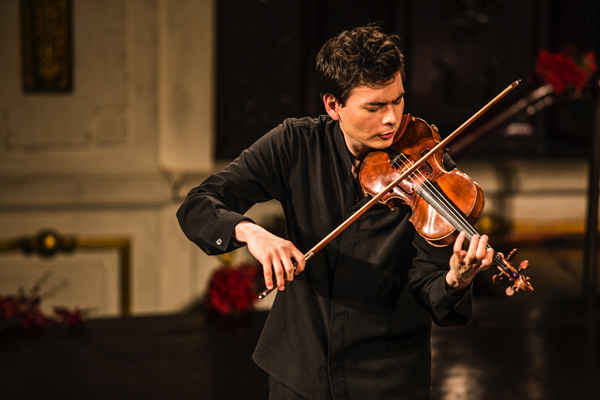
Stefan Jackiw
Stefan Jackiw’s entrance was all the quieter because he started that F# somewhere in the pianississimo range – could he even hear it himself? – and let it bloom into a haunting echo.

It happens again a few bars later, but this time the violin is more tonally assertive, echoing the piano’s interval of E to B, but finishing on A, the tonic. It’s subtle, but this is Brahms in his autumnal mode, creating drama in quiet ways. And, to their credit, Jackiw and pianist Anna Polonsky didn’t try to impose unnecessary drama. They followed the work’s mood shifts, bringing out its joyful rhythmic variety, letting the sunlight peep through in the movement’s development section.

Jackiw has a gorgeous tone and tremendous control. His shifts, for example, can be soundless if he so desires. “It’s the violin,” a woman behind me ridiculously declared at intermission. “That’s what makes him sound good.” No, an accomplished fiddler can make the humblest of instruments sound superb. And it takes nerves of iron, as well, as Jackiw demonstrated when a cell phone went off in the audience during the second movement and its owner struggled to figure out how to silence the thing. (When you give your grandparents cell phones, please teach them this important skill.)