 |
| Photo by B. A. Nilsson |
Sunday, February 28, 2016


Tuesday, February 23, 2016
Profile: Deb Girdler
From the Vault Dept.: Back in the late 1980s, the Cohoes Music Hall was under the artistic direction of Robert W. Tolan and churned out one hit show after another. A mainstay in several of those shows was Deb G. Girdler, whom I profiled in early 1989. She’s back in her native Cincinnati, where she just appeared in an acclaimed production of “Cinderella” with that city’s Ensemble Theatre; she’s also hit the big screen in the movie “Carol.”
SHE MAKES IT SOUND as if she’d leave acting in a minute and settle down in a dressmaking shop in Cincinnati, but stays on, oh, for the fun of it. She makes it sound easy. Makes it look easy, too, unless you’ve seen a few of the Heritage Artists productions this season at the Cohoes Music Hall. Deb Girdler has been in every one of them, a tour-de-force lineup of impersonations that have ranged from sultry to bratty to funny as hell.
 Watching her rehearse “I Do! I Do!,” in which she’s currently starring, gives you a feel for the craft she tries to conceal. Her character is pregnant, so Girdler has her walking in bowlegged syncopation, tilted slightly. The comedy is applied with skillful care: the character is never unbelievable. The finished product, which finds the actress beautifully gowned and amusingly pillowed, draws those low, knowing chuckles from the audience that are the best testimony to comic skill.
She’s a trained singer and dancer but those abilities are only underpinnings to her most obvious attribute: in the tradition of Gertrude Lawrence and Judy Holliday, Girdler is a comedian. That’s an extra touch of theatrical skill – many can act, few can transcend it with a comic sense.
Talk to her and you realize you’re being collected, another set of mannerisms for her histrionic lexicon. At the same time she speaks charmingly, a little Kentucky resonance belying her native state. “I’m having a great time here,” she says, indicating the Cohoes Music Hall. “Being in all these shows is like a dream for me. It gives me plenty to do, which is good – I get bored so easily.” She laughs, a gesture you recognize from the stage. It’s a contagious, Joyce Grenfell-like shriek. “And I always seem to end up in these nifty old little places. I’ve worked at the Charles Theatre in Boston and Ford’s Theatre in Washington – the only new place I think I’ve appeared in was at the Conservatory of Music in Cincinnati.”
SHE MAKES IT SOUND as if she’d leave acting in a minute and settle down in a dressmaking shop in Cincinnati, but stays on, oh, for the fun of it. She makes it sound easy. Makes it look easy, too, unless you’ve seen a few of the Heritage Artists productions this season at the Cohoes Music Hall. Deb Girdler has been in every one of them, a tour-de-force lineup of impersonations that have ranged from sultry to bratty to funny as hell.
She’s a trained singer and dancer but those abilities are only underpinnings to her most obvious attribute: in the tradition of Gertrude Lawrence and Judy Holliday, Girdler is a comedian. That’s an extra touch of theatrical skill – many can act, few can transcend it with a comic sense.
Talk to her and you realize you’re being collected, another set of mannerisms for her histrionic lexicon. At the same time she speaks charmingly, a little Kentucky resonance belying her native state. “I’m having a great time here,” she says, indicating the Cohoes Music Hall. “Being in all these shows is like a dream for me. It gives me plenty to do, which is good – I get bored so easily.” She laughs, a gesture you recognize from the stage. It’s a contagious, Joyce Grenfell-like shriek. “And I always seem to end up in these nifty old little places. I’ve worked at the Charles Theatre in Boston and Ford’s Theatre in Washington – the only new place I think I’ve appeared in was at the Conservatory of Music in Cincinnati.”
Monday, February 22, 2016
John Caldwell: In Memoriam
Now we're forced to bid good-bye to John Caldwell. I described my brief creative association with him in this post. Below is another of the sketches he made for a never-to-be-used campaign for the short-sighted Schenectady Symphony, nicely illustrating an ad for a concert that included Prokofiev's "Peter and the Wolf."


Thursday, February 18, 2016
Had the Jitters
From the Food Vault Dept.: Sometimes it didn’t matter how much I raved about a place. Jitters Café held forth for a few glorious years, serving as a reliable dinner spot when traveling to Saratoga Springs and back – and then it was gone. But here’s what I about it wrote five years ago.
“I KNOW THIS BUSINESS is supposed to be about turning tables and making money,” says Gina Prince, “but I don’t care if someone comes in here and just buys a cup of coffee and sits for four hours reading or using a computer. We want to be a friendly place.”
The place in question is tucked into a strip mall on Geyser Rd., on the western edge of Ballston Spa. Follow the road a few miles east and it puts you at one of the entrances to the Saratoga Performing Arts Center. Which is how we found the place: it sits along the back way to SPAC from my house.
With Saratoga’s dining options in something of an uproar this time of year, it’s a relief to find a place that’s both accommodating and inexpensive, offering an array of light-fare dishes that suit the summer weather well.
Not that I’d label the item I chose, a chicken quesadilla ($10) as especially light, but it became mine by default after my wife changed her mind while in the midst of ordering, opting instead for a portobello wrap ($8). There’s a protocol to dining out with me, one I thought was long established in my own family, for crying out loud. Everybody gets something different. We try to cover as varied a panoply of items as possible. And you don’t change you order.
“I KNOW THIS BUSINESS is supposed to be about turning tables and making money,” says Gina Prince, “but I don’t care if someone comes in here and just buys a cup of coffee and sits for four hours reading or using a computer. We want to be a friendly place.”
 |
| Photo by B. A. Nilsson |
With Saratoga’s dining options in something of an uproar this time of year, it’s a relief to find a place that’s both accommodating and inexpensive, offering an array of light-fare dishes that suit the summer weather well.
Not that I’d label the item I chose, a chicken quesadilla ($10) as especially light, but it became mine by default after my wife changed her mind while in the midst of ordering, opting instead for a portobello wrap ($8). There’s a protocol to dining out with me, one I thought was long established in my own family, for crying out loud. Everybody gets something different. We try to cover as varied a panoply of items as possible. And you don’t change you order.
Wednesday, February 10, 2016
Have Song, Will Travel
“BEYOND THE BLUE HORIZON” often is sung (when it gets sung at all) as the telling of a dream, in an “Over the Rainbow” approach. When Molly Ryan sings it, as the second track of her new recording “Let’s Fly Away,” it’s with the determination of one who has the tickets in hand and is raring to go.
 Travel is the theme of this collection of fourteen songs, recorded with an outstanding group of instrumentalists. It’s bookended by a pair of “wander” numbers, beginning with Bud Flanagan’s “Wanderer,” better known in England in the 1930s, but as shrewd a stage-setting song as could have been selected. “Leave me alone, let me wander,” Ryan sings, but her claim to be a roving vagabond is colored with the possibility that she wouldn’t mind some company.
That’s due in part to her self-assured, jazz-inflected style, and in part to the chorus that precedes her entry, with tight brass phrases and decorative response by Mark Shane’s piano. These players swing, and that offers its own irresistible invitation to follow.

That’s due in part to her self-assured, jazz-inflected style, and in part to the chorus that precedes her entry, with tight brass phrases and decorative response by Mark Shane’s piano. These players swing, and that offers its own irresistible invitation to follow.
Tuesday, February 09, 2016
The Censorship of Thought
Guest Blogger Dept.: Novelist Robert Keable wrote Simon Called Peter in 1921, telling the story of a priest’s dalliance with a nurse during the First World War. It signalled his rebellion against the Church of England – he’d been a priest – and a shift to the kind of enlightenment that prompted an invitation to contribute to the collection Nonsenseorship, sections of which have appeared here during the past few years.
I KNEW A MAN, about a year ago, who published a novel upon which the critics fell with such fury this side of the water at least, that whether in the body or out of the body, such was ultimately his state of bewilderment, he could not tell, and if I am asked to discuss “Prohibitions, Inhibitions and Illegalities” it is natural that the incident should be foremost in my mind. True, it is becoming increasingly the fashion for a parson to preach a sermon without announcing text, but modern preaching, like brief bright brotherly breezy modern services, does not seem to cut much ice. Therefore we will hark back to the manner of our forefathers and take the incident for a text. It affords an admirable example of nonsenseorship.
As is always done in approved sermons (but humbly entreating your forbearance, which is less common) let us consider the context, let us review the circumstances of the case in point. Our author left the lonely heart of Africa for the theatre of war in France. He left a solitude, a freedom, a beauty, of which he had become enamoured, for that assemblage of all sorts of all nations, in a cock--pit of din and fury, known as the Western Front. He expected this, that, and the other; mainly he found the other, that, and this. Being desirous of serving the God of things as they are, he pondered, he observed, and, his heart burning within him, he wrote. He had no opportunity of writing in France, so he wrote on his return, away up in the Drakensberg mountains, alone, with the clean veld wind blowing about him and the nearest town an hour's ride away, and that but three houses when he reached it. He had seen vivid things and it chanced he was able to write vividly. There were twenty chapters in his novel and he wrote them in twenty days.
 |
| Robert Keable Urging the Automaton Called Citizen to Turn on His Oppressor Illustration by Ralph Barton |
As is always done in approved sermons (but humbly entreating your forbearance, which is less common) let us consider the context, let us review the circumstances of the case in point. Our author left the lonely heart of Africa for the theatre of war in France. He left a solitude, a freedom, a beauty, of which he had become enamoured, for that assemblage of all sorts of all nations, in a cock--pit of din and fury, known as the Western Front. He expected this, that, and the other; mainly he found the other, that, and this. Being desirous of serving the God of things as they are, he pondered, he observed, and, his heart burning within him, he wrote. He had no opportunity of writing in France, so he wrote on his return, away up in the Drakensberg mountains, alone, with the clean veld wind blowing about him and the nearest town an hour's ride away, and that but three houses when he reached it. He had seen vivid things and it chanced he was able to write vividly. There were twenty chapters in his novel and he wrote them in twenty days.
Monday, February 08, 2016
Wicked Good Time
From the Theatrical Vault Dept.: Sifting through the ashes of the late Metroland magazine, I’m finding some pieces I wrote recently enough to leave me thinking I’ve posted them here – and discovering I haven’t. Here’s a review of the show Wicked, which played at Proctors in Schenectady during its second national tour.
NOTHING FIRES THE ENERGIES of your typical American lowbrow more surely than a figure of Evil, preferably in an austerely Manichean context. Faux-conservative windbaggery thrives on thumbnail vilification, and sculpts a steady stream of no-good-niks to hate. Tagging them, of course, with the label “liberal,” which is code for “smarter than I’ll ever hope to be.”
The Wizard of Oz’s Wicked Witch is an archetype of evil, eager to kill in pursuit of footwear, thus assuring herself a permanent place in populist entertainment.
Gregory Maguire’s novel Wicked ingeniously imagined a backstory for this babe, taking her far from the colorful but black-and-white characterization we know so well from the movie, and it’s fitting that this story should get a Broadway recrafting as well. I’m sure a new movie will follow.
What’s most impressive, however, is the great popularity of this piece. It’s been a Broadway sellout since it opened six years ago, and has spawned two national tours, one of which is spending a few weeks at Proctor’s Theatre. True, the theater audience tends to be a rarefied bunch, but it’s heartening to see that a live show can achieve blockbuster status in that context.
NOTHING FIRES THE ENERGIES of your typical American lowbrow more surely than a figure of Evil, preferably in an austerely Manichean context. Faux-conservative windbaggery thrives on thumbnail vilification, and sculpts a steady stream of no-good-niks to hate. Tagging them, of course, with the label “liberal,” which is code for “smarter than I’ll ever hope to be.”
 |
| Carrie Manolakos as Elphaba |
Gregory Maguire’s novel Wicked ingeniously imagined a backstory for this babe, taking her far from the colorful but black-and-white characterization we know so well from the movie, and it’s fitting that this story should get a Broadway recrafting as well. I’m sure a new movie will follow.
What’s most impressive, however, is the great popularity of this piece. It’s been a Broadway sellout since it opened six years ago, and has spawned two national tours, one of which is spending a few weeks at Proctor’s Theatre. True, the theater audience tends to be a rarefied bunch, but it’s heartening to see that a live show can achieve blockbuster status in that context.
Sunday, February 07, 2016
In Memoriam: Dan Nilsson
Bad News Dept.: It was a terrible shock to learn of the death of Dan Nilsson (no relation), chef-owner of Hudson’s DA|BA. A meticulous craftsman, he raised the dining bar for that city and for the greater area. I have no idea of what the restaurant is planning for its future, and no wish to call to find out. But here’s the review I wrote for Metroland in 2012.
WHEN IT COMES TO RESTAURANTS, the most fascinating few blocks of arrayed eateries is in Hudson, where a steady boom in arts and antiques also has delivered no lack of dining choices. DABA opened six years ago in a building that has served the city at least as far back as the 1940s, when it sported a faux log cabin look, spent some time as a pizza joint, and most recently was the Paramount Grill.
Now it’s a welcoming, unfussy eatery with two comfortable dining areas separated by a two-sided bar, with walls of muted earth tones and improbably elegant butcher paper laid over linen-topped tables.
To identify it as a Swedish restaurant acknowledges that it serves an astonishingly wonderful preparation of Swedish meatballs ($22), that you’ll find such characteristic items as herring and lingonberries and that the chef is surnamed Nilsson, a moniker shared only by an illustrious few.
But DABA’s Swedishness is only a jumping-off point. Chef-owner Daniel Nilsson has fashioned a dining environment that welcomes you into a meal experience where harmony and balance inform each plate.
WHEN IT COMES TO RESTAURANTS, the most fascinating few blocks of arrayed eateries is in Hudson, where a steady boom in arts and antiques also has delivered no lack of dining choices. DABA opened six years ago in a building that has served the city at least as far back as the 1940s, when it sported a faux log cabin look, spent some time as a pizza joint, and most recently was the Paramount Grill.
 |
| Photo by B. A. Nilsson |
To identify it as a Swedish restaurant acknowledges that it serves an astonishingly wonderful preparation of Swedish meatballs ($22), that you’ll find such characteristic items as herring and lingonberries and that the chef is surnamed Nilsson, a moniker shared only by an illustrious few.
But DABA’s Swedishness is only a jumping-off point. Chef-owner Daniel Nilsson has fashioned a dining environment that welcomes you into a meal experience where harmony and balance inform each plate.
Wednesday, February 03, 2016
Seriously Music
THE VIOLIN ENTERS in measure five of Brahms’s Sonata No. 2, and it’s a tentative moment, echoing the piano’s just-sounded trip from F# down to C#, but making a more reluctant descent of it by adding the intervening E and D. It’s marked “piano,” with an immediate decrescendo hairpin. But it’s tricky to be quiet there.
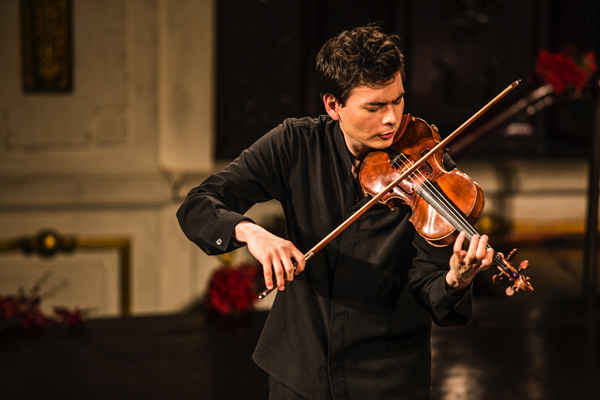
Stefan Jackiw’s entrance was all the quieter because he started that F# somewhere in the pianississimo range – could he even hear it himself? – and let it bloom into a haunting echo.
It happens again a few bars later, but this time the violin is more tonally assertive, echoing the piano’s interval of E to B, but finishing on A, the tonic. It’s subtle, but this is Brahms in his autumnal mode, creating drama in quiet ways. And, to their credit, Jackiw and pianist Anna Polonsky didn’t try to impose unnecessary drama. They followed the work’s mood shifts, bringing out its joyful rhythmic variety, letting the sunlight peep through in the movement’s development section.
Jackiw has a gorgeous tone and tremendous control. His shifts, for example, can be soundless if he so desires. “It’s the violin,” a woman behind me ridiculously declared at intermission. “That’s what makes him sound good.” No, an accomplished fiddler can make the humblest of instruments sound superb. And it takes nerves of iron, as well, as Jackiw demonstrated when a cell phone went off in the audience during the second movement and its owner struggled to figure out how to silence the thing. (When you give your grandparents cell phones, please teach them this important skill.)
 |
| Stefan Jackiw |
It happens again a few bars later, but this time the violin is more tonally assertive, echoing the piano’s interval of E to B, but finishing on A, the tonic. It’s subtle, but this is Brahms in his autumnal mode, creating drama in quiet ways. And, to their credit, Jackiw and pianist Anna Polonsky didn’t try to impose unnecessary drama. They followed the work’s mood shifts, bringing out its joyful rhythmic variety, letting the sunlight peep through in the movement’s development section.
Jackiw has a gorgeous tone and tremendous control. His shifts, for example, can be soundless if he so desires. “It’s the violin,” a woman behind me ridiculously declared at intermission. “That’s what makes him sound good.” No, an accomplished fiddler can make the humblest of instruments sound superb. And it takes nerves of iron, as well, as Jackiw demonstrated when a cell phone went off in the audience during the second movement and its owner struggled to figure out how to silence the thing. (When you give your grandparents cell phones, please teach them this important skill.)
Tuesday, February 02, 2016
House of Mike
From the Restaurant Vault Dept.: I recently had lunch at Chez Mike in East Greenbush, the first time I’ve been back in a long while, and the place was a good as I remembered – certainly as good as it was when I first visited, and wrote about it, in 2009.
“IT’S THE STRANGEST THING,” says Mike Cohen. “Somebody showed me a blog entry that said how nice my restaurant is and how good the food is – but the writer promised to return only if I move out of the strip mall I’m in.”
The Long Island-born chef-owner of Chez Mike notes that there seem to be few objections to big-city restaurants occupying strip mall-like spaces, so why this peculiar prejudice?
I’m inclined to blame it on the many mediocre eateries that strip malls attract, often joints where the bar dominates the room and the grilled chicken was burner-striped by Sysco. But as Cohen’s restaurant name suggests, this is far from the case at his eatery.
Formerly chef at Lippera’s Chatham House, Cohen decided to open his own place “while I’m still young and have the energy to do this. My wife and I live in East Greenbush, and when we looked at what else is here, we realized that there’d be a place here for the kind of restaurant I wanted to run.”
Chez Mike opened in June 2008, in the Hannaford Plaza on Columbia Turnpike, the restaurant so-named “to combine a sense of the French heritage of the cooking I do with something more tongue-in-cheek and accessible,” says Mike. He and Michele both are Culinary Institute graduates, and his resume also includes a stint at Manhattan’s renowned Four Seasons.
“IT’S THE STRANGEST THING,” says Mike Cohen. “Somebody showed me a blog entry that said how nice my restaurant is and how good the food is – but the writer promised to return only if I move out of the strip mall I’m in.”
 |
| Photo by B. A. Nilsson |
I’m inclined to blame it on the many mediocre eateries that strip malls attract, often joints where the bar dominates the room and the grilled chicken was burner-striped by Sysco. But as Cohen’s restaurant name suggests, this is far from the case at his eatery.
Formerly chef at Lippera’s Chatham House, Cohen decided to open his own place “while I’m still young and have the energy to do this. My wife and I live in East Greenbush, and when we looked at what else is here, we realized that there’d be a place here for the kind of restaurant I wanted to run.”
Chez Mike opened in June 2008, in the Hannaford Plaza on Columbia Turnpike, the restaurant so-named “to combine a sense of the French heritage of the cooking I do with something more tongue-in-cheek and accessible,” says Mike. He and Michele both are Culinary Institute graduates, and his resume also includes a stint at Manhattan’s renowned Four Seasons.
Sunday, January 31, 2016
Francesca Zambello: Theater for Social Change
From the Fairly Recent Past Dept.: This interview with Glimmerglass Festival Artistic Director Francesa Zambello was written before the start of the 2012 season, when she still was fairly new in town; since then, she has made the place and its productions better and better. This summer, Stephen Sondheim’s “Sweeney Todd” will be featured, along with Puccini’s “La Bohème,” Verdi’s “Thieving Magpie,” and Robert Ward’s “The Crucible.” More info here.
SHE HAD WHAT COULD BE ARGUED was the best possible Metropolitan Opera directorial debut, with her 1992 production of Donizetti’s “Lucia di Lammermoor” getting all but booed off the stage. Not only did Francesca Zambello’s stock as a director shoot way up, bringing a series of international engagements that has yet to slacken, but she also was invited back to the Met a decade later to helm what became a much-lauded production of Berlioz’s “Les Troyens” – which she’s repeating at that opera house this fall.
Last summer, she took over artistic and general direction of Cooperstown’s Glimmerglass Opera and immediately dropped from its moniker the O-word. It’s now the Glimmerglass Festival, and part of it mission is to present a season that mixes all manner of musical theater, from outsized opera to vintage Broadway, while adhering to Zambello’s vision of the Festival’s mission.
“This season is about ideas for social change,” says Zambello. “I chose works that could inspire discussion about those issues, and we’ve scheduled events beyond the productions themselves that allow us further exploration of those themes.”
Although Meredith Willson’s perennial “The Music Man” might seem to resist such a theme, “It has a message about music and community and Main Street USA,” says Zambello. “Which we are. And Marcia Dodge, who is directing it, has updated it to World War Two to give more of a social message and a sense that it doesn’t feel locked in a particular time period.
SHE HAD WHAT COULD BE ARGUED was the best possible Metropolitan Opera directorial debut, with her 1992 production of Donizetti’s “Lucia di Lammermoor” getting all but booed off the stage. Not only did Francesca Zambello’s stock as a director shoot way up, bringing a series of international engagements that has yet to slacken, but she also was invited back to the Met a decade later to helm what became a much-lauded production of Berlioz’s “Les Troyens” – which she’s repeating at that opera house this fall.
 |
| Francesca Zambello | Photo by B. A. Nilsson |
“This season is about ideas for social change,” says Zambello. “I chose works that could inspire discussion about those issues, and we’ve scheduled events beyond the productions themselves that allow us further exploration of those themes.”
Although Meredith Willson’s perennial “The Music Man” might seem to resist such a theme, “It has a message about music and community and Main Street USA,” says Zambello. “Which we are. And Marcia Dodge, who is directing it, has updated it to World War Two to give more of a social message and a sense that it doesn’t feel locked in a particular time period.
Saturday, January 30, 2016
Fats Waller: A Memoir
Guest Blogger Dept.: Joey Nash was a singer with Richard Himber’s Ritz-Carlton Orchestra during the mid 1930s, but he also was a skilled an effective writer, as this tribute to his buddy Fats Waller well proves. It appeared in the gatefold of a 1975 two-record set that began an attempt to issue all of Waller’s recordings, a project that eventually saw fruition in six multi-CD sets on the JSP label.
 THE MILK TRAIN LEAVING WASHINGTON enroute to New York was jammed. The locked windows and the conglomerate odors of muscatel wine, unwashed bodies and garlic infested sandwiches made breathing a horrific experience. During the mad rush for a seat I became separated from the rest of the guys in the band and wandered through car after car looking for a place to park my body. Finally I found an empty space, threw my sax case on the rack above me and flopped down.
I was exhausted. I had just finished a college gig with the Vincent Lopez band. It had been a rugged day—and night—what with the ride to Washington, a miserable dinner of an overcooked hamburger, heartburn coffee and seven hours of non-stop playing. I hated the music business and fervently wished I was a ditchdigger. My crumpled tuxedo, starched dress shirt and collar felt grafted to my sweaty skin.
 THE MILK TRAIN LEAVING WASHINGTON enroute to New York was jammed. The locked windows and the conglomerate odors of muscatel wine, unwashed bodies and garlic infested sandwiches made breathing a horrific experience. During the mad rush for a seat I became separated from the rest of the guys in the band and wandered through car after car looking for a place to park my body. Finally I found an empty space, threw my sax case on the rack above me and flopped down.
I was exhausted. I had just finished a college gig with the Vincent Lopez band. It had been a rugged day—and night—what with the ride to Washington, a miserable dinner of an overcooked hamburger, heartburn coffee and seven hours of non-stop playing. I hated the music business and fervently wished I was a ditchdigger. My crumpled tuxedo, starched dress shirt and collar felt grafted to my sweaty skin.
Wednesday, January 20, 2016
The Simple Act of Bending
The simple act of bending isn’t simple any more.
When something falls, I leave it on my very cluttered floor.
My eyes refuse to focus and my lower back is sore:
The simple act of bending isn’t simple any more.
The simple act of reading always sends me in a rage.
The tiny little letters swirl and dance upon the page.
I’m sure I’m missing nothing in this semi-literate age,
Yet the simple act of reading always sends me in a rage.
The simple act of dining now they tell me is a sin.
Don’t eat red meat! Don’t eat those carbs!
Don’t eat that chicken skin!
It isn’t worth the time it takes to get my dentures in:
The simple act of dining now they tell me is a sin.
The simple act of darkness, as the sex act once was known,
Was always over-rated, over-long, and over-blown.
The seeds of love I’m sowing are now seeds already sown,
So if you want my loving, keep in mind: you’re on your own.
When something falls, I leave it on my very cluttered floor.
My eyes refuse to focus and my lower back is sore:
The simple act of bending isn’t simple any more.
The simple act of reading always sends me in a rage.
The tiny little letters swirl and dance upon the page.
I’m sure I’m missing nothing in this semi-literate age,
Yet the simple act of reading always sends me in a rage.
The simple act of dining now they tell me is a sin.
Don’t eat red meat! Don’t eat those carbs!
Don’t eat that chicken skin!
It isn’t worth the time it takes to get my dentures in:
The simple act of dining now they tell me is a sin.
The simple act of darkness, as the sex act once was known,
Was always over-rated, over-long, and over-blown.
The seeds of love I’m sowing are now seeds already sown,
So if you want my loving, keep in mind: you’re on your own.
Friday, January 15, 2016
Capitalistic Boss
A delightful ditty from 1937, dedicated to all political candidates, office-holders, Super-PAC donors, and anyone portrayed in "The Big Short." And that's just for starters.
Monday, January 04, 2016
PDQ in NYC: AOK!
THE MUSIC OF PDQ BACH RETURNED, with orchestra, to a New York concert hall just after Christmas for two performances; I attended the first of them and, as expected, it was a joyful and nostalgic event.
Although usually scrupulous in his writing, the New Yorker’s Alex Ross previewed the concerts with the assertion that Prof. Peter Schickele would be making his dilatory entrance “swinging from a rope.” This is a lesson in the power of tradition. Prof. Schickele has made many memorable entrances over the years. He has raced down an aisle and belly-flopped on the stage; he has been discovered asleep behind the onstage podium; he has even strolled in on the arm of a pneumatic blonde who giggled at each mention of the word “organ” until she was hurried offstage. The only rope-based entrance I’ve seen involved a knotted length dropped from a balcony, down which the Professor descended.
But legend quickly dominates significant events. We who grew up attending the Christmastime PDQ Bach concerts have described them enthusiastically enough over the years to romanticize that entrance into the full Errol Flynn: thus Mr. Ross’s understandable assertion.
Prof. Schickele, now 80, prefers not to trust his unsteady legs while performing, and so made his entrance in a wheelchair. It got a laugh. And he was on time, too, so that he could receive an award from the American Musicological Junta, a group that has supported the world of PDQ Bach over the years with neither web presence or phone number to sully the purity of its mission.
 |
| Photo by Peter Schaaf |
But legend quickly dominates significant events. We who grew up attending the Christmastime PDQ Bach concerts have described them enthusiastically enough over the years to romanticize that entrance into the full Errol Flynn: thus Mr. Ross’s understandable assertion.
Prof. Schickele, now 80, prefers not to trust his unsteady legs while performing, and so made his entrance in a wheelchair. It got a laugh. And he was on time, too, so that he could receive an award from the American Musicological Junta, a group that has supported the world of PDQ Bach over the years with neither web presence or phone number to sully the purity of its mission.
Sunday, January 03, 2016
Another Classical Year
CLASSICAL MUSIC, OR WHAT’S LEFT OF IT, retrenches and redefines itself with impressive alacrity, trying again to do what it did before it was pushed out of sight: absorb the sounds that please the ears of the many, even as it clings to the big orchestral sound that continues to price it out of existence.
Put simply, there are far bigger profits to be made from music that’s less demanding. The corporate hand grabbing money from your pocketbook is impatient, and has taught us to be impatient, too. But new recordings soldier on, impressively redefining the old and discovering younger works.
 Thus, a couple of composers unfamiliar to me lead my list of the year’s favorites. New York City-born Mohammed Fairouz, a wildly successful 30-year-old (he’s been on Morning Joe!) weaves the textures of his Middle Eastern roots into his engaging music, and the album Follow, Poet (DGG) adds poetry both in an emotionally affecting setting and in spoken texts by Auden and Heaney, with a paean to poetry by John F. Kennedy to kick things off.
The poetry of José Santos Chocano inspired the work “América Salvaje” (“Wild Americas”), the compelling concluding work on a Harmonia Mundi collection of the music of Peruvian composer Jimmy López. It’s also different enough from the other three orchestral works on the CD to show how easily López can summon the texture he needs, even while embracing indigenous aspects of the music he grew up with — especially as demonstrated in “Perú Negro,” as excitingly danceable as a Ginastera ballet.
Put simply, there are far bigger profits to be made from music that’s less demanding. The corporate hand grabbing money from your pocketbook is impatient, and has taught us to be impatient, too. But new recordings soldier on, impressively redefining the old and discovering younger works.

The poetry of José Santos Chocano inspired the work “América Salvaje” (“Wild Americas”), the compelling concluding work on a Harmonia Mundi collection of the music of Peruvian composer Jimmy López. It’s also different enough from the other three orchestral works on the CD to show how easily López can summon the texture he needs, even while embracing indigenous aspects of the music he grew up with — especially as demonstrated in “Perú Negro,” as excitingly danceable as a Ginastera ballet.
Friday, January 01, 2016
Finally: Food
From the Digipages of Metroland Dept.: A bunch of us put the paper to rest with an online-only final edition, to which I contributed this worthy parable for my last-ever Metroland food column.
HE WORKED IN THE KITCHEN of a red-sauce restaurant during the last half of high school, and parlayed that experience into a front-of-house job when college began. College was a disaster, at least from the point of view of the college and his parents. The friendships he sought, the parties, the romance–these he found in the restaurant.
 Gathering what money he could muster, he switched schools. Although Hyde Park’s Culinary Institute sprawled like a hotel complex, it demanded a far more grueling work and study schedule than the college he’d been about to fail. This time, however, he was motivated.
He was too shy to strut and brag like the handful of classmates clearly destined for restaurant-business fame. But he felt confident of achieving more success than the ones who aspired to no more than a line-cook job at a backwoods Marriott. He studied hard. He aced his labs. His knife skills grew instinctive. His externships taught him how to talk to people: bosses, suppliers, customers.
Even before he graduated, one of his instructors recommended him to a prestigious Manhattan chef, and his trajectory of success became spectacular. The drugs didn’t hurt him. Nor did the affairs. He could see the destructive evidence of such pursuits on the face of an older sous-chef who clearly would rise to nothing greater, but he himself wasn’t persuaded to jam on the brakes until one of the affairs got pregnant and insisted on keeping the child. It was her first, and she was leaving her husband anyway, and he guessed he loved her and he married her and discovered that he actually did.
HE WORKED IN THE KITCHEN of a red-sauce restaurant during the last half of high school, and parlayed that experience into a front-of-house job when college began. College was a disaster, at least from the point of view of the college and his parents. The friendships he sought, the parties, the romance–these he found in the restaurant.

He was too shy to strut and brag like the handful of classmates clearly destined for restaurant-business fame. But he felt confident of achieving more success than the ones who aspired to no more than a line-cook job at a backwoods Marriott. He studied hard. He aced his labs. His knife skills grew instinctive. His externships taught him how to talk to people: bosses, suppliers, customers.
Even before he graduated, one of his instructors recommended him to a prestigious Manhattan chef, and his trajectory of success became spectacular. The drugs didn’t hurt him. Nor did the affairs. He could see the destructive evidence of such pursuits on the face of an older sous-chef who clearly would rise to nothing greater, but he himself wasn’t persuaded to jam on the brakes until one of the affairs got pregnant and insisted on keeping the child. It was her first, and she was leaving her husband anyway, and he guessed he loved her and he married her and discovered that he actually did.
Friday, December 25, 2015
Mediterranean Holiday
THE GUT-WRENCHING CRY of “Respondemos” – melismatic, nasal, featuring more flatted tones than any five Billie Holiday records – set a stark beginning against which Boston Camerata’s traditional entrance seemed all the more mysterious. Over a hurdy-gurdy drone, the voices behind us, which at another concert might have sounded the likes of “Watchman of Zion,” sang “Madre de Dios,” a Castillian carol from at least the 13th century.
This was the 26th Boston Camerata holiday appearance as part of the Union College concert series, and every year the ensemble is all the more desperately welcome. While it’s easy (and necessary) to note how awful is the season’s commercialism, there’s no more revolting aspect than bad holiday music, which thrives on the unfortunate fact that any song can be made memorable by relentlessly hammering it into your ears.
It’s doubtful that you’d encounter any part of any Boston Camerata Christmas program in the aural assault of the end of the year. It’s certain that no aspect of this year’s program, “A Mediterranean Christmas,” will be so sounded. Especially this year, when we’ve demonized so much of that region. “We need this program more than ever,” said artistic director Anne Azéma.
 |
| Boston Camerata and Sharq Ensemble |
It’s doubtful that you’d encounter any part of any Boston Camerata Christmas program in the aural assault of the end of the year. It’s certain that no aspect of this year’s program, “A Mediterranean Christmas,” will be so sounded. Especially this year, when we’ve demonized so much of that region. “We need this program more than ever,” said artistic director Anne Azéma.
Thursday, December 17, 2015
On a Ravioli Roll
CRUSHING YOUR CONCOCTION into pillows of pasta is the fun part, the payoff for the work you’ve been through to get there. For the many years that I’ve made ravioli by hand, I accepted that forming the pockets was tedious and the result – under my stewardship, at least – was irregular. But now that I’ve been introduced to the simplest of gadgets, one that checkerboards the pasta for you, I’m a total convert. Even better: It’s a handsome device that demands a place on an obvious shelf.
 The Fonde Ravioli Rolling Pin from Repast Supply Co. is a 17-inch, all-hardwood marvel of simplicity that produces 2 1/4-inch pasta squares with enough of a border to prevent leaking. You can see product videos here, but let me assure you that you’re not going to achieve such perfection right out of the gate. Let me take you through my own ravioli-making process.
You need to nail the pasta recipe. I looked at a variety of them for the egg-based version, which only worked when I increased the amount of eggs in the mix. A food.com contributor gives a ratio of 3 cups flour to 2 eggs, which ends up as a stiff lump. The classic Silver Spoon cookbook offers a more realistic 1 3/4 cups flour to 2 eggs, but that’s still too not pliable enough for our purpose.

You need to nail the pasta recipe. I looked at a variety of them for the egg-based version, which only worked when I increased the amount of eggs in the mix. A food.com contributor gives a ratio of 3 cups flour to 2 eggs, which ends up as a stiff lump. The classic Silver Spoon cookbook offers a more realistic 1 3/4 cups flour to 2 eggs, but that’s still too not pliable enough for our purpose.
Tuesday, December 15, 2015
The Argerich File
MARTHA ARGERICH IS A PIANIST for whom no music seems too technically challenging, but one with strong repertory preferences. Like Horowitz, she has burrowed herself into a not-terribly-large group of pieces, and to which she brings a bravura interpretive style filled with risk-taking that results only in excitement.
 Most of her official recordings have been for EMI or Deutsche Grammophon, and the latter, now under the aegis of Universal, which includes her recordings for Philips, have just been collected into a 48-CD box set as tempestuous and unpredictable as the pianist herself.
Her debut album was recorded in 1960 and comprised an impressive program of works by Chopin, Brahms, and Liszt, with Prokofiev’s “Toccata” as a harbinger of fiery works to come. You can feel the powers-that-be at work in choosing repertory here, and they’re probably behind the (nevertheless excellent) all-Chopin disc that followed seven years later.
But that same year also saw the release of a benchmark recording, on which she and a young Claudio Abbado collaborated, giving us Prokofiev’s Concerto No. 3 and Ravel’s Concerto in G. They are two works she would continue to champion but which sound as splendid here as they ever would.
Pianist and conductor seemed to incite one another. Abbado’s robust dynamics and keen orchestral textures are like a trampoline for the pianist, lofting her to magnificent moments. You expect this (or hope for it) in the Prokofiev; in the Ravel concerto it’s more of a surprise, but a welcome one.

Her debut album was recorded in 1960 and comprised an impressive program of works by Chopin, Brahms, and Liszt, with Prokofiev’s “Toccata” as a harbinger of fiery works to come. You can feel the powers-that-be at work in choosing repertory here, and they’re probably behind the (nevertheless excellent) all-Chopin disc that followed seven years later.
But that same year also saw the release of a benchmark recording, on which she and a young Claudio Abbado collaborated, giving us Prokofiev’s Concerto No. 3 and Ravel’s Concerto in G. They are two works she would continue to champion but which sound as splendid here as they ever would.
Pianist and conductor seemed to incite one another. Abbado’s robust dynamics and keen orchestral textures are like a trampoline for the pianist, lofting her to magnificent moments. You expect this (or hope for it) in the Prokofiev; in the Ravel concerto it’s more of a surprise, but a welcome one.
Subscribe to:
Posts (Atom)