Search This Blog

Monday, March 30, 2015

Through the Listening Glass

VALENTINA LISITSA HAS CHOPS, which she proved with recordings of works by Rachmaninoff and Liszt. You need that kind of technical ability with the music of Philip Glass, particularly in the rhythmic challenges.

Lisitsa’s two-CD set of Glass’s music because seductively with “Opening” from the 1982 “Glassworks,” a six-movement work “intended to introduce my music to a more general audience than had been familiar with it up to then,” as the composer noted, and, indeed, it’s a gentle ripple of an introduction, a haunting, peaceful harmonic progression realized through an accented rocking motion. You’re lulled into what should by now be the familiar sound of minimalism.

But Glass remains its master. Aimless though some of the pieces may sound to grumpy ears, there’s always a well-planned trajectory with an affecting emotional payoff. This is particularly true in the five-movement “Metamorphosis,” which makes up much of disc two. The first part of it strikes a mood of uncertainty, bathed in a pentatonically-fueled sense of timelessness. A series of questioning gestures transforms into a sense of resolve in the second section, adding a gentle high-note filigree halfway through. Each successive movement begins in a contrasting place but revisits elements from movements past, so the metamorphosis as a whole is evolutionary – and when we revisit those questioning gestures in the final section (“Metamorphosis V”), they don’t seem to be at all unsure any more. That’s part of the magic of Glass’s music – its seeming ambiguity is never far from a freshly tinted change of mood.

Sunday, March 29, 2015

Ménage à trois

From the Classical Vault Dept.: The mention I made a couple of days ago of Andy Stein’s arrangement of Gershwin’s “Summertime” reminded me of the concert at which it was the encore piece. Now you can share the memory thanks to the five-year-old review below.


THE SERIES BEGAN 20 YEARS AGO, and artistic director Chantal Juillet opened Monday’s concert with what no doubt will be the first of many goodbyes as she and new husband Charles Dutoit prepare to take their talents elsewhere.

Kalichstein-Laredo-Robinson Trio
Photo by Christian Steiner
Having this world-class trio kick off the summer chamber music season is testimony to her vision and influence. Programming has always been a mix of new sounds and standards, and if the Kalichstein-Laredo-Robinson Trio’s program (Beethoven-Brahms-Shostakovich) adhered to the latter, it reminded us why such pieces persevere.

Although Brahms’s big Trio in B Major, Op. 8, should be the fulcrum of any program it inhabits, its thunder was swiped by the Shostakovich piece that ended the first half. The Russian composer wrote his Trio No. 2 in E Minor in 1944, after learning of both the death of a close friend and the horrific revelations of Nazi death camps.

Shostakovich wore his pain on his artistic sleeve, and this piece pulses with pain. It’s not unrelenting – he had a wide range of expressive devices at hand, and even in the seemingly spare context of a musical threesome he painted textures Brahms and Beethoven never went near.

Saturday, March 28, 2015

Friday, March 27, 2015

The Stein Way

The slow movement of Schubert’s “Death and the Maiden” Quartet presents its haunting theme (from the song that gives the work its title) as a sad, shuffling march, its mournfulness only made the sadder by the Picardy third that tries to lighten the mood at the opening statement’s end.

Five variations follow, giving the quartet players a wide range of styles and dynamics as the ever-present feeling of foreboding weaves through. It’s intimate music for an intensely personal struggle, and could never work in any other form. So believes what I used to call the “purist” in me, and which got knocked aside when I heard an orchestral version of the work that carries its heartache and other emotional demands to this bigger canvas with such a thorough sense of accomplishment that it easily stands beside Schubert’s other symphonies.

“It’s his best one,” says Andy Stein, and he has a right to this opinion: he orchestrated the piece. “Schubert was writing everything in a hurry at that point – he knew he wasn’t going to live much longer – that I don’t think he was about to take the time to write it for orchestra. But that’s where it belongs.”

Thursday, March 26, 2015

No Bull

Restaurants in Review Dept.: The Bull’s Head Inn closed in the middle of 2012 and changed hands the following January. The new owners are busily restoring the place – it’s said to be oldest building in Cobleskill – and you can follow their progress on their Facebook page. But here’s my review from 2010.


YOU CAN GET TO COBLESKILL QUICKLY via I-88, or you can wander out along Route 7. The former offers a panorama of beautiful Schoharie County farmland; the latter is a close-up reminder that farms and farmer aren’t necessarily faring too well these days. Cobleskill itself is a small, agriculturally oriented city with a similarly inclined SUNY campus.

Photo by B. A. Nilsson
The village center hangs onto the old-world charm of historic buildings, many of them kept well maintained, but the outskirts have been blighted by several stretches of low-rent strip-mall stores, where Dollar General becomes the default department store.

The Bull’s Head Inn sits at a busy intersection in the nicer, dare I even say quainter part of the village, a turn-of-the-19th-century building bought at foreclosure two years ago and refurbished into charming shape. It’s the oldest building in the village, and has been some kind of gathering place for much of its 200-year history.

It’s right next to the town’s movie theater, a single-screen reminder of the old days. The Bull’s Head dining room opened late in 2008; after still more renovation, the Cellar Tavern (downstairs) opened.

Most significant, as far as the menu if concerned, was owner Tony Giammattei’s decision to hire chef Rick Vincent, bringing yet another history into the place.

Wednesday, March 25, 2015

Oliveira Branching

From the Classical Vault Dept.: He was a first prize winner at the Naumburg International Competition and the first violinist to receive the Avery Fisher Prize; more surprisingly, Elmar Oliveira won the gold medal at the 1978 Tchaikovsky International Competition in Moscow, and unheard-of victory for an American, which was rumored to have required special intervention by violinist Leonid Kogan on his behalf. Oliveira has maintained a steady career ever since, devoting much of his time to teaching even while performing regular in solo, chamber, and orchestral settings. Here’s my 1987 interview with him, in advance of a SPAC appearance my review of which also is below.


DURING THE THREE WEEKS of Philadelphia Orchestra performances at the Saratoga Performing Arts Center there always is an array of world-class instrumental soloists on hand to take on the responsibility of concerto performance.

Elmar Oliveira (c. 1987)
Elmar Oliveira is a violinist who carved out an international reputation for himself in just a few years; he'll return to SPAC on Aug. 5 to play the Violin Concerto by Samuel Barber, a work he’s been championing lately.

“It’s a work that hasn’t been played very much until recently,” he explains, “but it’s been getting some renewed interest in the last year or two. It’s very romantic work – Barber really uses the instrument as a vehicle for a kind of vocal expression, but it also departs from that at moments, especially in the last movement, a moto perpetuo, which introduces for the first time in the piece – I wouldn’t say dissonance, because there’s nothing in there that’s unpleasant-sounding, but something a little less solidly romantic.”

Tuesday, March 24, 2015

“Swifty” and Sure

Guest Blogger Dept.: By 1921, (Newton) Booth Tarkington was a Pulitzer Prize-winning novelist and a playwright with significant Broadway success, so it must have been gratifying to young John Peter Toohey to have a seasoned mentor with whom to correspond. Here’s some advice Tarkington passed along as Toohey’s play “Swifty” was having its out-of-town tryouts.


Kennebunkport, 29 June 1921
Dear Toohey:-

Prescription for your opening:

Booth Tarkington in Kennebunkport, Maine
You convince a large part of yourself that you don’t care. Thus: your living doesn’t depend on how it goes – it’s not really important, like the result of surgical operations, etc. or an oculist’s verdict. It’s really a little fling on the side – like a try at Monte Carlo that one can afford. Lovely if you win – but no damage if you don’t. And anyhow a large experience accumulated to one’s general worth to himself. After all, our worth to ourselves is what comes up on Judgement Day.

A playwright ought to have some such prescription for his nerves, as the time approaches, and also he oughtn’t to make pictures of a success: he oughtn’t, really, to hope or speculate much. Of course the safest thing is [George S.] Kaufman’s pessimism and incredulity. His constitution was protecting him against a drop in his spirits by not letting them rise so that they could drop. Then the rise when it comes, is in the nature of relief only – one does lose a flux of joy by following the safer course.

Monday, March 23, 2015

Beethoven’s Starry Sky

Beethoven was impressed enough by Immanuel Kant’s tombstone epigraph – “There are two things which raise man above himself and lead to eternal, ever-increasing admiration: the moral law within me, and the starry sky above me” – to copy it into his own notebooks. And to portray, in his late-in-life works, a vision of the celestial as a response to mundane strivings.

Paul Lewis | Photo by Jack Liebeck
No longer in thrall to a heroic ideal that drove his earlier works, desperate for money, a shambling, ill-dressed figure who was taken for a bum when he strayed from the street, Beethoven answered a publisher’s request for piano sonatas with what would be his final three works in that form, producing a triptych transcended anything that had come before, from his own or anyone else’s pen, sonatas so seemingly abstruse that it took decades for them to win unreserved acceptance.

Paul Lewis played all three in a recital at Schenectady’s Union College on Sunday, March 22. He spoke no words, played no encore, and only reluctantly took an intermission. He relied on the music itself – and the cumulative effect of these pieces – to lead a journey from the very earthly (one of the movements quotes a German folksong that chants, “I’m a slob and so are you”) to a magical realm of multiple trills and twelve-tone leanings, as if Beethoven were trying to leave behind all conventional notions of music.

Sunday, March 22, 2015

The Real Hatfield

My Uncle Opal died two years ago. I haven’t kept in touch with my West Virginia relatives, whom I last saw over twenty-five years ago towards the end of a cross-country trip my wife and I took.

Here’s the obit I found recently, and then I’ll give you a little more info:
Opal Burke
DELBARTON, W.Va. — Opal Burke, 91, of Delbarton, died Fri., Oct. 4, 2013, at his home. Born December 31, 1921, at Thacker, he was a son of the late Claude Burke and Ida Deboard Justice. Also preceding him in death was his wife, Ruth Hatfield Burke; sister, Ailene Nilsson, and a brother, Bobby Justice.
Opal was a retired UMWA coal miner and a U.S. Navy veteran having served in World War II. 
Survivors include his son: Lewis Dale Burke of Delbarton; daughters: Gail Dotson of Delbarton Ida Burke of Charleston, and Louise (Daniel) Smith of Matewan; brother: Billy Justice of Detroit, Mich.; sister: Dimple (Bill) Bishop of Williamson; grandchildren: Larry Dale Dotson, Lewis Dale Burke II, Karla Marie Dennison, Katrina Burke, Blaine Pruitt, Terence Pruitt, Amanda Sansom and Merissa Pruitt, and great-grandchildren: Cassie Dotson Mahon, Micah Dotson, Jade Dotson, Avaree Dennison, Mason Burke Dennison and Aidan Burke. 
The family will gather with friends from 6-9 p.m. Sun., Oct. 6, at Chambers Funeral Services' Chapel for an evening of remembrance and to honor the life of their dad, Opal Burke.

Saturday, March 21, 2015

Wednesday, March 18, 2015

All You Can Eataly

From the Back Pages Dept.: When I’m in the mood to dodge the strollers and my pocket is bulging with cash, I stop at Eataly. It’s a hugely fun Manhattan experience, where I easily dropped $150 on olive oil alone one day. Here’s my account of a visit there three years ago.


IT’S AN UPSCALE INDOOR STREET FAIR, a locus of culinary phantasmagoria that dazzles the eye and palate even as it chews deeply into the pocketbook. Eataly opened towards the end of 2010 near Manhattan’s Flatiron Building, at Fifth Avenue and 23rd St., the brainchild of Italian entrepreneur Oscar Farinetti, who already had opened a similar place in Turin.

Photo by B. A. Nilsson
For the 50,000-square-feet New York edition, he went into partnership with Mario Batali, Lidia Bastianich and Joe Bastianich, well-established as excellent restaurateurs with cookbooks and TV appearances to bolster their celebrity. According to Batali, Eataly is “a grocery store with tasting rooms.”

It’s a dizzying array of aisles and tables and shelves and people on the move. Plate-laden servers glide by with impossible dexterity, threading through throngs of the fascinated and oblivious, deftly dodging the designer strollers that halt when young parents become food-transfixed.

Tuesday, March 17, 2015

Genuine Mexican Plug

Guest Blogger Dept.: Mark Twain chronicled his adventures in the West, chasing gold, crossing Utah, working in San Francisco, and going on to the Sandwich Islands in his 1872 book Roughing It. Here’s an excerpt describing the author's horse sense.


I RESOLVED TO HAVE A HORSE TO RIDE. I had never seen such wild, free, magnificent horsemanship outside of a circus as these picturesquely-clad Mexicans, Californians and Mexicanized Americans displayed in Carson streets every day. How they rode! Leaning just gently forward out of the perpendicular, easy and nonchalant, with broad slouch-hat brim blown square up in front, and long riata swinging above the head, they swept through the town like the wind! The next minute they were only a sailing puff of dust on the far desert. If they trotted, they sat up gallantly and gracefully, and seemed part of the horse; did not go jiggering up and down after the silly Miss-Nancy fashion of the riding-schools. I had quickly learned to tell a horse from a cow, and was full of anxiety to learn more. I was resolved to buy a horse.

While the thought was rankling in my mind, the auctioneer came skurrying through the plaza on a black beast that had as many humps and corners on him as a dromedary, and was necessarily uncomely; but he was “going, going, at twenty-two!—horse, saddle and bridle at twenty-two dollars, gentlemen!” and I could hardly resist.

A man whom I did not know (he turned out to be the auctioneer’s brother) noticed the wistful look in my eye, and observed that that was a very remarkable horse to be going at such a price; and added that the saddle alone was worth the money. It was a Spanish saddle, with ponderous tapidaros, and furnished with the ungainly sole-leather covering with the unspellable name. I said I had half a notion to bid. Then this keen-eyed person appeared to me to be “taking my measure”; but I dismissed the suspicion when he spoke, for his manner was full of guileless candor and truthfulness. Said he:

“I know that horse—know him well. You are a stranger, I take it, and so you might think he was an American horse, maybe, but I assure you he is not. He is nothing of the kind; but—excuse my speaking in a low voice, other people being near—he is, without the shadow of a doubt, a Genuine Mexican Plug!”

Monday, March 16, 2015

Italian Profit

From the CD Shelf Dept.: Mario Castelnuovo-Tedesco wrote a version of “Largo al factotum” (from Rossini’s “Barber of Seville”) for Jascha Heifetz to play, exploring all of the impossible show-off techniques of the fiddle and even giving the piano high comedy in the form of a triplet figure at the end that starts on far-removed Cs (left hand: three octaves below middle-C, right hand: four octaves above it) and proceeds chromatically until they’re an octave apart. Useless to describe; great fun to hear. His violin concertos, though much more serious, radiate similar charm.


Naxos has served the music of Mario Castelnuovo-Tedesco quite well, having issued CDs of his piano concertos, several discs of solo piano words, works for cello, for violin, for chamber ensemble, sacred music, all of the Shakespeare overtures and the 30 songs he set from Shakespeare’s play, guitar music galore (Segovia was a friend), including his own “Goyescas,” a two-CD set of short pieces inspired by Goya’s etchings Los Caprichos, and, of course, the guitar concerts, the first of which keeps the composer’s name alive in the concert hall.

Castelnuovo-Tedesco was born in Italy in 1895. A prodigy who began composing at the age of nine, his works soon gained fame enough to make them a staple of performances and radio broadcasts, all of which skidded to a close as Mussolini aligned himself with Hitler and the works by the Jewish composer were ignored.

A 1939 concert appearance in New York led to his emigration, with Toscanini as a sponsor. He had another champion in Heifetz, who had performed Castelnuovo-Tedesco’s first violin concerto a few years earlier and was now pestering the composer for another. Naxos has issued Heifetz’s 1954 recording of Castelnuovo-Tedesco’s Violin Concerto No. 2, as definitive as a rendering as you’ll find, but a new recording, with violinist Tianwa Yang, pairs it with its predecessor – and restores a few measures of music missing from the Heifetz version of number two.

Sunday, March 15, 2015

Break a Play!

From the Theater Vault Dept.: I’m afraid I had it in for Ira Levin going into this piece, which I wrote six years after witnessing the horror of Levin’s one-performance Broadway flop Break a Leg. It was a ghastly play that featured “that pig Jack Weston” in the lead – as characterized by Michael Connolly, another actor in the piece. “Every time anybody else gets a laugh,” he told me as the play came together in rehearsal, “Weston throws a fit and insists that he be given the line.” It hardly mattered, and, despite the presence of  talent like Julie Harris, Rene Auberjonois, and Charles Nelson Reilly, who directed, the piece died a deserved death. Below are an advance and a review of Albany Civic Theater's 1985 production of Levin’s Veronica’s Room.


IT USUALLY WORKS LIKE THIS: A fat packet of information crosses my desk. I call some of the principals involved: director, actors and so on. Possibly read the script. By the time I’m in my seat on opening night. I’m intimate with the histories of most of the people I see onstage.

Margaret King and Giselle Sigond
So why is Albany Civic Theater behaving so strangely?

We got a terse notice informing us that Ira Levin’s thriller Veronica’s Room opens Wednesday. It went on: “The two-act play takes you on a series of twists and turns that will keep you on the edge of your seat until its nail-biting conclusion.”

Fair enough. I called Margaret King, one of the four cast members. “I can’t talk about the play,” she said, explaining that she didn’t want to give anything away. Fair enough, I returned – who wants to spoil a good surprise? “Tell me about the character you play,” I said.

Saturday, March 14, 2015

Sweet Siberia

My daughter will be on an airplane today flying over Siberia en route to Shanghai. This explains why the territory remains a popular flyover country.


Thursday, March 12, 2015

Spring Reawakening

Speaking of Diners Dept.: And we were doing so just the other day, saluting Schenectady’s defunct Ruby’s. Happily, Jack’s Drive-In endures (and has done so for 77 years) and will open for the season on Monday, March 23. Here’s my 2009 review of the place.


A STRANGE KIND OF CHANGE came over my friend Peter as we neared our lunch destination. He grew unprecedentedly quiet, somber even. “It’s just ahead,” he murmured as the small red shack and its white roadside sign eased into view. “You’ve never been here before? I grew up with this place.”

This was more than a search for a meal: this was a pilgrimage. We parked and walked the grounds slowly. “This used to be gravel,” he said of the parking lot. “And the original building was much smaller. It burned down years ago. My parents came here when they were dating, so it’s been here a long, long time.”

In fact, it opened in 1938, my subsequent research revealed, when RPI grad Jack Horn sought some supplementary cash. He got it, and then some.

Although Jack’s has changed in many ways over the years, a greater sense of continuity remains in the eyes of its fanatic followers. Enough so that the greatest scandal to hit the place in recent years was the addition of cheese to the burgers 15 years ago.

Wednesday, March 11, 2015

Actor James

Guest Blogger Dept.: Much of P.G. Wodehouse’s early poetry was inspired by life events, as in the case of the case of Dodson vs. Forbes-Robertson, as reported in The (London) Times on 16 July 1903. At its heart: actor Alfred Dodson claimed that Johnston Forbes-Robertson, the lessee of the Lyric Theatre, had switched the role that Dodson was supposed play for less-desirable one. We can only hope that the case proceeded the way Wodehouse imagined it.


P.G. Wodehouse
Sir Charles Wyndham stated that, 
as regards a West-End theatre, 
once an actor was engaged for a 
piece, the engagement was for 
the run of the piece.

The Judge: It is perfectly clear that 

the only way to get rid of an actor 
if you do not like him is to shoot him. 
– Extract from Theatrical Case.


The deeds of Histrion PYM
     (James was his Christian name)
The bard proceeds to hymn.
     Draw profit from the same.

JAMES did as well as an actor can
In the arduous rôle of a “first young man.”
His form was graceful, his step was light,
His hair was auburn, his eye was bright,
His voice expressive, his laughter free:
He played in musical comedy.

Tuesday, March 10, 2015

De Luxe Dining Car

From the Food Vault Dept.: A mainstay of downtown Schenectady for so many years, Ruby’s Diner had a personality wonderful enough to make up for its ragged edges. As long as you didn’t look too closely at the physical plant, so to speak, you were fine. Ruby sold it in 1996 and it closed a year later. It was demolished in 2009. Here's my review from 28 years ago.


A RAILROAD CAR moved down Erie Boulevard, traveling over pavement. It was 1936. Seventeen years before, this street had been a canal. The variety of vehicular traffic was remarkable.

Ruby's Silver Diner
In this case, the car was split lengthwise and down the middle, stretched, patched and settled on a foundation in which a kitchen was constructed. Within ten years it was advertised as the “De Luxe Dining Car of the Mohawk Valley.”

It’s still pretty de luxe, in a homey sort of way. But to diner freaks, Ruby’s Silver Diner is one of the few in the Northeast that maintains the atmosphere of a good old-fashioned center-of-town eatery.

The book Diners of the Northeast celebrated it among some pretty exclusive company, the requirements being good food, good atmosphere and the railroad-car look. While many of them were built to look like railroad cars, this one actually was purchased from the Delaware & Hudson line – for $100.

Monday, March 09, 2015

Moscow and Butterfly

From the KGB Files Dept.: I interviewed the legendary Natalia Sats twice, in 1986 (you can read it here) and again two years later, which you’ll find below. She needed but one question to get her going. (You can see my review of the Butterfly in question here.)


THE MOSCOW MUSICAL THEATER FOR CHILDREN presents Natalia Sats’s highly-acclaimed production of Puccini’s Madame Butterfly with a cast of Bolshoi-trained singers in the Main Theatre of the Egg, Empire State Plaza, Albany, at 8 PM Friday and Saturday, 2 PM Sunday, and 10 AM Tuesday and Wednesday.

Natalia Sats
At a recent press conference she thwarted interviewers’ attempts to discover why Butterfly was chosen for this tour: but that’s because the 85-year-old matriarch of Russian theater speaks only about what she wishes to say.

And she has decided to do her own speaking, in English, as her helpful interpreter stands by with the occasional elucidation. 
   
At a private session in her hotel room, Mme. Sats confessed that she was tired and wouldn’t speak for very long; but the interview became a performance as she sat back in her chair, eyes afire with reminiscence, and recreated the astonishing childhood that led to the founding of the Moscow Theatre for Children.

Metroland: You have devoted so many fruitful years to working with children. What provided your inspiration to do so?

Sunday, March 08, 2015

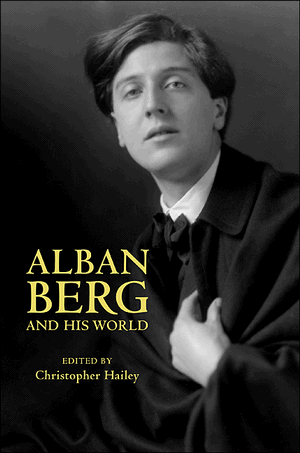
Berg Thawing

From the Classical Vault Dept.: Each summer, Bard College devotes a slew of concerts and other activities to a single composer and the context in which that composer lived and worked. This year it will be Carlos Chávez, which I’m eagerly looking forward to. Here’s my account of a long day in 2010 spent in pursuit of the world of Alban Berg.


BARD COLLEGE’S ANNUAL SUMMERSCAPE PROGRAM ran for two intensive weekends (Aug. 13-22) and this year featured the music of everybody’s favorite inaccessible composer, Alban Berg. But here’s where the “ ... and His World” part came into skillful play. We heard music of such Berg contemporaries as de Falla, Korngold and Gershwin, so hummable tunes cropped up from time to time.

More than that, each concert has an accompanying talk that helps contextualize the music. I attended the Saturday events during the second weekend, and thus missed any lecture that might have helped with the business of listening to atonal stuff, but I’ve been a Berg fan since I discovered his opera Wozzeck as a moody and disenfranchised teen, when murderous rages and possible self-destruction seemed entirely reasonable possibilities, and the clangier the soundtrack the better.

The big piece on the second Saturday’s program was Franz Schmidt’s unbelievably overwrought oratorio Das Buch mit sieben Siegeln (The Book of the Seven Seals), a work rarely performed ostensibly because of the composer’s possible Nazi-regime connections, but more probably evading the limelight because it slams you over the head with a passion that’s mostly artifice, the musical version of a painting by Thomas Kinkade.