Search This Blog

Sunday, November 30, 2014

Ron Nicoll: 1937-2014

A SNOWSTORM TURNED THE HIGHWAYS treacherous as I drove from Ridgefield, Conn., to Schenectady, NY, for a job interview in the middle of February, 1980. What should have been a three-hour trip took longer, so it was dark by the time I found my reclusive destination, a building that housed WMHT’s television and radio studios.

I was given a list of composer names to pronounce. I demonstrated my familiarity with a mixing board and microphone – I was expected to be my own engineer – and my ability to assemble an interesting variety of classical-music selections. I had chosen to write a cover letter in lieu of a resume to make it easier to fudge my lack of a college degree, which I did by stressing my experience working at a college radio station, implying that I’d also attended classes there.

Ron Nicoll at WMHT-FM, c. 1981
Photo by B. A. Nilsson
When I returned to begin the job, the station’s Acting Program Manager welcomed me with “Hello, dammit.” This would prove to be his standard greeting, resonating with his re-naming of the Schenectady suburb where we worked as “Rottergoddamn.”

Ron Nicoll died at the age of 77 last Sunday after a long illness and brief hospital stay. My wife and I visited him two days before. Despite his extreme physical debilitation, he retained the wit and acuity I knew very well. “We give you all our love,” Susan told him as we prepared to depart. “I thought I already had that!” he shot back.

He was pretty sure I had no college degree when he hired me. Although he rarely called attention to it, neither did he, but the autodidact is typically better-informed and better-spoken than those who rely for their smarts on academia. And there’s a high educational threshold required to appreciate classical music enough to work with it as a radio professional – or it was back then.

Saturday, November 29, 2014

Christmas at Caffe Lena

Photo by Lily Whiteman

Celebrate the dismantling of Christmas as performed by Amy Prothro, Malcolm Kogut, and me at Saratoga's Caffe Lena at 8 PM Friday, December 19. More details to follow!

Friday, November 28, 2014

The Nurses at Ellis

You’re Getting Verse Dept.: My mother saved the letters I sent her, a packet that was returned to me after her death several years ago. I haven’t been courageous enough to go through them – I wrote them in my teens and 20s, when my prose was far more pretentious than it is now – but the following piece of doggerel came to hand when I was searching my files for something else. I wrote it while a patient at Schenectady’s Ellis Hospital in 1985, recovering from a dislocated hip (the other driver ran a stop sign). I was surrounded by motorcycle-accident victims, many of whom were impressively loud in their complaints. And I suffered a heroic case of constipation. I knew that my mom, who was an RN, would appreciate my views on the matter.


The nurses at Ellis can tell you that hell is
To find you’re assigned to D-3,
Where patients in traction demand interaction
From feeding to helping them pee.

Though splinted and plastered they 
    shout like a bastard
For linens and blankets and towels,
And, though they’ve progressed, you will find them obsessed
(Let’s try to be nice) with their bowels.

Oh, Milk of Magnesia will certainly please ya
When five days have passed without crapping;
Then, under your sheet, some poor nurse gets a treat:
Your package came while you were napping.

And so let us sing to the bedpan, that thing
That conveniently kisses your haunches,
And the nurse, with a smile, will comfort you while
You prepare for the next of your launches.

And so let us moan in a miserable tone
As our bodies proceed on the mend:
It’s the doctor alone who will deal with the bone;
It’s the nurse who must deal with the end!

– 9 May 1985

Tuesday, November 25, 2014

Toddling Along

Guest Blogger Dept.: Although the practice of hanging dogs has become enough of a rarity, in my circles at least, that my party-overstaying no longer can be accurately measured along that scale, I find great comfort in Robert Benchley’s explanation as to why he had trouble quitting such gatherings in a timely way.


WHAT IS THE DISEASE which manifests itself in an inability to leave a party—any party at all—until it is all over and the lights are being put out? It must be some form of pernicious inertia.

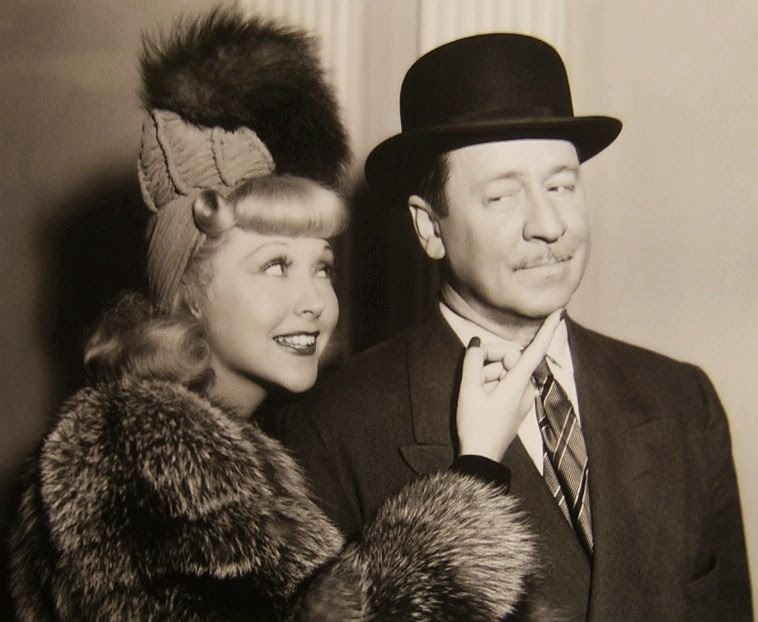
Robert Benchley (with Joyce Compton)
No matter where I am, if there are more than four people assembled in party formation, I must always be the last to leave. I may not be having a very good time; in fact, I may wish that I had never come at all. But I can't seem to bring myself to say, “Well, I guess I’ll be toddling along.”

Other people are able to guess they’ll be toddling along. One by one, and two by two, and sometimes in great groups, I watch them toddle along, until I am left, with possibly just my host to keep me company. Sometimes even my host asks me if I mind if he toddles along to bed. When this happens, I am pretty quick to take the hint.

Monday, November 24, 2014

Myths of Thanksgiving

BACK IN THE UNENLIGHTENED ’60s, we elementary-school wretches celebrated the run-up to Thanksgiving by collecting dying leaves, cutting endless amounts of corn ears and turkey tails out of colorful cardboard, and most annoying of all, holding some manner of classroom pageant complete with hastily made approximations of the received image of Pilgrim haberdashery.

"The First Thanksgiving at Plymouth"
Painting by Jennie Brownscombe, 1914
You would have thought, to see this spectacle, that the 17th-century Pilgrims threw an annual party to which they invited their Indian neighbors, reflecting the general goodwill that prevailed and endured among the races. At the expense of many a turkey.

Like leftover turnips, such misbegotten ideas accumulate until someone mercifully gets rid of them, so let’s clean up a few of them. I’m indebted, not surprisingly, to the Internet, where Plimoth Plantation (www.plimoth.org) and www.snopes.com contributed info. Not to mention The Thanksgiving Book by Jerome Agel and Jason Shulman (Smithmark Publishers, 1987).

Thanksgiving originated neither with the Pilgrims nor in the New World. This kind of feast went on even earlier in England, and is traceable back in time to the Hebrew Feast of the Tabernacles as well as to Greek and Roman harvest festivals.

Sunday, November 23, 2014

Much Obliged, Plum

What Was Literature? Dept.: Many a blog-post ago I noted that the photo I added for this piece (a piece that ran in the Albany Times Union) was taken for a different article. This is that article, which I wrote for Metroland Magazine at the outset of Overlook Press’s Wodehouse-reissue project – which is now up to 98 titles which, by my count, means they have four titles to go, two of which will be out next spring. [Update: they've worked in a few unexpected – to me – titles, so it may take a bit longer.]


HIS WORK WAS PROBABLY the most outdated of any 20th-century writer. Right off the bat, Pelham Grenville (but known to his friends as “Plum”) Wodehouse established a milieu of English country houses, doddering Earls and clever butlers – and some of the sappiest star-crossed lovers in literature. Others who mined this milieu – think Ben Travers, E.F. Benson – are deservedly obscure, but Wodehouse endures. In fact, thanks to the enthusiasts at Woodstock-based Overlook Press, his work triumphs, in a series of hardcover reissues that’s now 36 titles strong.

Photo by B. A. Nilsson
“We’re planning to reissue all of his titles,” says publisher Peter Mayer, even as he acknowledges the enormity of the task. There are close to a hundred volumes, turned out between 1902 and 1974 by a writer who lived to the age of 94.

To call each of the books a gem is to be only slightly overgenerous. It can be argued that he was treading water in the very last few books, and even some of the early titles – The Coming of Bill, for example – are kneecapped by leaden plots. Otherwise, his books remain the funniest writing of the past hundred years, the humor of which almost conceals the extraordinary craftsmanship.

Saturday, November 22, 2014

Mama's Boy

Mollie Minot, Byron Nilsson, and Amy Ferrara
Photo by John C. Moulds | 1975
John C. Moulds was working on a film project that needed a staged photo as part of its storytelling material. He borrowed Harry Minot's mom, Mollie, to give a disapproving glare at her back-from-the-Navy son (me) because he has pre-maritally knocked up his girlfriend (my not-pregnant but convincingly padded then-girlfriend, Amy).

Friday, November 21, 2014

Tea with the Missus and Me

Gadding About Dept.: Early in 1987, my wife and I learned about a wonderful travel opportunity: fly as a courier to London and you’ll pay only $100 for round-trip airfare. We were interviewed at the Queens-based headquarters of one such service and then booked to travel. We’d get a week in London, but, with only one such flight leaving daily, we had to fly on consecutive days. Which was fine with us. Here’s a piece of mine that came out of that trip.


THAT ELUSIVE FOURTH MEAL OF THE DAY, afternoon tea! What is its appeal, how should it be practiced? For an answer, my wife and I traveled to London with an expectation of traffic stopping and shops closing down at 4 to enable visitors and residents to indulge in this custom.

The Georgian Room at Harrod's
It turns out to be not that dramatic. In fact, we came upon our high tea quite by accident, while visiting the place that’s as much of a tourist attraction as it is a department store: Harrod’s, in the wealthy district of Knightsbridge.

A Rolls-Royce was parked outside. Behind it sat a Daimler-Benz. Several other no doubt pedigreed, hyphenated cars followed. The doorman sported more buttons than an elevator in a high-rise.

Inside was a mixture of British restraint and American let’s-sell-‘em fervor (the sale was to begin in a week: “There’s only one Harrod’s. There’s only one sale” is how ad copy reads).

Thursday, November 20, 2014

Innocent Abroad, Part Two

I WAS STILL, AT AGE 16, enough of an innocent to consider an all-night make-out session as an end in itself. That is, a languorous stretch of time sitting side by side, or in the embrace of one another, bringing our faces together from time to time, exploring each other’s dentistry – but leaving the rest of the body unmolested.

As I recall it, this particular night, Friday, February 16, 1973, I had invited my recently acquired girlfriend to watch a movie on television with me. The movie may have been “The Treasure of the Sierra Madre,” a wonderful picture for a date.

A new job had moved my father and the rest of my family to the Chicago area not long before; I remained in Ridgefield, Conn., to finish my senior year. I was living at the home of my friend Harry Minot, himself a year-before graduate of that school, now working in radio. My girlfriend and I were in a second-floor room that boasted an ancient floor-standing console TV. As the movie came on, I had sense enough to favor this unprecedented oscular activity. As we moved through the single-digit hours, she grew tired enough to seek sleep, and did so in a spare ground-floor bedroom. I went to my third-floor room and finished packing. I was traveling again to London. I couldn’t sleep.

This romance would jutter to a stop in the coming couple of months, but for now I was able to enjoy a dewy-eyed breakfast with this wonderful girl before her angry father fetched her home.

The evening meal at the Minot house featured a marvelous array of creative souls, the number unpredictable, but each afternoon Harry’s young sister, Ione, tried to get a head count. She found me at the front door, about to trudge my bags to the just-arrived airport van.

“Where’re you going?” she asked. “London,” I told her. “Ah,” she said, unimpressed. “Then you won’t be here for dinner tonight.”

Wednesday, November 19, 2014

Innocent Abroad, Part One

IN CELEBRATION OF my daughter’s first visit to England – she’s there as I write this, newly arrived, enjoying the fruit of an exchange between her school, Troy’s Emma Willard, and the Red Maids School in Bristol – I’ve got a couple of reminiscences on tap of my own high-school-aged travels.

I wrote about my brush with Alec Guinness in this post, one of the highlights of my first trip to London, which took place in February 1972, when I was 15. My high school offered a weeklong theater tour that would put us in West End seats, I talked my parents into paying for the trip (it cost about $300 all in all), and our group of students and chaperones caravanned from Ridgefield, Connecticut, down to JFK in time to wait six hours as our flight was again and again delayed.

No matter. It was my first trans-Atlantic trip, placing me in the city I’d most wanted to see. British film comedies and the BBC radio series “The Goon Show” infected me with Anglophilia: how exciting to be surrounded by people for whom the Mother Tongue truly was part of the family. I would find the precision of the prose of P.G. Wodehouse spoken in the mellifluous tones of Laurence Olivier.

We landed at Heathrow. I couldn’t understand a damn thing any of the natives was saying. There’s a close-to-London way of speaking that took me a day or so to get used to, and the more used to it I grew, the more self-conscious I felt about my own nasal drawl. (Back in the 1950s, the Goons – Peter Sellers, Harry Secombe, and Spike Milligan – dubbed Americans “Herns,” because the sound of American speech could be summed in that single syllable.)

The group was installed in a London hotel and the sightseeing began. Not surprisingly, there was a huge interest in shopping that I didn’t share, and being the knee-jerk contrarian I’m afraid I remain, I feigned no interest in taking in Westminster Abbey, the Tower of London, and other must-see sights.

Monday, November 17, 2014

Mastering “Harold”

From the Theater Vault Dept.: Whatever voice I’ve developed as a critic was developed in full view of my readers. These pieces, from the infancy of that career, haven’t gotten much past the thumb-sucking stage. Nice to note that the cast of Capital Rep’s “Master Harold” has gone on t significant careers: Corey Parker has been seen in “Nashville” and “Will and Grace”; Basil A. Wallace has done “West Wing” and “CSI” among many other TV shows, while Lou Ferguson is known for his appearance in the movie “Maid in Manhattan as well as appearances on “Law & Order.”


IN ATHOL FUGARD’S “Master Harold” ... and the boys, young Hally observes that he “os-killates between hope and despair,” which is a good reflection of the playwright’s state of mind, speaking of the human condition in general and very specifically about South Africa’s policy of apartheid.

Corey Parker and Lou Ferguson
The very tone of the play similarly “os-killates,” beginning with a most casual and seemingly irrelevant exchange between two black South Africans, Sam and Willie, about an upcoming dance contest and continuing into an alternately funny and poignant series of confrontations with the “Master Harold” of the title.

Fugard wove a fabric that is worn successfully only by skilled actors, and Capital Repertory’s current production showcases the considerable skill of three.

Sunday, November 16, 2014

Corrects Perverted Secretions


I don't know where this ad appeared, but we know the stuff must be good: it also has a full-page ad in the June 1895 "National Board of Health Magazine: A Review of Sanitary and Therapeutic Science" (Vol. IX No. 6). That one is an ad designed to resemble the neighboring editorial content (not that said content doesn't get similarly sensationalist). Here's the ad copy (and dig those diseases!):

Saturday, November 15, 2014

Goons? Go On!

One of my last radio appearances wasn't even on my usual side of the Atlantic -- but that's only because I was Yank Johnny-on-the-Spot. My wife and I traveled to Bournemouth near the end of October, 1995, to attend "A Weekend Called Fred," a convention of Goon Show aficionados from around the world who descended on this channel-side resort town to meet some heroes (Harry Secombe and Dennis Main Wilson were there), demonstrate their Goon-character voices, and, one morning on the beach, hurl batter pudding.

The BBC's Roy Bainton was there, and interviewed me one morning in our hotel's dining room. My brief but pretentious-sounding segment was part of an excellent overview of the event -- and the Goon Shows themselves -- that was broadcast on 25 October 1995:


Roy Bainton and Byron Nilsson | 22 October 1995

Thursday, November 13, 2014

Sweeney (Todd) Agonistes

From the Vault Dept.: Although I thought John Doyle’s concept of “Company” was fairly successful, I’ve yet to be won over to the play-your-own-instruments approach to musicals that weren’t developed with that in mind. It was a particular problem with “Sweeney Todd,” which has a score that begs for as full an orchestra as can be had. Below is my report on a touring production that hit town a few years ago.


THE STORY OF SWEENEY TODD progressed, over the centuries, from urban legend to penny-dreadful to children’s bogeyman to Grand Guignol melodrama, until a backstory-rich stage version from 1973 inspired Stephen Sondheim’s acclaimed, effective musical.

That version, too, has traveled a circuitous route since its 1979 Broadway debut, soon thereafter appearing at opera houses and community theater halls, in semi-staged productions with classical orchestras, as a Tim Burton film shorn of its ensemble numbers and, most imaginatively, in John Doyle’s 2004 staging (brought to Broadway a year later) in which ten actors play all of the characters and also provide the entirety of the musical accompaniment.

This is what played last weekend at Proctor’s Theater, as diverting a Good Friday entertainment as I’ve ever experienced. But it’s a production I admire more than I enjoy, and for a number of reasons.

Wednesday, November 12, 2014

Re-Making Monteverdi

RINALDO ALESSANDRINI HAS BEEN IMMERSED in the music of Monteverdi for over twenty years, both as a scholar, editing and assembling idiomatic performance editions of his work, and as founding director of Concerto Italiano, the early-music ensemble with which he has recorded much of Monteverdi’s work (in addition to much by Vivaldi, including the best of the umpteen million “Four Seasons” versions, and one of the better Bach Brandenburgs sets).

Their latest recording, of Monteverdi’s “Vespri Solenni per la Festa di San Marco,” gives us a work that doesn’t exist, recreating the soundscape of St. Mark’s Basilica in Venice by using Mantua’s Church of Santa Barbara – ironically reversing Monteverdi’s own career path, which took him from Mantua to Venice, where he revitalized the music at St. Mark’s.

As Alessandrini convincingly argues, the acoustic of the hall in which Monteverdi’s works were performed was itself an instrument in the ensemble, able to “invest the music ... with that essential and indispensable timbral component which the analytical acoustics of our modern concert halls can never replace.” You’ll hear the two-second decay in the recording, but it’s a phenomenon that informs all of the many antiphonal moments. The textures of voice and instrument blend and build with an uncanny sense of emotion, heightening the drama that was one of Monteverdi’s innovations as he moved music into the Baroque era.

Tuesday, November 11, 2014

Schubert a Trois

Classical Stages Dept.: It’s always a treat when Wu Han and David Finckel are joined by Philip Setzer for a piano trio concert, but none was more gratifying than their 2009 visit to Schenectady’s Union College to perform the trios by Schubert, which they also recorded. Here’s my review.


BEETHOVEN CAST A DAUNTING SHADOW over Schubert’s life and work, so it’s all the more amazing to note the quality of the compositions the latter churned out. The two piano trios, written during what seem to be about the last six seconds of his life – Schubert snuffed it at 31, his last few years a frenzy of composing – are pinnacles of the repertory, their debt to Beethoven’s work eclipsed by their tunefulness and originality.

David Finckel, Wu Han, and Philip Setzer
Pianist Wu Han and cellist David Finckel made the latest of many appearances at the Union College Concert Series last Sunday, this time with one of Finckel’s fellow Emerson Quartet members: violinist Philip Setzer. The ambitious program comprised the two Schubert trios, lately also recorded by this group.

These are works that have endured a wide range of praise and condemnation, the latter typical of the lunacy of classical music’s great blowhards. Schubert played fast and loose with such things as the oh-so-sacred sonata-allegro form that formed the structural basis of most opening movements written during the powdered-wig decades.

Monday, November 10, 2014

I've Got a Secret

NEARLY THIRTY YEARS AGO, I got involved with computers to an unhealthy degree, fueled by curiosity and the sizeable fees I soon was paid by computer magazines for coherent articles. I got my first machine – an IBM-style PC – in 1985, when the screens were a single color and a ten-megabyte hard drive was a costly luxury. And, in those pre-Windows days, the computer was mutely enigmatic. It greeted you, once it was activated, with an unhelpful prompt: A>

You were expected to type a command to tell it what to do. As a typewriter virtuoso, I was surprised by and angry at this demand. I needed to get some writing done. I’d been promised that this would show me an easier way. I was about to throw the damned thing out the window when my wife suggested I submit to some training.

I acquired a number of books, most of which assumed that I knew far too much of the subject I sought to learn. One that didn’t – one that taught me what needed to know, thus preserving my sanity, was The Secret Guide to Computers, self-published by a (then) Massachusetts-based eccentric named Russ Walter. Unlike most of the other computer-guide writers, Walter seemed to know what challenges you faced each step of the way and in a clear, non-patronizing tone, eased you through them. He also offered 24-hours-a-day phone support for the price of the call. He was known to don a wizard’s costume for speaking engagements and appearances at computer shows. And he updated the book regularly enough to accommodate the rapid technology changes that characterize the industry.

Sunday, November 09, 2014

Reverenza!

From the Vault Dept.: My list of favorite operas is headed by Verdi’s “Falstaff.” My list of favorite performances includes Richard McKee’s turn as the lusty knight, performed with the Lake George Opera in 1990. Here’s my review.


Verdi’s “Falstaff” is a transitional work that masks its forward-thinking character with an incredibly bubbly humor. On the surface it looks like a bass-baritone’s tour de force. Dig a little deeper and you discover an ensemble piece to which everyone must give of their best_especially the conductor.

David Kellett, Richard McKee, and Gary Aldrich
Photo by Rusty Ridell

Revived by the Lake George Opera Festival Saturday night, it brought back Richard McKee, star of the 1976 production. This is a man who was born to sing Falstaff, and if, as I suspect, God has a taste for Italian opera, McKee’s tasks in Heaven will include frequent performances of this piece.

And because there are only two more performances – 8 p.m. Wednesday and Friday – you really should ignore the rest of this review and just order yourself some tickets. This is the kind of performance that will delight all fans of good musical theater and could even make an opera-loving convert out of you.

One secret is to have a great Falstaff, of course, but there’s much more. What’s transitional about the piece is that it looked beyond the tradition (helped by Verdi) of opera as a bunch of big moments to a more dramatically-unified style. That Verdi should have chosen a comedy to accomplish this is an even greater testimony to his genius.

Saturday, November 08, 2014

One That Got Away

Per yesterday's post, not everybody I sought to interview accepted that request. But none turned me down as charmingly as Peter De Vries, whom I invited to be interviewed on radio back in the days when I did that.