Search This Blog

Tuesday, December 31, 2013

Working at Home, Part 1231

SUCH ARE THE EXIGENCIES of this last day of the year that I’m not performing tonight, my wife took the day off from work, and my daughter is on a school break. We are discovering that such close quarters can be endured only with a maximum of politeness, which I lack, and tolerance, which they have in annoying excess.

Hector Berlioz
I am cooking, of course. Some manner of cassoulet, although there’s no confit, and I suspect it will end up veering toward hoppin’ John (sans rice). But that’s left up to me.

What’s not left up to me is the choice of entertainment. Last year we improbably celebrated the turn of the year in Times Square (which I swore I’d never do, and thus cannot admit I enjoyed), subjected to the pop-culture strains of all that is loud and relentless. There’s no television available here at home (and I won’t steer any of the computers to that purpose), so the choice of music is important.

As we circle in upon the subject, I’m assured where we’re not heading this evening. I proposed that we follow the precedent of WKCR, the Columbia University radio station, which, many years ago, would mark this day by mourning the passing of the old year. They’d start the Berlioz Requiem during the 11 o’clock hour, and never note, during the 70-minute piece, when midnight came and went. I love that idea, but fear I’m stuck again with “Auld Lang Syne.”

Monday, December 30, 2013

Increasing the Bawd Rate

Back to the Nasty Bits Dept.: I take you back to early 1995, when the World Wide Web was in its infancy and CompuServe ruled the day. We were still on dial-up modems, but you didn’t have to dial far to find sex-related material. I wrote this piece for a Valentine’s Day issue of Metroland.


“I WANT YOU,” he says. “Will you be mine for tonight?”

“That’s not very romantic,” she chides him.

There is a pause. His words emerge slowly. “I’ve never met anyone like you before,” he says, more truthfully than he realizes. “Nobody has ever talked to me with such insight before, and you’ve really turned me on.”

“That’s better. I’m unbuttoning my blouse. Do you want to see my breasts?”

His first night at the pickup scene, and he’s struck pay dirt! “Yes!” he says. “I do!”

“First you have to tell me more about yourself. I want the good stuff. How big is it, really?”

His measure of himself is changing. He’d almost come to believe that he was geeky as unkind classmates had said. But this!

This was being conducted at the terminal of his personal computer, in a private “conversation room” with an online presence called 42EEBABE who had responded to his own nickname – MR12INCH – by inviting him to talk in private. In this sense, talking means typing back and forth to one another. What MR12INCH would never know is that 42EEBABE was another man, a man who excited himself by luring “newbies” – newcomers to the network – into intimate sessions of mutual gratification conducted from terminals that could be tens or hundreds or thousands of miles apart.

Sunday, December 29, 2013

Location, Location, Location!

From the Tech Vault Dept.: Here’s a look at the early consumer-use days of GPS, long before Garmin and the like got into the game. I can’t tell from the files I have exactly who I wrote this for or when, but I think it was for Mobile Office magazine, and it ran in the summer of 1996.


GREG RIKER GETS AROUND. And during the course of his travels, he knows precisely where he is, where he's been, and where he's headed at any given moment.

Riker, who develops and evangelizes innovative uses of technology for Microsoft Corp., constantly travels around the country, discussing how technology improves people's professional and personal lives. Last year he and his wife logged 30,000 miles in their Newell motor home.

Riker’s high-tech land yacht is equipped with several laptops, a Motorola Envoy, a SkyTel 2-Way pager, and two cellular phones. But his ability to pinpoint his exact location and destination is a function of the Trimble Mobile Global Positioning System (GPS) PC Card attached to his dashboard-mounted Toshiba T-2000 pen-based computer.

As Riker rolls down the road, an antenna on the roof of his motor home picks up satellite signals that are carried to a GPS receiver wired to the PC Card. The card converts the signals into data delineating the vehicle’s location, speed, and direction of travel. The card then feeds that information into Automap Pro, a digital mapping program from Microsoft. A map appears on the Toshiba’s display, and a representation of the motor home moves along that map.

Friday, December 27, 2013

Soul Proprietor

From the Vault Dept.: An Albany Times-Union article from 1996 suggested that a stretch of that city’s Central Avenue might see an economic revival thanks to the efflorescence of minority-owned businesses there. Two of them – a hair salon and a restaurant – were owned by Rev. Marjorie Sims and her husband, David. I reviewed the restaurant in 1997 and found it exceedingly congenial – with terrific chitlins – but it soon fell victim to the area’s changing fortunes.


YOUR SOUL IS UNDER CONSIDERATION HERE in a couple of ways. Food, sure. But the menu promises dinner and a prayer, and Reverend Sims, the chef, will happily help supply whatever aspect of your being needs nourishment.

Chitterlings
When she’s off the premises, which isn’t terribly often, she’s preaching. That’s the calling  she followed in South Carolina, where she left behind her home and heart when she came north a year and a half ago to care for her ailing father.

A year ago, she and her husband, David, opened the restaurant on Central Ave., a little west of downtown. It was named Julia’s after her 85-year-old mother, now widowed and living in Troy. “We have to be here for her,” says Rev. Sims. “She doesn’t want to move south.”

So she divides her time among her mother, the various churches where she preaches and her restaurant, and you’ll find the restaurant about the friendliest place you’ve ever dined in. I stopped in late one recent afternoon for an early dinner, my loyal friend Dorothy in tow. And I started right out in putting her off guard by ordering chitterlings as an appetizer.

Thursday, December 26, 2013

The Trumpet Did Sound

From the Manger Dept.: Back in the heyday of my concert reviewing, the holiday season invariably dumped a “Messiah” or two in my lap. By 1990, when I wrote what’s offered below, it truly had to be impressive to garner as good a notice as I gave. The Capitol Hill Choral Society was founded in 1953 by Judson Rand, who conducted it until 1985, when Benjamin Van Wye took over and was able to get another couple of decades out of the community-based ensemble before it went the way of so many a classical-music making organization in these culture-straitened times.


SOPRANO CHRISTINE BRANDES has the kind of voice that would melt the heart of the most Scrooge-ish of holiday grumps. There's an artlessness about her singing that makes vibrato and other vocal effects seem like the most unnecessary of decorations.

Christine Brandes
With tones pure and sweet, she offered her four recitatives halfway through the first part of Handel’s “Messiah” with inspiring sincerity, bringing what already was a marvellous performance to an even greater height. With more of the same to follow.

Good, clean singing, a terrific orchestra and even some unexpected witnessing were part of the Capitol Hill Choral Society’s annual presentation of the oratorio Friday evening at the Troy Music Hall.

Conductor Benjamin Van Wye has been promoting a more intimate conception of the work than has been the tradition in this century; each year the focus becomes a little clearer and this year was his best yet as he drew an impressively Baroque sound from the orchestra and placed a wonderfully talented quartet of soloists in front of the chorus.

This year Van Wye also chose to conduct throughout and brought in skilled harpsichordist Robert Conant to play continuo. A dozen players from the St. Cecilia Chamber Orchestra comprised the orchestra, same size as last year, showing off concertmaster Robert Taylor’s tremendously effective solo voice.

Wednesday, December 25, 2013

Box of Candy and a Piece of Fruit

A powerfully evocative song for the holiday. 
Written and performed by Bob Gibson and Tom Paxton.

Tuesday, December 24, 2013

Christmas Eve

'Twas the Night Before Dept.: Here's a reprise of last year's post on this day, to save you the trouble of thumbing back through so many pages . . . 


IT'S THE NIGHT before Christmas, 1908. The man you've loved for so many years has come back to town, but you've been unable to discover if he returns your affection. Now, as twilight falls over the village, a group of carolers goes back, celebrating the holiday. You respond in a far different mood.

From Beasley's Christmas Party, with music by Tom Savoy and book and lyrics by Byron Nilsson, based on the novella by Booth Tarkington.


Music and lyrics copyright © 2007 by Byron Nilsson and Tom Savoy.

Monday, December 23, 2013

Dressing the International Table

WE IN THE UNITED STATES may be among those who lay out the most excessive Christmas dinners. The British were recently cited as the worst in Europe by health app-maker Lifesum, because they typically consume a meal that is 30 percent sugar, with 69 grams of fat and 211 carb grams.

Putting that in menu terms, it’s some manner of roasted fowl with stuffing, roasted potatoes, mince pie, Christmas pudding and, even in the Cratchit household, more.

The healthiest? France. This despite the prominent role foie gras plays in the meal, which rarely includes processed food and comes in with 69 grams of fat and 211 grams of carbohydrates. In addition to goose liver, the French enjoy oysters, lobster, roasted fowl with chestnuts and stuffing, at least three types of cheese and a traditional holiday cake known as a bûche de Noël and shaped like a Yule log. And, of course, Champagne.

Lifesum is based in Sweden, which was 10th on the best-to-worst ranking of 19 European countries. That country’s typical Christmas Eve dinner is a buffet that includes meats and fish and a number of sweets, including risgryngrot, a rice pudding that contains a single almond to grant its discoverer a wish or a wedding.

Says Lifesum’s Lovisa Nilsson (no relation, as far as I know), “Christmas is a time for eating well and enjoying food, but clearly some European countries have, by accident of tradition, dishes that offer far less reason for diners to feel guilty,” which is a nice thought until that pudding is served.

The American holiday meal is descended from the British model, so we’re probably doing ourselves no favors. So if you want to do something different and aren’t ready to try the French model, the second-healthiest tradition is in the Czech Republic, where fish soup, cold potato salad and sour cabbage are the favorites.

Sunday, December 22, 2013

Christmas with the Camerata

Where Was I? Dept.: Almost exactly one year ago I was enjoying the same thing I plan to enjoy today: the annual Union College concert by the Boston Camerata. This year’s theme takes us to Renaissance France; here’s my account of last year’s Hispanic journey.


EVEN AS DIE-HARD A FAN such as I has to admit that there can be a certain sameness to a Boston Camerata Christmas program. But I counter the dreaded December assault of horrible holiday music with an annual visit to Union College’s Memorial Chapel to enjoy the early music ensemble’s trip back in time, and last Friday’s program was an outstanding example of how inspiring and peaceful such a concert can be.

Anne Azéma and Boston Camerata members.
And necessary. Coming as it did with the images of the Newtown school slaughter still distressingly fresh, music director Joel Cohen uncharacteristically made a brief statement to open the program, noting that “we don’t know why terrible things happen. We don’t know why wonderful things happen,” and dedicating the concert to the pursuit of peace.

And then tenor Daniel Hershey sang from the back of the house, an unaccompanied Sephardic song signaling the Day of Judgment, segueing into the drone of a hurdy-gurdy played by soprano Anne Azéma, who sang the 13th-century intercessionary “Madre de Deus,” punctuated by baroque trumpet (from the left balcony), played by Michael Collver. Followed by bass-baritone Don Wilkinson’s stately right-balcony “O oriens,” a solo-voice Gregorian chant.

Saturday, December 21, 2013

Friday, December 20, 2013

Ashkenazy and the Romeros

From the Vault Dept.: A double-feature look-back to 1985, when I was able to see (and write about) concerts by the Romeros, the guitar-playing quartet of father and sons, and pianist Vladimir Ashkenazy, back when Proctor’s in Schenectady made unremunerative attempts to program classical music. Here are my reviews.


A FORMER STUDENT of one of the Romeros once said “one of them is the finest guitarist in America. The question is, which one?”

Los Romeros, c. 1978
It’s a fitting statement, the truth of which was borne out at Sunday afternoon’s concert by the four Romeros – father and three sons – at the Egg. Four distinct personalities emerged, especially in the solos taken by each.

The concert began with a transcription of a Telemann concerto, followed by the last movement of Bach’s Brandenburg Concerto No. 6. The latter allowed the group to sparkle with dazzling runs and perfect coordination.

Angel, the youngest brother and in some ways the flashiest, played Tarrega’s “Recuerdos de la Alhambra,” a melancholy piece which seems, to some, to be the essence of Spanish guitar. Hollywood of the 40s would have loved this man playing this piece – he’s much more dreamy-eyed than, say, Iturbi.

Thursday, December 19, 2013

Family Tradition

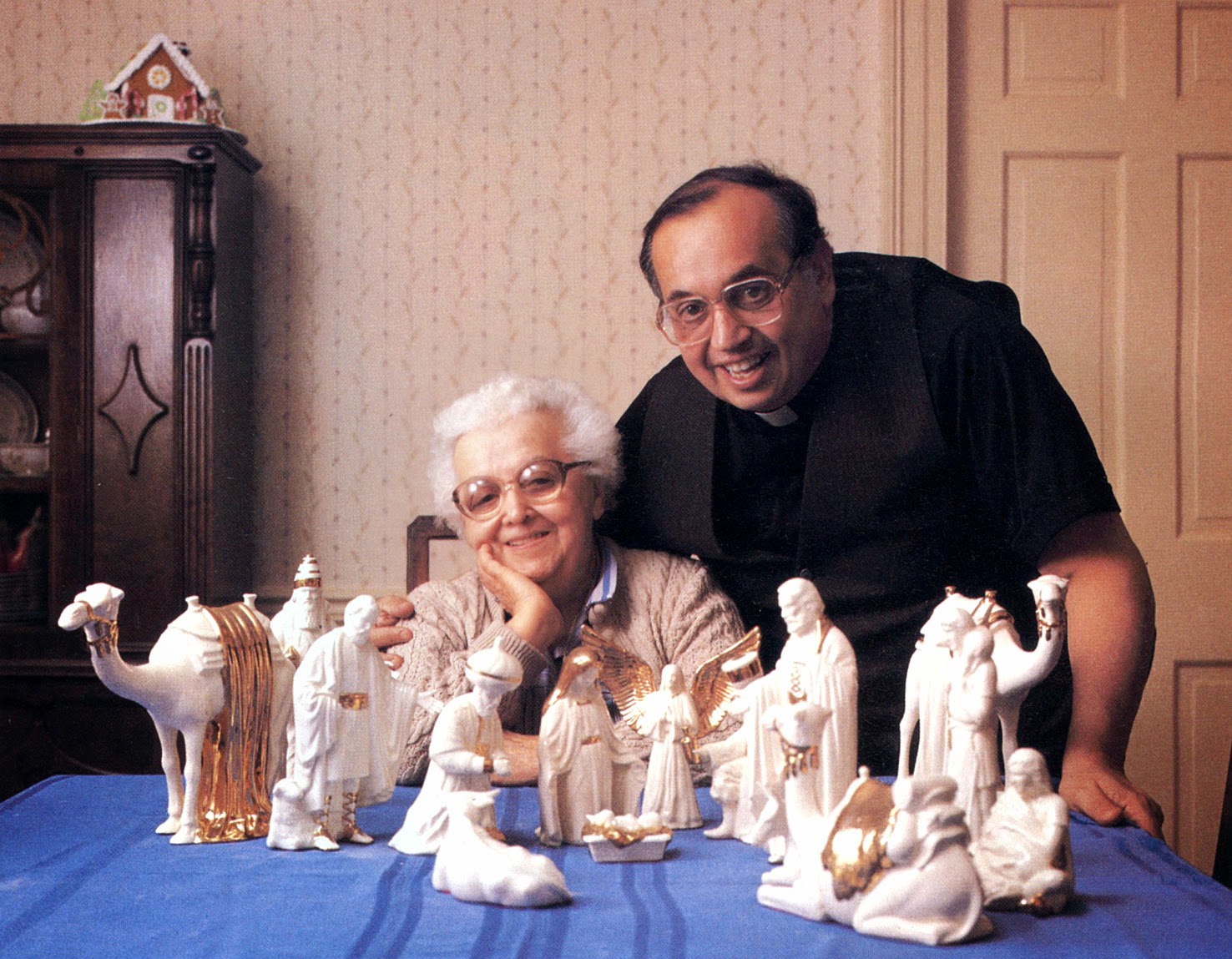
From the Vault Dept.: Today’s Metroland features a piece I wrote about Christmas dining traditions throughout the world. I grabbed a bit of the information from myself – from a piece I wrote 27 years ago, about dinner at the rectory of Schenectady’s Church of the Immaculate Conception, where my friend Tom Savoy was music director at the time, and where I thus was able to see the feast described below in preparation. Like much of what passed through the editing process at Capital Region magazine, my words were sent through a savage editorial mill, so parts of this leap out at me as not at all mine, particularly the dorky finish. The original is lost to bit-space.


Photo by Mark McCarty
TO MOST OF HIS PARISH he’s Father Joe, a chubby, cherubic pastor you expect to find in a suburb of Rome. But he’s here in the Bellevue neighborhood of Schenectady, just beginning his eighth year at the Church of the Immaculate Conception, where he practices Christmas traditions that have been meaningful to him and his family for generations.

Father Joseph Cotugno was born and raised in the Italian section of Albany. And although his father was born on Front Street in Schenectady, the older Cotugno was taken back to Sicily as a boy, where he was raised. He passed away several years ago, but Father Joe’s mother, who is still alive, lives with her son.

“She’s technically and legally blind, but she can smell a dollar bill lying on the lawn,” chuckles Father Joe. “And she still does the cooking for our Christmas Eve dinner, one of our big traditions year after year.”

Wednesday, December 18, 2013

A Singular “Hamlet”

Guest Blogger Dept.: Edgar Wilson Nye (1850-1896), who wrote as Bill Nye, was a lawyer, postmaster, journalist, and lecturer in a career that took him across the United States and back – he was postmaster of Laramie City, Wyoming, before Wyoming was even a state – and during which he developed a comic voice with a uniquely American flavor. His account of James Owen O’Connor’s “Hamlet” comes from a collection of short pieces Nye put together at the end of his life.


Edgar Wilson "Bill" Nye
THE CLOSING DEBUT of that great Shakespearian humorist and emotional ass, Mr. James Owen O’Connor, at the Star Theater, will never be forgotten. During his extraordinary histrionic career he gave his individual and amazing renditions of Hamlet, Phidias, Shylock, Othello, and Richelieu. I think I liked his Hamlet best, and yet it was a pleasure to see him in anything wherein he killed himself.

Encouraged by the success of beautiful but self-made actresses, and hoping to win a place for himself and his portrait in the great soap and cigarette galaxy, Mr. O’Connor placed himself in the hands of some misguided elocutionist, and then sought to educate the people of New York and elocute them out of their thralldom up into the glorious light of the O’Connor school of acting.

The first week he was in the hands of the critics, and they spoke quite serenely of his methods. Later, it was deemed best to place his merits in the hands of a man who would be on an equal footing with him. What O’Connor wanted was one of his peers, who would therefore judge him fairly. I was selected because I know nothing whatever about acting and would thus be on an equality with Mr. O’Connor.

Tuesday, December 17, 2013

A Vintage Three Sisters

From the Vault Dept.: I missed Williamstown Theatre Festival’s “Three Sisters” in 2008, but I was there for the 1987 production – the last time Nikos Psacharopoulos directed Chekhov. But I wasn’t as pleased with it as I would have liked to be.


A LITTLE CORNER of the Russian imagination is created almost every summer at the Williamstown Theatre Festival with the production of a Chekhov play. This year it’s “The Three Sisters,” the brooding search for happiness that results in compromise, despair and, ultimately, a quiet affirmation of faith.

John Heard, Rob Lowe, Roberta Maxwell,
Kate Burton, Amy Irving, Stephen Collins,
and Christopher Walken at Williamstown, 1987
The production teeters on a fine fulcrum. Is it a well-realized presentation of the intricate drama starring some of the better-known actors of today, or is it a chance for some Hollywood folk to get back on the stage (and thus assuage a guilt as old as the movie industry that celluloid just ain’t legit)?

Each of the three sisters has a core of pragmatism fired by an intense capacity to dream. The youngest, Irina (Kate Burton), looks forward to a perfect love, preferably in distant Moscow. Masha (Amy Irving) is married to a bore, Kulygin (John Heard) and encourages the attention of Lt. Col. Vershinin (Christopher Walken). Olga, the oldest (Roberta Maxwell), already is settling into the single life her sisters envy and dread.

Monday, December 16, 2013

Making a Liszt

Holiday Buying Dept.: Clever title. But Liszt doesn’t appear on this list, except insofar as you’ll find some of his works on the Horowitz set. Here’s my year’s-end wrap-up of what you could be wrapping for very fine and cultured friends this Christmas.


DAVID ALAN MILLER and the Albany Symphony have been Grammy nominated for their recording of John Corigliano’s “Conjuror,” a percussion concerto written for Dame Evelyn Glennie, cast in six parts, showcasing three different percussion families solo and with orchestra in a 36-minute work with a satisfying cumulative effect. Miller also helms the Orquestra Gulbenkian in a recording of pieces by Portuguese-born Luís Tinoco, leading off with the percussion-heavy “Round Time.” Both CDs are excellent showcases of new music; both are on Naxos.

Also from Naxos are JoAnn Falletta conducting a 19-minute suite from Duke Ellington’s “Black, Brown and Beige,” along with “The River” (an American Ballet Theater Commission), “Les Trois Rois Noirs” (unfinished at Duke’s death, completed by his son, Mercer) and other works in effective orchestral versions.

Controversial Turkish composer Fazil Say writes expansive, programmatic works. His Symphony No. 2 is titled “Mesopotamia” and its ten movements tell a complicated story about the titular region, the orchestra abetted by bass flute, bass recorder and theremin. “Universe” (his Symphony No. 3) turns its attention to the skies and very meaning of existence. Stirring, unashamed works excellently performed by the Borusan Istanbul Philharmonic (Naïve).

Every recording label has a back catalogue that’s aging even faster than what remains of the classical audience, and they’re the stuff of a parade of box sets.

Sunday, December 15, 2013

Peter O'Toole


. . . and Joan Fontaine didn't take the news of O'Toole's passing very well.

Saturday, December 14, 2013

Friday, December 13, 2013

Rising Interest

What’s In This Week’s Issue? Dept.: I’m the worst kind of evangelist in the piece below: One who has just discovered the wonderfulness of the subject and can’t shut up about it. Having at long last been persuaded to try using a breadmaker, I now can’t see living without one.


IT’S DIFFICULT TO FIND a true loaf of whole-wheat bread. Most of what passes for it uses some manner of refined flour, and refined sugar activates the yeast. My daughter wisely has chosen a diet that proscribes those ingredients, so after too many frustrating supermarket-aisle hours, I have discovered the breadmaking machine.

Photo by B. A. Nilsson
Last time I looked, these gadgets turned out oddly cylindrical loaves with large dents at one end. But that was long ago, and everything has changed. Except the dents.

Each of the three machines described below can turn out worthy bread; each is capable of much more. Most importantly: each of them produced a terrific, for-real whole-wheat loaf. The only drawback is that you have to slice them yourself. The differences among the machines mostly lie in feature details.

Like all the machines I looked at, the Cuisinart CBK-100 ($100) offsets its boxiness with stainless steel; unlike the others, it had convenient handles on its sides. It makes up to a two-pound loaf, which is going to be taller than your toaster can handle, yet is irresistible to watch rising above the sides of the baking pan. (All of the machines sport viewing windows.)

Thursday, December 12, 2013

A Bit of Music

Resurrected Reviews Dept.: Here’s a piece I wrote a couple of years ago but which never saw publication. Now the CD is out of print and selling on Amazon at upwards of $80. The Cantaloupe website (access it through the work's website) promises that it will be back in print soon, at a more reasonable $30. It’s a delightful piece of art.


“1-BIT SYMPHONY” is a five-movement work whose first four movements run about 45 minutes, with the final movement clocking in at infinity, or until the battery runs out, which probably will occur first.

Composer Tristan Perich works in electronic music, with a special fondness for that which can be rendered using a single bit, the smallest building block of digital information. He is also a visual artist who celebrates the aesthetic of electronics – he has performed music produced by the judicious use of soldering irons – and the place of electronic music in our lives. Not surprisingly, he has worked with the innovative ensemble “Bang on a Can.”

But “1-Bit Symphony” is more of a chamber work, housed in a conventional CD jewel case. There’s no CD – just the aforementioned battery, an on-off switch, an earphone jack, a volume control wheel, a movement-skip button and an IC chip. You supply the earphones. An accompanying page gives the program code.