Search This Blog

Wednesday, October 31, 2012

Ghost at Stake

From the Tomb Dept.: A shorter version of this story ran in Metroland in 1988. I’ve been back to Jackson’s Garden on summer nights since, but the spectre described below continues to elude me.


A FULL MOON only accentuates the blackness of midnight, as if the orb were sucking into itself any radiance around you. With the first full moon of summer comes the nighttime sparkle of new-grown leaves, the pleasant warmth anticipated during long June days, and the sounds of maniacs racing cars through the back streets of the city.

I was sitting on a small rise in a wooded area behind Union College shortly after midnight last June 29, keeping watch over a small brook. A few feet away my wife also waiting, also watching, also silent. Aside from the distant traffic there was hardly a sound, so every creak and rustle in the undergrowth seemed more startling. But the figure we sought would be silent, we knew.

This is a ghost story without much of a plot; we’re not even sure if the main character will appear. But I want to tell you about Schenectady’s most famous spectre, a restless young woman doomed for the 316 years since her death to recreate her final walk in life. Her name is Alice, surname given variously as Van Derveer and Van Verveer, and she was victimized in the name of love, the most classic reason to slip into ghostdom.

Can we imagine a portrait of young Alice? She wears the Dutch costume of her day, lovely brown hair tucked into the traditional stern cap, eyes modestly lowered as she passes the men of the settlement. But she has a rebellious spirit, born of enduring her father’s harshness. For reasons that would gladden only the staunchest Calvinist, this would be her undoing.

Tuesday, October 30, 2012

Our Town

From the Vault Dept.: I’ll be part of a panel of critics discussing how new works are reviewed at 1 PM Sunday, Nov. 4, at Capital Repertory Theatre (111 North Pearl St., Albany, NY). Here’s one of my contributions to that genre, describing the first professional production of Ned Rorem’s Our Town.


THE CAPITAL REGION’S most significant cultural event of the year—of many years—was the professional premiere of Ned Rorem’s operatic version of Thornton Wilder’s classic play Our Town.

Our Town, which debuted on Broadway in 1938, famously did away with props and scenery, its three acts ramping up in intensity through characterization and the friendly Stage Manager’s frighteningly omniscient point of view. To add music adds emotional intensity, which needs to be synchronized to a plot in which conflicts are small and infrequent. Verismo it ain’t.

Rorem, who is 82, has a deserved reputation as one of the world’s leading art-song writers. He melds words and music with a rare sense of the weight and flavor of a lyric, in a voice unmistakably American, but European-influenced American, with nary a blue note or syncopated riff in the Our Town score. Think Barber, not Bernstein.

A pleasant but plangent chord, breathy with wind instruments, repeats as the opera opens, then segues into an unsettling setting of the hymn “Our God, Our Help in Ages Past,” as the chorus makes a serpentine procession across the stage. Thus we meet the Stage Manager (Robert Swensen) only after the musical stage, so to speak, has been set, and he offers his introduction. It’s a good idea: Better to introduce the musical feel of the piece before this avuncular character gets started, so we can accept that what he has to say will be sung.

Monday, October 29, 2012

Witch

Scenes from Childhood Dept.: To honor the approaching holiday, if that’s the term I’m after, here’s a piece of mine that appeared in Metroland Magazine many years ago.


A KID UNDERSTANDS the importance of tracking down the neighborhood ghouls. The kid knows (as parents don’t) that those ghouls exist. It’s just a matter of finding them.

We had a witch on our street. I don’t know if we really saw her as someone who consorted with bats and such, although the movie “The Three Lives of Thomasina” gave witches a pretty good image. But we convinced ourselves that this lady was at least gently malevolent—and she certainly added a tinge of excitement to my afternoons.

It was our after-school ritual to tramp through the woods behind the houses on my street, back in a time before my Connecticut town annexed itself to New York City and lost its woodland to developers. Next-door neighbor Kenny, my brother, and I built primitive shelters and hacked at the bark of trees.

We discovered, on a neighbor’s property, an abandoned car. It sat in a woodsy corner of an otherwise immaculate lot, a hulk with the squatty wheelbase and sloped top of a vehicle in an old gangster movie, pale blue where any paint survived. At first we just sat in the smelly old thing, imagining it to be a limo or rocket or time machine. Than we got more rambunctious. I jumped on the roof, enjoying the bouncy resilience of the metal. My brother broke the windows, delighted with the reticulation of the old safety glass. Kenny peed on the engine.

Our games got noisy and attracted the property’s owner. She came after us waving a stick, like the lady on the old Dutch Cleanser can, careening across a quarter-acre of fresh-trimmed lawn to flush us from her rotting car.

Sunday, October 28, 2012

Ode to Clyde

Juvenalia Dept.: A macabre little piece from my teenaged years. I lived at that time in the same town as did Maurice Sendak, and clearly my work wasn’t going to threaten his success.


A mouse got in the house.

Our large grey cat had brought him in. The mouse was dying, but not quite dead.

My daddy put him in a box with wads of cotton by his head, then asked us how a mouse was fed.

Illustration by Gerian Williams
I said, “I’ve never fed a mouse. We’ve never had one in the house.”

My daddy shook his head.

*

Daddy fed the little mouse. He held the box upon his lap, and put in grass and other crap, then told the mouse to take a nap.

The mouse replied, “I’ll thank you, sir, to call me Clyde.”

We thought it was some kind of joke, but Daddy told him, “Okey-doke! From now on we shall call you Clyde.”

The mouse seemed rather satisfied. He yawned and turned upon his side, and went to sleep.

Friday, October 26, 2012

Beckett Calling

Autobiography Dept.: It was a turning point that snuck up on me, and it was an excellent accompaniment to teen-aged angst.


SOME OF MY high-school classmates and I took a perverse delight in reading material that assigned to other classes, material available through the school but not administered, during a particular class, by our teacher. Or we’d pervert an assignment, as when (I believe it was) Bleak House was assigned, but a group of us studied Great Expectations instead.

This required more initiative than a regular assignment required, and we must have intuited that; in any event, I recall little friction with the teachers in question, who no doubt were thrilled to have students willingly participating at all.

Which is how I came across a copy of Samuel Beckett’s play “Waiting for Godot.” It sat in a multiple-copy stack on a side table in one of my classrooms. My Theater Arts teacher probably mentioned it, but I don’t remember ever spending time in active study of the piece. This does not mean it wasn’t studied. I was a virtuoso at teen-aged disconnection, paying only sporadic class attention and finishing few assignments.

But “Waiting for Godot” opened unexpected vistas of understanding for me – understanding myself, my family, and my society, all through the twin lenses of comedy and despair.

Connecticut’s Manhattan suburbs were (and remain) upscale, tony places, and this school system had plenty of money behind it. This was also the late ’60s and early ’70s, when there was more room for academic experimentation.

Thursday, October 25, 2012

Another Woman

Doggerel Dept.: Here's a piece revealed in a recent spate of archive-combing, and I have no recollection of its provenance. But it's embarrassingly reminscent of Noël Coward at his most precious, which can be very precious indeed.


THEN I MEET another woman,
And she smiles with her eyes;
She is beautiful, well-spoken,
And my heart will soon be broken,
For attraction always dies.

Then I ask her out to dinner,
And she asks about my wife;
And her smile's turning brittle,
Though I tell her there’s a little
Room for others in my life.

Wednesday, October 24, 2012

Tourist Among Tourists

Across the U.S.A. Dept.: Another installment of my cross-country journey pieces chronicling the adventures my wife and I enjoyed while piloting a VW bus from New York to California and back. This one is datelined Cody, Wyoming, and was written Sept. 9, 1989. The Royal Palace restaurant has changed owners since our visit, but still is operating seasonally.


IT’S TOUGH TO BE a tourist among tourists. Especially when the summer season simmers down and you arrogantly expect some measure of privacy in your travels.

“Buffalo Bill” Cody is the avatar of the Wyoming town that bears his name. A large museum sits smack in the town center, and historic Sheridan Street is flanked by antique and antique-looking buildings that offer the tourist every comfort of the left-behind home.

In the Royal Palace Restaurant on a post-Labor Day Sunday morning it’s so quiet you can hear the compressor on the cooler. The thin sound of a pop radio station issues from behind the kitchen door. The large Rock-Ola jukebox is dark, perhaps unplugged for the season.

Proper Western obeisance is paid by the wall display of photos and old lithographs. There are at least three portraits of Robert Redford in his Sundance Kid costume, hanging near the larger-than-life black velvet renderings of Clint Eastwood and James Arness.

“Coffee?” The inevitable good-morning question at eateries everywhere, but somehow more sympathetic when asked with all this cowboy tradition around us. Terry, our waitress, has already asked after our health and the quality of our sleep, and I have no doubt that it is a genuine concern. That’s how western folk are.

Tuesday, October 23, 2012

Perfection in Four Lines

Guest Blogger: Harry Graham, writing under the psuedonym “Col. D. Streamer.” From Ruthless Rhymes for Heartless Homes. (New York: R. H. Russell, 1901.)


Aunt Eliza
 
In the drinking-well
(Which the plumber built her)
Aunt Eliza fell.
We must buy a filter.

-- Harry Graham


Monday, October 22, 2012

Time Travel to the Sagamore

From the Unpublished Vault Dept.: Back in the late 1980s, the glossy magazine Capital Region enjoyed a run of a few years, although it suffered under a wingnut editor who alienated successive waves of writers and staffers. I’d been contributing travel pieces at the time I submitted this for the Sept. 1987 issue, and the whimsy of my piece was appreciated not at all. I decided I’d had enough, and stopped writing for the magazine. Not surprisingly, it ceased publication soon thereafter.


TIME TRAVEL AT THE SAGAMORE is easy, and may be accomplished in any of a number of attractive locations. My favorites are the Veranda, mid-afternoon, just before high tea, and the boat dock, although it’s a little tougher at the Veranda because it was glassed in not too long ago and thus rather different from its architectural ancestry.

The Sagamore | May 16, 2004
Photo by B. A. Nilsson
But now that I have the hang of it, I time travel from the Sagamore regularly, although my first trip occurred on Manhattan’s Canal Street one hot day last summer when I sat on a bench to take a break from the morning’s appointments, trying to imagine a less hectic time. . . .

It took several minutes to realize that there was not supposed to be an elevated train here; several more to appreciate the strange clothing of those around me. I still wasn’t fully comprehending my situation when a big, bearded man with a red face took my arm.

“Come along, son,” he insisted. “We don’t want to miss the boat.” He led me along Canal to the river – the North River, they called it, indicated by signs to the Jersey ferry at Pier 41.

We boarded the steamship Vibbard after my companion bought two fares for four dollars. The vessel was quaintly enormous, built of iron with three smokestacks lined abreast, wrought with the filigree of a slower age.

Sunday, October 21, 2012

A Trip Down Domain Street

From the Tech Vault Dept.: I wrote for the online tech site c|net during its earliest days, and the piece below dates from about 1996. Almost nothing in it is still relevant, but it did prompt me to snag the domain name banilsson.com back then.


WHAT’S THE DIFFERENCE between your Web site and the one run by, say, McDonalds? Assuming your site has animation that achieves the creative equivalent of a bunch of happy children waving from the window of a fast food restaurant, probably nothing. Except that the burger purveyor is at http://www.mcdonalds.com, while you’re probably at something like http://www.provider.com/users/~yournamehere/index.htm. McDonalds has a unique domain name, telling the Internet’s computer system where to find the Web page. So, while having a Web site is cool, having your own domain name for that Web site is much, much cooler.

Domain names are also addresses, telling your computer where to find information on another computer. Thanks to sophisticated search engines and bookmark-laden sites like this one, it’s easier than ever to find what you’re looking for, but it also makes sense to promote yourself with a recognizable name. C|net is at cnet.com, which you won’t easily forget. Good businesses know the power of words, and choose names with great care. Now you have the opportunity to put your name in there, too. As long as it isn’t McDonalds.

Registering that name is simple. A government entity called InterNIC handles the process, for a modest $50 per year. And you can search for available names for free. You can apply directly to InterNIC (http://rs.internic.net), or, more easily, go through your service provider. Here are the points to consider in the process:

Saturday, October 20, 2012

Friday, October 19, 2012

Irreverent Dangerfield Raps Appreciative Crowd

From the Vault Dept.: Back in my reviewing heyday I covered just about everything, which was particularly nice when that “everything” included events like a Rodney Dangerfield gig. Which also brings back a fond recollection of Latham’s doomed Coliseum, later Starlite, Theater. Of the heckler comebacks referenced below, one I remember went like this. Audience Lout: “Hey, Rodney! How big is your rod?” Dangerfield: “I don’t know. Ask your sister!” I borrowed the original headline from this piece, pausing only to correct the headline writer’s irreverant spelling of “irreverent.” Such was the charm of the doomed Knickerbocker News.


IT WASN’T A TRAFFIC JAM of Bruce Springsteen proportions, but the crowd pushing onto Route 9R for Rodney Dangerfield’s late show at the Coliseum Saturday was a sizeable one.

“Yeah, so I’m here in Latham again. Big deal,” the comedian declared when he came onstage after a screening of his video, “Rappin’ Rodney.” He shook his shoulder, adjusted his tie, and was off for an hour-long diatribe on all of his favorite subjects. He worked the audience like a pro, and they loved him.

Dangerfield is shameless. He gets away with wife jokes even Henny Youngman wouldn’t use, but pulls it off as part of his “I get no respect” shtick. The catch phrase – “no respect” – was shouted out more often by the yahoos in the audience than by Dangerfield himself.

Thursday, October 18, 2012

The Point

Lap of Luxury Dept.: How often I am asked to describe my favorite-ever meal! I can’t say for sure that what’s recounted in the piece below is the culinary zenith; there have been simple, found dinners-out with my family that needed no fanciness and even a ragoût of leftovers consumed at home that was pretty special. But for total sensory immersion in luxury, capped by a supper in which each course flowed effortlessly from one to the next, this was pretty damned special. Be forewarned that the rates I mention at the end of the following piece have doubled in the intervening eighteen years.


WHEN THE PARIS-BASED Relais & Châteaux group of fine hotels decided to celebrate its 40th anniversary by sharing its prize-winning French chefs with North American member establishments, it was a gesture both elegant and superfluous. Superfluous in that the food at these establishments – if The Point is any indication – is already superb. Elegant in that it’s beneficial to learn other techniques, and such cross-pollination is always a culinary benefit.

Built in the 1930s as the sumptuous Adirondack “camp” of William Rockefeller, the property became The Point in 1980. Soon thereafter it was bought by the current owners, David and Christie Garrett, who set about realizing their dream of the ultimate in secluded elegance. As David observes, with no pretense whatsoever, a resort property like this is his canvas. “I try to make it into a work of art,” he says.

The best restaurants reflect the personalities of the owners. It's a quality that eludes resorts, which most often are owned and run by committee. But the Garretts have an excellent sense of what works in The Point's particular setting, and it's reinforced by the resident managers, Claudia and Bill McNamee.

Wednesday, October 17, 2012

Sneakin' Sally Through the Stereotypes

From the Theater Vault Dept., Part One: While looking for a vintage Hallowe’en tale (I’ll post it in the coming days), I was pleased to be reminded of two world-premiere theater events that took place around this time of year in 1986. Here’s my review of Capital Rep’s Dusky Sally, followed by an interview with one of its stars.


SALLY HEMINGS DOESN’T make it into many history books, yet it’s a pretty good bet that this country’s third First Lady was black. Thomas Jefferson didn’t marry her: he didn’t even own up to the affair. But he seems to have lived quite domestically with this attractive slave at Monticello and fathered several children by her.

Dusky Sally, which is having its world premiere at Albany’s Capital Repertory Company, gives the story the fictional sheen of an epic drama while it investigates Jefferson’s attempt to reconcile his revolution for the sake of equality even as he kept a stable of slaves.

It’s a rich issue, and playwright Granville Burgess squares off immediately with a dialogue between Jefferson (brilliantly portrayed by Pine MacDonald) and the foppish Marquis de Lafayette (Richard Maynard). Some passages from Jefferson’s Notes on the Slate of Virginia are called into question, passages that reveal heavy racism.

It’s a pat setup, telegraphing all too clearly what’s to come. Jefferson is in Paris, minister to France, attended by a slave named James (L. Peter Callender). When Jefferson’s daughter, Patsy (Katherine Leask), arrives for a visit, she brings James’ sister Sally as a companion. And as James is drawn more and more into the steadily burgeoning revolution, Sally finds herself increasingly attracted to the statesman.

Erica Gimpel (of Fame fame) creates the role with a virtuoso mixture of determination and innocence, and a gentle manner of delivery that is the opposite of the declamations of Jefferson and Lafayette—and, for that matter, James. To her brother she is affectionately known as “Rabbit,” an acknowledgment of her cleverness and charm.

Murder and So Much More

From the Theater Vault Dept., Part Two: . . . And here’s my review of the other world premiere, Sidney Michaels’s Possession, commissioned by the City of Albany to celebrate its tricentennial – with a gothic piece based on the true story of the Cherry Hill murder. The piece is followed by an interview with Michaels that ran in the previous week’s issue.


“A GIRL WITH long blonde hair can never get anyone to take her seriously!” Elsie Lansing Whipple declares with a petulant stamp of her foot in Sidney Michaels’ new play Possession. That hair certainly makes her a cynosure: it falls to her ankles and sweeps around her like an elegant gown.

In an ironic twist on the Faustian gothic sensibility that informed the literature so popular in Elsie’s day, Michaels presents us with a female Faust, an enchantress so thoroughly evil that it takes the devil himself to destroy her.

Never mind the history behind this tale: it’s there, we’re familiar with it, it’s rendered accurately, but it’s ultimately unimportant. This is a 20th-century salute to literary and dramatic tradition, but with an up-to-date smile. When the devil finally does arrive, he gets a laugh.

The story, suppressed for many years, is a good yarn, particularly as it involves a scandal in an upper-class household and an affair between an upper-class lady and her lower-class servant, the solid stuff of the gothics. The servant, Jesse Strang, was hanged: Elsie went free.

Two images dominate the play: various notions of possession, particularly as it applies to human autonomy, and clockwork as a metaphor for the destiny of which an autonomous man seeks to wrest control.

A pastel primitive of the house on the hill is painted on the ornate scrim, flanked with stationary borders of simple foliage. Outdoor scenes are played before the scrim; it is raised for scenes in the house. Stuart Wurtzel designed a mechanism whereby a kitchen floor rolls out and fills the stage for much of the action; it withdraws to accommodate scrim and ancillary roll-ons, like the well where the lovers meet and the shed from which Strang fires the fatal shot.

Tuesday, October 16, 2012

Mencken on Beethoven

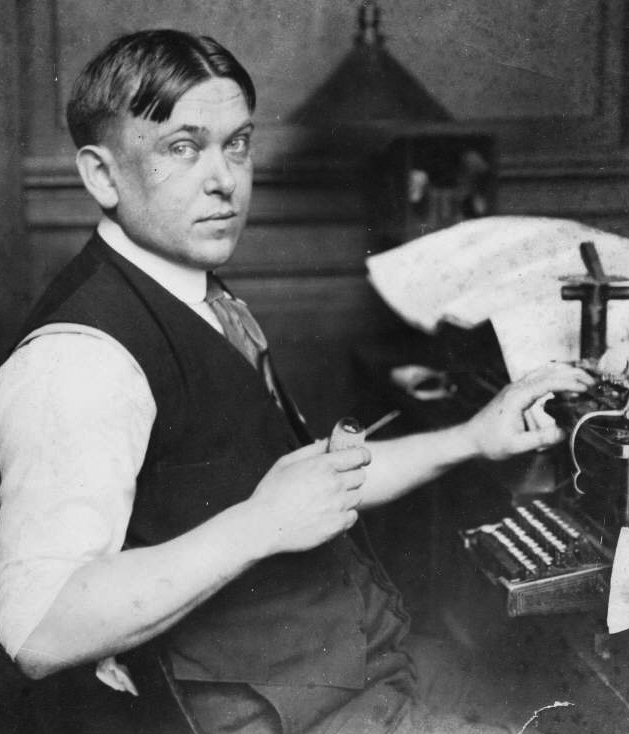
Guest Blogger: H. L. Mencken. Henry Louis Mencken (1880-1956) was a tireless essayist who expounded on society, the arts, language – his three-volume The American Language is essential to understanding why we speak and write the way we do – and much, much more, so that what he wrote about music is but a small fraction of his output. What’s reproduced below now seems sweetly overwritten, but I admire its passion. And it taught me to listen with fresh ears to a symphony I thought knew pretty well.


H. L. Mencken
BEETHOVEN WAS ONE OF those lucky men whose stature, viewed in retrospect, grows steadily. How many movements have there been to put him on the shelf? At least a dozen in the hundred years since his death. There was one in New York in 1917, launched by idiot critics and supported by war fever; his place, it appeared, was to be taken by such prophets of the new enlightenment as Stravinsky. The net result of that movement was simply that the best orchestra in America went to pot – and Beethoven survived unscathed. Surely the Nineteenth Century was not deficient in master musicians. It produced Schubert, Schumann, Chopin, Wagner and Brahms, to say nothing of a whole horde of Dvořáks, Tschaikowskys, Debussys, Verdis, and Puccinis. Yet it gave us nothing better than the first movement of the Eroica. That movement, the first challenge of the new music, remains its last word. It is the noblest piece of absolute music ever written in sonata form, and it is the noblest piece of programme music. In Beethoven, indeed, the distinction between the two became purely imaginary. Everything he wrote was, in a way, programme music, including even the first two symphonies, and everything was absolute music.

Monday, October 15, 2012

No Debate about It

From the Vault Dept.: In this corner, violinist Iona Brown. In this corner . . . How shamelessly I drew on then-current events to liven this 1988 concert review.


IN THESE MONTHS of pretend debates that serve only to amuse us with adversarial wisecracks, it’s nice to be treated to a musical context where adversarial behavior is much more exciting.The Academy of St. Martin-in-the-Fields visited Proctor’s Theatre last night with a program of works by Mozart and Stravinsky, the stunning centerpiece of which was Mozart’s Sinfonia Concertante in E-flat Major for Violin, Viola and Orchestra.

Iona Brown
Iona Brown, who leads the group, was the violinist, squared off against violist Nobuko Imai. Both dug into the piece innocently enough, doubling the opening tutti, but as soon as the orchestral exposition was over a shimmering solo unison passage in octaves announced the start of the match.

The classical concerto is a “look what I can do” showcase that lays bare the soloist’s technical and interpretive abilities. With two in the ring, there’s an extra spark of tension. And this concerto plays up that tension.

Much of the fun comes from alternating arpeggio passage work that keeps fingers and bows a blur. Using a formula done to death in the pop song realm, the passages are also alternately higher-pitched, which on a string instrument provokes a more brilliant sound.

Sunday, October 14, 2012

Zero Intolerance

From the Vault Dept.: My decade-old account of a moment of DMV confusion that speaks for itself.


IN THE END, she decided to blame me. After all, it was I who suggested to my wife that she not surrender the license plates before she had the new ones in hand. I’m going to go out on the sexist limb a bit and suggest that men spend much more time in the Department of Motor Vehicles offices than do women, experiencing that unique frustration of long lines and incorrect forms. It’s horse trading in the modern world: it toughens you.

But Susan had researched her mission, found the proper forms on the DMV’s web site, switched the insurance, signed the paperwork – she was ready to transfer ownership to us of the two cars we drove, cars formerly owned by a business run by her family.

So confident was she in the ease of this transaction that she began it by handing over the four license plates. And the trouble began.

“The record for this plate shows that there was no insurance on the vehicle from January to October 2001,” said the clerk, indicating a freshly printed page of green. It was almost as an afterthought that she also noted that both vehicle title certificates had been altered with Wite-Out by an unthinking secretary, completely invalidating the purpose of our visit.

Because of the insurance lapse, the clerk explained, Susan would have to wait an equivalent amount of months to re-register the car. In other words, it was off the road until November. Sitting, license plate-free, in the DMV parking lot.

Saturday, October 13, 2012